
Search results: 2679
Business is an occupation or trade (the purchase and sale) of products or services in an attempt to make a profit.Business Mathematics, Business Statistics and Quantitative Techniques for Business module are courses intended to provide students of BBA with the mathematics and statistical background necessary for the specializations of the programme like Accounting, Finance, Economics and Management Science itself (programs strongly related to business activity). This module digests quantitative techniques that modern Managers need in their business and economic decision making.
Welcome all to the PhD course of QUALITATIVE RESEARCH METHODS.
The module will render the participant theoretical as well as practical knowledge about academic methods in order to be able to collect, organize and analyze qualitative data. The module will make the student familiar with both traditional and emerging research methods. Further, the students shall be knowledgeable about the quality and ethics demands in qualitative research as applicable to management disciplines.
Module Teaching Team:
Prof. Rama B. Rao: Module Leader
Dr. Byungura Jean Claude: Module Partner
Dr. Shema Jean Bosco: Module Partner
The Quality Improvement in Health care course will explore continuous quality improvement frameworks and tools including, monitoring and evaluation utilized in healthcare programs in the sub-saharan region.
The purpose of this course is to explore successful continuous quality improvement frameworks and tools including monitoring and evaluation utilized in healthcare programs. It will also explore the topics of root cause analysis, change concepts, monitoring and evaluation, methods of information collection in the clinical setting, and best practices in continuous process improvement.
The purpose of this course is to explore successful continuous quality improvement frameworks and tools including monitoring and evaluation utilized in healthcare programs. It will also explore the topics of root cause analysis, change concepts, monitoring and evaluation, methods of information collection in the clinical setting, and best practices in continuous process improvement.
This module will enable the students to understand and apply various quantitative methods for efficient decision making in different organizational scenarios.
At the end of this module, students should be able:
- To apply hypothesis testing, regression and correlation analysis, multiple regression and business/economic forecasting.
- To understand different quantitative methods and their utility in optimizing decisions in certainty and uncertainty situations.
- To apply the quantitative methods practically in decision making.
- To interpret output from quantitative techniques and tools applied in the process of decision making.
- To apply the quantitative techniques in finding practical solutions to the business problems.
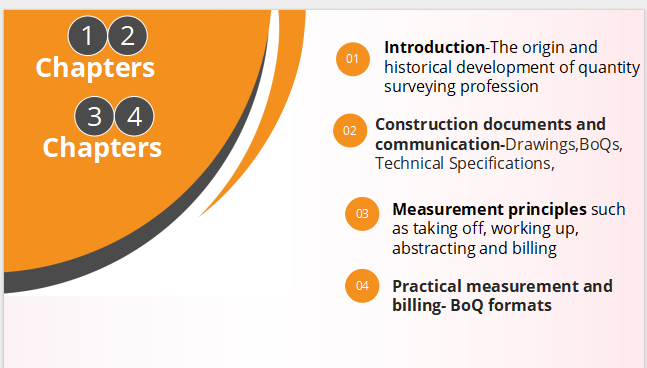
The course introduces the origin and historical development of quantity surveying profession. It highlights on the method of communication of data within the construction industry and their relationship to the design and construction processes. Measurement principles such as taking off, working up, abstracting and billing, types of bills, bill formats and their uses are discussed and illustration of practical measurement and billing.
BRIEF DESCRIPTION OF AIM AND CONTENTS
The objective of the module is to introduce learners to various applications used in Quantity surveying such as MS-Office Excel, MS- Office Project, QS-Plus, WinQS among others as well as AutoCAD and ArchiCAD especially the measurement tools in computer aided design software. Practical studio sessions are conducted.
LEARNING OUTCOMES
Knowledge and Understanding
Having successfully completed the module, students should be able to demonstrate Knowledge and Understanding of:
1.1 Application of MS-Office Excel to quantity surveying.
1.2 Use of QS-Plus in quantity surveying.
1.3 Other computer programs important in quantity surveying.
1.4 AutoCAD and ArchiCAD.
1.5 MS Project.
Cognitive/Intellectual skills/Application of Knowledge
Having successfully completed the module, students should be able to:
2.1 Prepare some quantity of bills.
2.2 Understand various applications used in quantity surveying.
Communication/ICT/Numeracy/Analytic Techniques/Practical Skills
Having successfully completed the module, students should be able to:
3.1 Prepare simple quantity of bills.
3.2 Understand and use computer programs relevant to quantity surveying.
General transferable skills
Having successfully completed the module, students should be able to:
4.1 Undertake self-learning in computer programs.
4.2 Presentation using computer programs.
INDICATIVE CONTENT
The module covers various applications used in Quantity surveying such as MS-Office Excel, MS- Office Project, QS-Plus, WinQS among others as well as AutoCAD and ArchiCAD especially the measurement tools in computer aided design software. Practical studio and workshop sessions are conducted.
LEARNING AND TEACHING STRATEGY
The course is delivered mainly through lectures backed up by studio/lab sessions. The lectures include interactive elements whereby students in groups apply principles to simple problems to ensure their involvement and so gain understanding. Hand-outs are used so that students can concentrate on the material of the lectures, but with gaps where students either have to fill in or make separate notes.
Problem sheets are given out to students and after time, the problems are discussed in class. Some of the problems will be handed in and then marked by peers to give formative feedback to fellow students.
The site visits and assignments will require the students to undertake some investigation on their own and to develop ideas and apply them. They will also produce a report for each.
ASSESSMENT STRATEGY
The assessment strategy is:
- To assess knowledge and application skills through a written examination. The students therefore will not just rely on memory but also show understandings of the principles in application to exam problems.
- To assess practical skills through studio and lab sessions.
- To asses self-learning through producing and presenting of the reports in groups.
- To assess understanding and application through the assignment whose feedback is given to students in time to allow them to know their weakness or strength.
Assessment Criteria:
- Examination shall comprise 50% of the total score. Assessment shall cover general understanding of the concepts as well as the application of the concepts among others.
- Assignments and Tests shall comprise 50% of the total score. Questions will be drawn up appropriate to the topic. General understanding, interpretation ability and application shall carry more weight as opposed to memory
The course aims to provide knowledge on labour regulations, statutory legislation relating to industrial disputes, payment of wages and trade unions, Construction Plant and Equipment, Principles of equipment and plant selection (economic comparisons of alternatives, systematic plant selection, ownership costs, leasing costs, calculation of plant hire rates), Work study and measurement. Lecturer: MUGIRANEZA Philippe Tel:0788655659 Email;phil.mugiraneza@gmail.com
The course covers application of the standard method of measurements (SMM) rules to measurement of more complex foundations, multi-storeyed framed concrete structures, basements, framed and unframed structural steelwork, flat roofs, floor slabs, staircases, balustrades, external and site works, sites service installations including storm water and foul drainage.
Major topics covered under this module include application of SMM rules to measurement of complex multi-storeyed framed buildings, basements, pile and raft foundations, concrete structures, framed and unframed structural steelwork structures, waterproofing flat roofs, composite floor slabs, staircases, and balustrades, external and site works, including storm water and foul drainage, car parks, estate roads, foot paths, gates and fencing, and landscaping. Studio exercises in measurement of work will be given.
This module is a continuation of what was learnt in the last trimester. It is advised that you revise what was studied last trimester before proceeding with this module. Therefore, I welcome you to another enjoyable learning session on Construction Management. Like I told you, picture yourself as a construction manager and not quantity surveyor in this class. All the best!!!
The module aims to provide you with knowledge on construction project management procedures from inception to completion; systems approach to construction project management, activities involved in construction project management, organization structure of construction project management, role of participants on construction projects, coordination, control and supervision of construction projects, construction project scheduling, and network analysis. Finally, it covers the practical application of computer aided tools/software for programme of works.
THE LEARNING OUTCOMES ARE AS FOLLOWS:
At the end of this module, you will be able to:
1. Determine the enabling and facilitating procedures to be adopted on specific construction projects
2. Carry out the appraisal of the budgets of construction projects vis a vis its performance on the project
3. Demonstrate the various methods of project planning (time management and resource scheduling)
4. Adopt computer aided planning tools/software to manage construction projects.
The course aims to provide the students with knowledge on Principles of generation, transmission and distribution of electrical energy; production of natural gas and principles of planning and design of gas services supply and installation in buildings, mechanical communication systems in buildings, data transmission systems, fire alarm detection systems and cold storage and refrigeration systems in buildings.
The course covers an insight into Earthworks in dams and road embankments; soil stabilization for improved bearing capacity; It further briefly discussed the following civil engineering structures: retaining walls, culverts; pile foundations, underpinning, tunneling, simple bridges, culverts, including consideration of civil engineering plant and equipment. Studio exercises are conducted to help relate the learnt works to other construction works.
In this course, a detailed study of the civil engineering standard method of measurement (CESMM) is done. This includes measurement of preliminaries, earthworks, soil retaining structures, concrete works, underpinning, tunneling, roads and bridges, dams, railway trunks, power generation, structural steel engineering works. Also included are Dayworks and consideration of civil engineering plant and equipment, and preparation of civil engineering tender documents.
The course is a core for Bsc. Quantity Surveying Year 4 and is intended to cover the following.
- The evolution and need for rules of professional conduct and practice
- Practice procedures for quantity surveyors
- Educational requirements and professional training
- Principles of good practice for quantity surveyors in both private and public sector;
- Professional organizations in building and construction industry and their status in Rwanda, including statutory regulation
- Independent role of a quantity surveyor.
- Quantity surveying organization and practice surveying - office and staffing organization, private practice, public sector work
- Contracting and procurement
- Appointment of quantity surveyors & their fees, rules of professional conduct, professional negligence and insurance
Module Description
Learning Outcomes
Having successfully completed the module, students should be able to demonstrate knowledge and understanding of:
- Topographical survey of land
- Preparation of contour maps and profiles of road, drain/channels
- Principles and applications of Geographical Information system and remote sensing.
- To define and illustrate the basic concepts of participatory approaches from both theoretical and practical perspectives.
- Articulate how participatory methods can elicit peoples’ knowledge and expertise.
- Describe how participatory methods build local capacity for effective problem solving and action.
Reading Materials
- Principles of Agricultural Engineering Part-I and II by Michael, A.M and Ojha T.P
- Survey and leveling by Khurmi, R.S
- GIS: Fundamentals, Applications and Implementations by Elangovan, K. 2006
- Remote Sensing Applications in Dryland Natural Resource Management by Gaur, Mahesh, 2013
The module has two components called " Intermediate macroeconomics and Intermediate macroeconomics" The main objective of the module is to be familiar with analysing how individual behaves on markets of goods and services when they are constrained by their limited resources. This module provides students with a thorough analysis of the intermediate macroeconomic theory concerning aggregate expenditure functions, expectations, inflation, economic growth and open-economy macroeconomics. The module also highlights how individual or a firm make decision on perfect competition or their strategies taken when operating on imperfect markets.
Introduction
The module of Managerial and Decision Tools has two components. Mathematics for Economist is taught in Year 2 RD, Year 2 AGEC and Year 2 Agribusiness in Trimester I. Mathematics for Economists component introduces students to the general aspect of algebraic notations, mathematical calculus and mathematical analysis. It will strengthen students' capability to understand and solve probability business and Economics problem using basic mathematics concepts. The main objective of this module is to become familiar with basic knowledge of fundamentals of mathematics applied in economics; Develop tools and techniques used in decision theory in economics, Develop software programming language and apply software in problems solving.
Learning Outcomes
Having successfully completed the module, students should be able to:
- Understand mathematical and statistical models explaining social behavior
- Improved critical thinking capacity
- Improving the mathematical tools in economics and more particularly in development economics
- Manipulate Data using various software
Module contents
Indicative Resources:
The following textbooks are recommended for reading:
- Carl P.Simon.1994. Mathematics for Economists. London
- Alpha C. Chiang.1984. Fundamental Methods of Mathematical Economics. Third edition. McGraw-Hill, Inc.
- Mike Rosser. 2003. Basic Mathematics for Economists. 3rd Edition, London.
- Ian J. (2003). Mathematics for economics and business. Fourth Edition Ohio. USA.Mukras 2004.
- Gilat A. 2011. MATLAB. An Introduction with Applications. Fourth edition. Ohio.USA
- Ian J. (2003). Mathematics for Economics and Business. Fourth Edition. Pearson Education, Malaysia
- Mukras. 2004. Elements of Mathematical Economics. Kenya Literature Bureau. Nairobi. Kenya
- Mukras. 2011. Advanced Mathematical Methods for Economics. Kenya Literature Bureau. Nairobi. Kenya
- A course in statistics with R. John Wiley & Sons, Ltd. ISBN: 9781119152729
Background Colour
Font Face
Font Kerning
Font Size
Image Visibility
Letter Spacing
Line Height
Link Highlight
Text Alignment
Text Colour