
Search results: 2679
The aim of this course is to introduce students with key knowledge in the field of Engineering Drawing and CAD as applied to Engineering design practice in first angle and third angle projections. It covers Orthographic and Isometric projection of regular objects. It also introduces Solid works and CAD modelling to the engineering design.
The course is intended to teach students about various aspects of the design process, firstly through a series of topics covering different principles of design, and secondly through an extended design project where these principles can be put into practice. An important aim is to integrate their theoretical knowledge into the design of a final product.
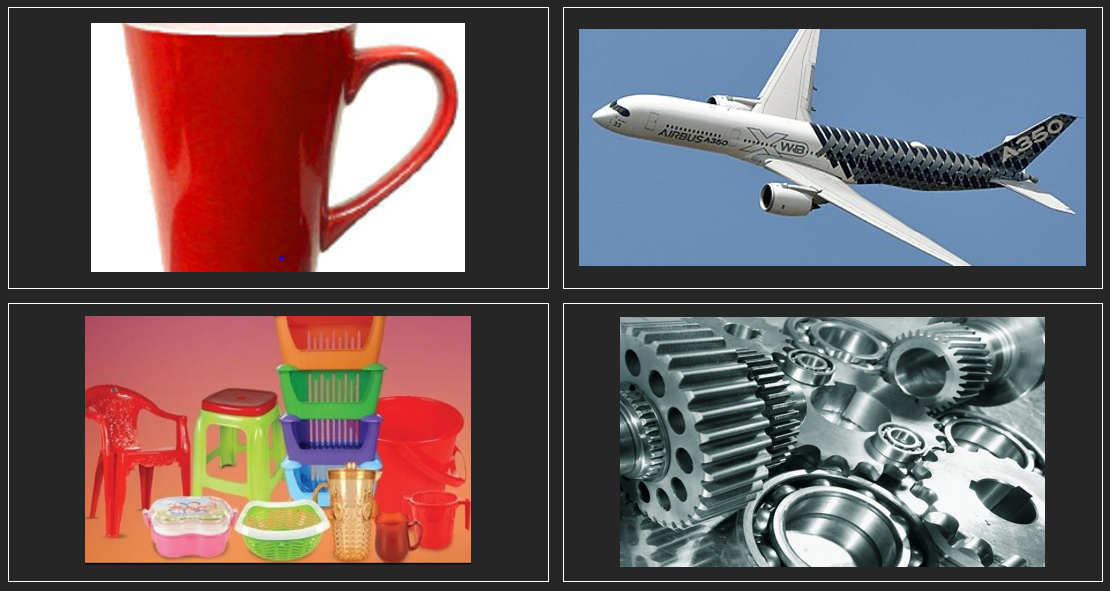
The course of Engineering Materials and Metallurgy gives insight and clear understanding on the most common types of engineering materials, their properties, their processing and their applications in engineering.
- Introduction to Engineering Materials
- Metallic Materials
- Ceramics, Glasses & Refractory Materials
- Polymers & Rubbers
- Composites
- Environmental Degradation
This course aims to provide the basics of steam power plant, gas power plant, refrigeration and air conditioning. It covers steam properties, vapour power cycles, application of steam to turbines and gas turbines. It also covers the refrigeration cycles, psychometric properties and air conditioning process.
Measurement procedures are an indispensable component of engineering practice, from the inception of new ideas (experiment), through the manufacturing process (prototype testing) to the final product delivery (quality control). The course aims to develop a fundamental knowledge on measurement principles and systems as well as on Instrumentation Engineering to enable the student to use rationally laboratory equipment with analytical approaches.
The course aims the application of dynamic principles in the working principle of machines .It covers the inertia forces in the slider crank mechanism, the balance of rotating and reciprocating parts. The course also deals with the analysis of gyroscopic couple and the working principle and dynamic analysis of the governor.
Indicative Content
- Inertia Forces in Reciprocating Parts.
- Balancing of rotating masses.
- Primary and secondary unbalanced forces of reciprocating masses, partial balancing.
- Governor: Introduction, Characteristics of governors, controlling force, stability, sensitivity, isochronism.
- Gyroscopic motion.
-Turning Moment Diagrams and Flywheel.
The course aims to provide fundamental concepts of turbo-machines as applied to Engineering practice. It covers application to hydraulic machines, specific speed and machine selection, machine-system operation, application to axial flow compressors and turbines, radial turbines and compressors.
Alternative energy is a form of energy that can provide energy without the planet warming effects of fossil fuels like sunlight, geothermal heat, wind, hydro-power, Nuclear etc.. From sunlight, we get energy in the form of solar energy, from the wind we get wind power energy, from the force of the river flow we get hydro energy. There is also geothermal energy available in nature. Those energies are called as the source of those energies will not get finished anyway.
In Alternative Energy, students need theoretical and practical knowledge to understand the entire concept of alternative energy with ease.
This course aims to provide a comprehensive understanding of internal combustion engines (ICE), covering their history, types, and key components. It explores fundamental thermodynamic principles and analyzes ideal and real engine cycles to explain engine performance. The design and construction of engines, including materials and configurations, are discussed to highlight practical considerations. Combustion processes, fuel systems, and injection techniques are examined to understand how fuel is ignited and controlled. Performance parameters such as power and efficiency are studied alongside emission formation and control technologies. Cooling and lubrication systems essential for engine longevity are included. Finally, modern advancements like hybrid systems and advanced combustion methods are introduced to show trends in efficiency and environmental impact reduction. The course blends theory with practical aspects to equip learners with a solid foundation in ICE technology.
At the end of this course, students will be able to:
- Understand the heat treatment processes
- Understand the effects of various heat treatment processes on the component's properties.
- Understand the relationship between structure of steel and its mechanical properties
Course objective
- Primary objective is to present the basic fundamentals of materials science and engineering.
- Expose the students to different classes of materials, their properties, structures and imperfections present in them.
- Help understand the subject with ease by presenting the content in a simplified and logical sequence at a level appropriate for students.
- Aid the teaching learning process through relevant illustrations, animations and web content and practical examples.
- Highlight important concepts for each topic covered in the subject
- Provide opportunity of self-evaluation on the understanding of the subject matter.
Indicative content
- Heat treatment: General principles, properties and microstructure, normalizing, annealing, hardening, tempering.
- Microstructure and mechanical properties: constitution of steel, effect of alloying elements and heat treatment, transformation temperatures.
- Austenite and its transformation and classification of steels: relationship between structure of steel and its mechanical properties, two basic methods of controlling structure.
- Annealing and normalizing of steel: the annealing of steel, the procedures for controlling structure, problems of scaling, decarburization, normalizing. Hardening steels and tempering processes. Surface and case hardening processes.
- Heat treatment of tool steels; water hardening, shock resisting, non-deforming, hot work and high speed steels.
- Heat treatment of stainless steels; martensitic, ferritic, austenitic.
- Heat treatment of cast irons; factors affecting graphitization.
- Heat treatment of nonferrous metals and alloys: annealing and recrystallization, cold work, phase diagrams, mechanical properties
Indicative Resources
- George E. T. (2006) Steel Heat Treatment: Metallurgy and Technologies, CRC, 1st Ed.
- Zakharov B. (2007) Heat Treatment of Metals, University Press of the Pacific, 1st Ed.
Course Evaluation
With this module, the grading system will be based on:

Heads-up:
Students will meet the objectives listed above through a combination of the following instructions in this course:
- Attend all lectures
- Check Moodle course page frequently
- Submit projects on time
- Actively participate in design project team
- Respect the provided format for project report
Facilitator:
- Names: Dr Bernard MUSHIRABWOBA
- Designation: Lecturer
- Tel:+250737242339
- Email: b.mushirabwoba@ur.ac.rw
This course deals with the geometry of Riemannian and Symplectic manifolds by means of multilinear algebra and Tensor calculus methods.It contains four units.Unit one is focused on tensor algebra, unit two gives an overview of the differential geometry of curves and surfaces in the three-dimensional Euclidean space. Unit three develops basic results about tensor calculus on smooth manifolds and finally the unit four deals with Riemannian and symplectic manifolds and their applications in Relativity theory and Hamiltonian system.
Dear Master's students following the Mathematics Education Programme at UR-CE.This module entitled MEM 6244: STMA was developed for you to explore advanced ideas and concepts of mathematical analysis you missed during undergraduate studies.
At the end the module of mental health nursing, 4 four students in General nursing in General nursing will be equipped with knowledge and skills in management of mental disorders. The management of mental disorders should be based on cultural context, holistic approach and legal ethics standards. Also, the concept of community mental health will be focused on and will include psycho-social rehabilitation of psychiatric clients with severe and chronic diseases.
This module deals with basic principles of electrodynamics and their applications. This module begins with an overview of electromagnetism and physical optics with emphasis on applications, problem solving and experimentation. It introduces boundary value problems, conservation laws in electrodynamics, propagation of electromagnetic waves in different media and radiation by moving charges with emphasis on applications, problem solving, teaching/learning skills and use of ICT in teaching/learning.
The aim of this module is to introduce fundamental theorems of vector analysis, Fourier series and Fourier transforms, second order differential equations, mathematical physics equations and their applications in physics. The module also gives a practical introduction for physicists with little or no computing experience to the use of computer programming as a tool for physics. It will also give an introduction to the techniques of computational physics with various applications.
Background Colour
Font Face
Font Kerning
Font Size
Image Visibility
Letter Spacing
Line Height
Link Highlight
Text Alignment
Text Colour