
Section outline
-
Introduction
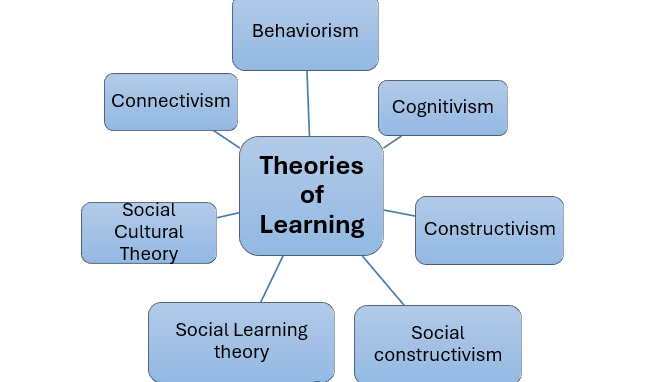
Learning occurs in diverse ways and is shaped by many factors, leading to the development of psychological theories that explain how individuals acquire, process, and retain knowledge. This unit focuses on key theories including behaviorism, cognitivism, constructivism, social constructivism, social learning, sociocultural theory, and connectivism, each offering a unique perspective on learning. Understanding these theories helps to make informed decisions about instructional strategies, classroom management, and the creation of inclusive learning environments that address diverse learner needs.
Unit learning outcomes
By the end of this unit, you will be able to:
-
- Describe major learning theories to build a foundational understanding of how learners acquire knowledge and how teaching approaches are shaped.
- Compare learning theories in terms of their assumptions to evaluate their strengths, limitations, and relevance in different educational settings.
- Discuss classroom applications of learning theories to guide the selection of effective instructional strategies that address diverse learner needs.
-
-
Opened: Saturday, 9 May 2026, 12:00 AMDue: Saturday, 30 May 2026, 12:00 AM
-
Opened: Tuesday, 12 May 2026, 4:00 PMClosed: Friday, 15 May 2026, 11:59 PMStudents mustMark as done