Resources for unit 5
2. Taxonomies and Domains of Educational Objectives
2.1. Understanding taxonomy and domains of educational objectives
The word taxonomy is derived from two Greek words “taxis” which means arrangement or classification; and “nomos” which means law, science. Thus, literally, the taxonomy is the science of classification. It is the science of classification into ordered categories, the science of hierarchical classifications. To do the taxonomy is to make a list of elements that form categories concerning a particular domain, a particular science or discipline.
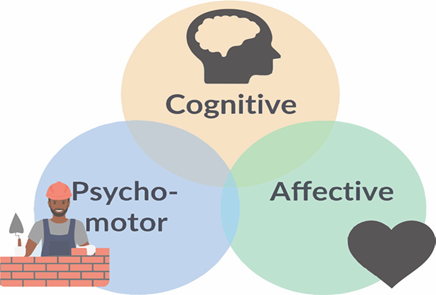
In educational sciences, taxonomy is defined as the science of classifying behaviours into categories or levels. Specifically, in the teaching domain, it is about the expected behaviours of the student after he/she has learnt a given content of knowledge. In teaching and learning, the teacher constantly assesses the expected students’ behaviours (objectives). Generally, these behaviours are classified into three categories or domains of manifestation of human behaviour which are cognitive, affective and psychomotor domains.
In pedagogy, taxonomy of educational objectives refers to the hierarchical classification of educational objectives. Taxonomy of educational objectives defines and distinguishes different levels of objectives. The taxonomy divides learning objectives into three broad domains: cognitive (knowledge-based), affective (emotion-based), and psychomotor (action-based), each with a hierarchy of skills and abilities. In other words, educational objectives are linked to any of the three domains of human behaviour, namely:
• The cognitive domain in relation to intelligence or the “brain”
• The affective domain, in relation to emotions, feelings or “heart”
• The psychomotor domain, in relation to movements or the “body”
These domains are used by educators to structure curricula, assessments, and teaching methods to foster different types of learning. Teaching aims at developing these three types of educational objectives: Cognitive objectives, psychomotor objectives, and affective objectives.
- Cognitive objectives relate to knowledge or thought. They aim essentially at the assimilation of course content. Examples: to explain the importance of educational objectives.
- Psychomotor objectives deal with movement and /or activities where gestures are used to express or interpret information or concepts. In general, these objectives are developed in Physical Education as well as other technical and vocational training courses. Examples: Draw, sing, high jump, disassemble an engine, etc.
- Affective objectives deal with values or attitudes. They occur at all levels of the teaching/learning process, but they are often neglected because they belong to the domain of attitudes. Examples: To fulfill someone’s commitments; to like mathematics, to stick to deadlines of appointments.
These objectives are also placed at various levels of complexity (from simple to complex) in their respective domains, according to their hierarchical classifications (their levels).