Resources for unit 4
| Site: | UR - Elearning Platform |
| Course: | CE80241: Theories and practices of Teaching and Learning |
| Book: | Resources for unit 4 |
| Printed by: | Guest user |
| Date: | Wednesday, 21 October 2026, 3:59 AM |
Description
Dear student,
Engage with the learning materials of unit 4 and do all related activities.
1. Principles of Teaching and Learning
Activity: Think of a lesson you plan to teach in the future. Based on your intentions as a teacher, write down four specific actions you would do to ensure that the lesson is effective and engaging for your learners.
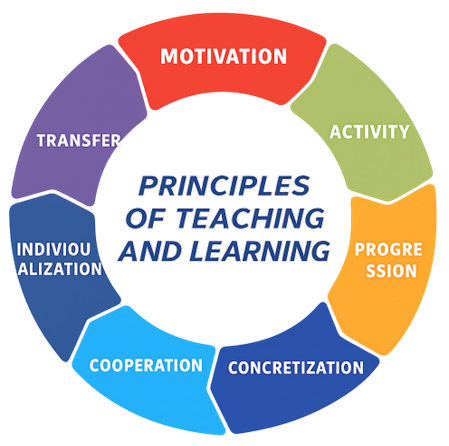
Teaching and learning principles are foundational guidelines that influence how teachers approach their practice and how students engage with the learning process. They are interrelated and aim to create and promote effective teaching, enhance student engaging learning, create a positive educational experience and supportive educational environment. There are seven key principles of teaching and learning as summarized in the figure below and explained.
1.1. Motivation
Motivation refers to the internal or external factors or forces that drive individuals to act, pursue goals, or engage in specific behaviors. It is what energizes, directs, and sustains actions, whether they are aimed at personal success, overcoming challenges, or fulfilling basic needs. Motivation can be classified into two broad types: Intrinsic and extrinsic motivation.
A. Types of motivation
i. Intrinsic motivation: originates from within the individual and is driven by personal interest, satisfaction, or enjoyment derived from performing a task. Examples: A teacher who teaches because they simply enjoy the act of teaching. A student who reads a book simply because they enjoy the subject and learning, rather than earning a grade.
ii. Extrinsic motivation: arises from external factors or incentives such as rewards, recognition, or the desire to avoid punishment. An individual is extrinsically motivated when they perform a task not out of personal interest, but in response to external demands or pressures. Examples: A student who studies hard to earn high grades in order to receive a scholarship or praise from parents and teachers. A student who puts effort into studying primarily to avoid failing a class or being reprimanded by their parents.
Motivation plays a critical role in how students engage with learning and influences learning outcomes. Without motivation, effective teaching and learning cannot take place. You cannot learn effectively if you are not motivated to learn. A teacher cannot teach effectively if he/she is not motivated to teach.
B. How can a teacher identify that his or her students are motivated during a lesson?
Motivated learners demonstrate behaviors that reflect active engagement, focus, and a positive attitude toward learning. They participate in class discussions, stay attentive, show curiosity, and persist through challenges. Such students put in consistent effort, seek feedback, set goals, and take pride in their progress. Their enthusiasm extends to both individual tasks and group activities, often encouraging and collaborating with peers. These behaviors not only support their own learning but also create a positive and effective classroom environment.
C. How can a teacher identify that their students are not motivated during a lesson?
When students lack motivation, they often show signs of disengagement such as minimal participation, distracted behavior, and negative body language like avoiding eye contact or appearing bored. They may put in poor effort on assignments, resist feedback, and exhibit irregular attendance. Negative attitudes, lack of curiosity, inconsistent academic performance, and verbal expressions of disinterest or defeatism further indicate low motivation. These behaviors signal a reduced interest in learning and a need for strategies to re-engage students.
D. How can a teacher motivate learners in the classroom?
Teachers can inspire motivation by setting clear and achievable goals, making learning relevant to students’ lives, and using varied teaching methods. Providing positive feedback, fostering a growth mindset, and building a supportive classroom environment also play a key role. Offering students autonomy, incorporating gamification, and maintaining an engaging learning atmosphere boost interest and participation. Motivation is further strengthened by appropriate challenges, recognition of progress, access to resources, enthusiastic teaching, and opportunities for peer learning. Patience and adaptability are crucial in addressing diverse student needs and sustaining motivation.
1.2. Activity
Learning is more effective when students actively participate in the process, engaging with the content through activities that require critical thinking and application. Teaching should actively engage students in the learning process, encouraging participation and collaboration rather than passive listening.
Strategies to make students active in class: engaging them physically, mentally, emotionally, and socially in the learning process. This requires moving beyond traditional lecture-based teaching to create an environment where learners participate, think critically, collaborate, and apply knowledge. To foster active and meaningful learning, teachers should use engaging strategies like group work, games, simulations, and peer teaching. Asking open-ended questions promotes deeper thinking, while hands-on activities and fieldwork make learning tangible. Creating a safe and supportive classroom where students have choices and responsibilities encourages participation and confidence. Incorporating technology and multimedia enhances engagement and caters to diverse learning styles. Finally, linking lessons to real-life context increases relevance and helps students connect learning to their personal experiences and future goals.
1.3. Concretization
Concretization refers to the process of making abstract concepts more understandable and relatable by linking them to real-life experiences, physical objects, or visual aids. It involves moving from theoretical or abstract ideas to practical, observable examples that students can engage with meaningfully.
Strategies to concretize a lesson: To make abstract concepts more understandable, teachers can use various concretization strategies such as visual aids (e.g., diagrams, charts, videos), hands-on activities with real objects, and real-life examples that relate to students’ daily experiences. Use of demonstrations and simulations that bring concepts to life, while analogies and metaphors help simplify complex ideas by connecting them to familiar situations. These strategies enhance comprehension by making learning more tangible and relatable.
1.4. Progression
The principle of progression in teaching and learning refers to the idea that instruction should be organized in a logical, step-by-step sequence, moving from simple to more complex concepts based on the learner’s developmental level, prior knowledge, and learning needs. This principle emphasizes that students learn best when new information builds gradually on what they already know and can do.
Applications of progression in classroom settings: applying the principle of progression in the classroom involves structuring instruction to match students’ developmental levels and gradually increasing content complexity. Teachers begin by assessing prior knowledge and logically sequencing lessons from simple to complex. They scaffold learning, revisit topics through a spiral approach, and differentiate instruction to meet diverse needs. Regular reviews and the use of appropriate language support understanding, while goal setting and reflection encourage learner ownership. Continuous monitoring and adjustment ensure instruction remains effective and responsive to student progress
1.5. Individualization /Personalized Learning
Learning becomes more effective when it is individualized tailored to each student’s unique needs, abilities, interests, and learning styles. Individualized learning allows students to progress at their own pace, engage with content in ways that suit them, and demonstrate understanding through diverse methods. It emphasizes personal effort and independent work, acknowledging that learning is a personal journey.
Strategies for individualizing learning: Individualizing learning involves adapting instruction to meet each student’s pace, needs, and learning style. This includes offering flexible learning speeds, multiple resources and activities, and varied ways for students to show understanding. Teachers use diverse assessment methods, provide extra support when needed, and scaffold complex tasks to build independence. Lessons are structured to progress from simple to advanced concepts, with language and content tailored to the learner’s level. Differentiating task difficulty ensures all students are appropriately challenged and supported.
1.6. Cooperation
Cooperation refers to the process of students working together in pairs or groups to achieve a common goal or complete a shared task. It emphasizes collaboration, communication, and teamwork, fostering an environment where students contribute to each other’s learning and support one another’s academic growth.
Strategies to foster cooperation in class: Fostering cooperation among students requires intentional strategies that create a supportive and collaborative learning environment. Teachers should begin by establishing a classroom culture rooted in mutual respect, clearly defining expectations for respectful communication and modeling cooperative behaviors such as sharing and problem-solving. Inclusive language like “we” and “our” can reinforce a sense of community. Cooperative learning strategies, such as Think–Pair–Share, jigsaw, group investigations, and team-based learning, encourage students to work together toward shared goals. Additionally, teaching social skills like active listening, conflict resolution, and turn-taking equips learners with the tools necessary for effective collaboration. Tasks should be interdependent, with students taking on roles in project-based learning or engaging in peer teaching and collaborative problem-solving. Teachers must also monitor group dynamics, provide formative feedback, and encourage reflection through journals or discussions. Celebrating cooperative efforts through recognition, group rewards, or leadership roles motivates students and reinforces positive behavior. Finally, connecting classroom cooperation to broader values such as peace education and citizenship, helps students understand the importance of working together not only in school but also in society at large.
1.7. Transfer of learning
Transfer refers to the process by which students apply knowledge, skills, or concepts learned in one context to new or different situations. It involves the ability to take what has been learned and use it in other settings, tasks, or problems, either within the same subject area or across different subjects (Hajian, 2019). Transfer can occur in both positive and negative forms— positive transfer is when prior learning aids new learning, while negative transfer is when previous learning interferes with new learning (Chunk, 2021; Mestre, 2020; Perkins & Salomon, 2019).
Examples of positive transfer: A student who has learned to play the piano may find it easier to learn the guitar because both instruments involve understanding music theory, rhythm, and coordination between hands and fingers. A student who learns how to organize their time effectively for school assignments might apply the same organizational skills to manage their work tasks in a job after graduation.
Examples of negative transfer: If someone learns to drive a car with a manual transmission, they may struggle to drive a car with an automatic transmission at first because the new skills conflict with their prior knowledge. A person who is used to using a smartphone may face difficulty navigating a touchscreen laptop because they might expect the same gestures (like swiping or tapping) to work in the same way, but the laptop’s interface may require different gestures.
A. Types of transfer of learning
There are three main types of transfer:
i. Near transfer: When skills or knowledge are applied to a very similar context. For example, after learning how to use past tense verbs in an English grammar lesson, a student correctly applies them when writing a personal narrative in class. A student learns how to solve simple addition problems (e.g., 15 + 7) and then applies the same process to slightly more complex addition problems (e.g., 234 + 56). The concept of addition remains the same; only the numbers are different. The student transfers the strategy used for smaller numbers to larger ones.
ii. Far transfer: When skills or knowledge are applied to a very different or novel context. For example, applying problem-solving techniques learned in science to resolve issues in daily life or in other subjects like history. A student who has been involved in debating applies the skills of argument construction, critical thinking, and public speaking in their role as a lawyer, arguing cases in court. Both debating and law involve the ability to analyze arguments, present evidence, and speak persuasively.
iii. Zero transfer refers to a situation where previously learned knowledge, skills, or experiences have no impact on or do not help with learning or performing a new task or concept. In other words, previous knowledge or skills are irrelevant to the new task. Examples: Knowing how to drive a car does not help you learn how to play the piano, as the skills and knowledge involved are unrelated. Studying French vocabulary will not assist you in solving equations in algebra; the two domains do not overlap in terms of content or cognitive processes. Being a skilled swimmer does not help you type faster or more accurately; the motor skills are entirely different. Knowing how to prepare complex meals in the kitchen won’t help you fix electronic components in a phone.
Note: The negative transfer and zero transfer are not needed because they do not contribute to new learning.
B. Strategies to promote transfer in learning
To promote transfer in the classroom, teachers should help students connect their learning to multiple contexts by teaching for transfer and using real- world problems. Encouraging reflection allows learners to think about how their knowledge applies in future situations. Teachers should also promote generalization of concepts across different contexts, highlight connections between subjects, and provide varied practice opportunities to reinforce transferable skills.
In short, these seven principles relate to one another, they are interdependent. Here, they are presented separately just for practical and methodological reasons. Practically, one does not exist without the other; the fact of resorting to a principle automatically makes you think that the other one exists.
Activity: Select a lesson topic from the subject you intend to teach and answer the following questions:
1. How will you motivate your learners?
2. What activity will the learners do?
3. What real-life objects or examples will you use?
4. How will the content build from simple to complex?
5. How will you address individual learning needs?
6. What will learners do together?
7. How will they apply what they learn to real life?
2. Teaching Approaches, Methods, Styles, Strategies, and Techniques
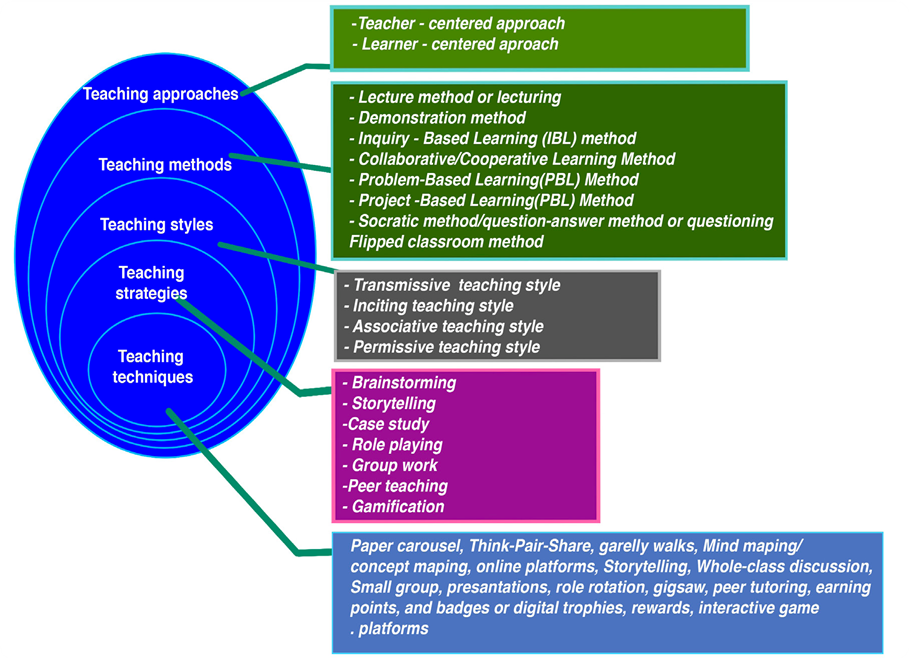
This section explores the diverse ways in which teaching can be effectively delivered and adapted to meet learners’ needs. It provides an overview of key pedagogical concepts, ranging from broad approaches to specific techniques, that teachers use to facilitate learning. By examining various methods, styles, strategies, and techniques, this section aims to highlight how thoughtful instructional choices can enhance student engagement, understanding, and academic success.
2.1. Teaching Approaches
A teaching approach refers to the broadest and most philosophical orientation toward teaching and learning. They are grounded in educational theories and reflect beliefs about how learning occurs and what role the teacher and learner play. Examples include.
a. Teacher-centered approach: Emphasizes the teacher’s role as the primary source of knowledge (e.g., direct instruction, lecture method).
b. Learner-centered approach: Emphasizes the student’s active role in constructing knowledge (e.g., inquiry-based learning, constructivism).
2.2. Methods of Teaching
Methods are organized and systematic ways of teaching aligned with the chosen approach. They provide a general plan for conducting instruction. It comprises the ways in which the teacher delivers the content. A teaching method is a broad framework used by teachers to deliver content to students. It guides how the lesson is conducted. Teaching methods focus on how content is presented to students, and they often define the role of the teacher in the classroom. Teaching methods provide a big picture for teaching. Methods of teaching and learning are varied and cater to different educational goals, learning styles, and contexts. An approach is more theoretical, while a method is more practical and detailed in application.
A. General methods of teaching
Commonly used methods in teaching and learning process are the following:
i. Lecture method or lecturing
Lecture method (also called lecturing) is a traditional, teacher-centered method of instruction where the teacher presents information verbally to students, usually in a structured and continuous manner. This method is often used to deliver large amounts of content to a whole class within a limited time frame. Lecturer method is often used for large groups. In the lecture method, the teacher plays the dominant role, while students listen, take notes, and absorb the information presented. The learners ask very few questions compared to the great number of questions the teachers ask. This method is more passive for learners. It is particularly effective for introducing new topics, explaining complex theories, or providing background knowledge. While it may not actively engage students in critical thinking or hands-on learning, the lecture method can be enhanced by integrating visual aids, examples, questioning, and brief discussions to maintain attention and promote understanding. Example: A history teacher might give a lecture on the causes of World War I. He/she presents the material while students listen and take notes.
ii. Demonstration method
The demonstration method is a teacher-centered teaching method that involves showing students how to do a particular task or process while explaining each step. It combines telling and showing, making it particularly effective for teaching practical skills, procedures, experiments, or the use of tools and equipment. In this method, the teacher models the desired behavior or skill while students observe closely. After the demonstration, students are usually given the opportunity to practice the skill themselves, often under the guidance of the teacher.
This method is highly effective in subjects like science, vocational studies, mathematics, physical education, and arts, where visual understanding enhances learning. It caters especially to visual and kinesthetic learners and helps clarify abstract or complex concepts by turning them into observable actions. Students are actively involved in the learning process as they watch, observe, and sometimes even participate in the demonstration, leading to better retention. Example: A science teacher demonstrates how to measure temperature using a thermometer.
iii. Inquiry-Based Learning (IBL) method
Inquiry-Based Learning (IBL) is a student-centered teaching method that emphasizes active learning through questioning, exploration, investigation, and critical thinking. Rather than simply receiving information from the teacher, students are encouraged to ask questions, conduct research, experiment, and draw their own conclusions. In IBL, the teacher acts as a facilitator or guide, helping learners navigate the inquiry process, rather than directly delivering content. This method often follows stages such as:
1. Asking questions
2. Gathering and analyzing information
3. Interpreting data or findings
4. Drawing conclusions
5. Reflecting and communicating results
Inquiry-Based Learning is particularly effective in subjects like science, social studies, environmental studies, and language arts, where exploration and problem-solving are central. It promotes curiosity, independent learning, develops critical thinking by encouraging students to engage deeply with the content, collaboration, and the ability to apply knowledge in real-life contexts, making learning more meaningful and enduring. However, it may be time-consuming and may not suit all learning styles. Example: In a biology class, students investigate the factors affecting plant growth.
iv. Collaborative/Cooperative Learning Method
The collaborative or cooperative learning method is a student-centered teaching method in which learners work together in small groups to achieve shared academic goals. In this method, students are actively engaged in the learning process by interacting with their peers, discussing concepts, solving problems, or completing tasks collectively.
Cooperative learning is structured, with clearly defined roles, group norms, and shared responsibilities. Each member of the group is accountable for both their individual learning and for helping their peers learn, promoting mutual support and interdependence.
This method enhances communication skills, critical thinking, teamwork, and problem-solving abilities. It also fosters a sense of community, reduces classroom competition, and encourages respect for diverse perspectives.
The teacher’s role in cooperative learning is to organize groups, facilitate interaction, provide guidance, and assess both group and individual performance. When well implemented, collaborative learning leads to deeper understanding, improved retention, and the development of social and emotional skills alongside academic achievement. Example: In a geography class, a group of students is asked to create a presentation on different climate zones around the world. Group members must teach their topic to the class together, ensuring that each member understands and contributes. The teacher provides oversight and support, but the students lead the activity and learn through teamwork and shared learning. The teacher assesses both the group product and individual input.
V. Problem-Based Learning (PBL) method
Problem-Based Learning (PBL) is a student-centered teaching method in which students are presented with a real-world problem (often presented as a scenario or case study) that they must solve by applying their knowledge and skills. Students take responsibility for their learning, deciding how to approach the problem, what information they need, and how to solve it. Students work collaboratively to explore and solve the problem, and in doing so, they acquire new knowledge, skills, and understanding.
In PBL, the teacher acts as a facilitator, guiding students through the process. Example: students are given an algebra problem to solve. The teacher shows students how to break down the problem into smaller parts and apply formulas to solve it. The teacher may work through the first part of the problem as a class, then assign similar problems for students to work on individually or in pairs. The teacher circulates and offers help as needed. The enhances students’ ability to think critically, solve complex problems, collaborate effectively, and apply their learning to real-life situations, making education more relevant and impactful.
vi. Project-Based Learning (PBL) method
Project-Based Learning (PBL) is a student-centered teaching method in which learners gain knowledge and skills by actively exploring real-world problems and challenges. Teachers assign projects that require students to apply their knowledge to real-world problems, typically over an extended period. Students engage in a long-term project that requires them to research, design, and present a solution to a real-world problem. Students take ownership of their learning, conduct research, plan, and present their findings.
PBL helps students develop critical thinking, creativity, collaboration, communication, and self-management skills. It connects classroom learning to real-life contexts, increases motivation, and prepares learners for lifelong learning and problem-solving beyond school. It promotes deeper significant planning and time management and may be difficult to implement in all subjects. Example: A science teacher asks students to design a model of school garden that is environmentally sustainable and beneficial to the community. Over several weeks, students research, plan, build, and present their projects, demonstrating how the model functions.
vii. Socratic method/ question-answer method or questioning
The Socratic method, also known as the question–answer method or simply questioning, is a teaching method that uses guided questioning to stimulate critical thinking, promote discussion, and lead learners to discover answers on their own. This method involves the teacher posing thought-provoking questions rather than giving direct answers. The teacher asks a series of probing questions to stimulate critical thinking and draw out ideas from students. The teacher asks questions he/she prepared before and asks other questions after receiving one or more answers so that the learners can understand better. It aims to help the learner find out the answer by himself/herself and thus allows him/her to go further in his/her search for knowledge. Very often, the teacher will not answer the question of the learner. He/she will ask the learner the same question he has been asked so that he/she can find the answer by himself/herself.
In this approach, learners are encouraged to analyze, evaluate, and reflect on their ideas. The teacher challenges assumptions, probes reasoning, and prompts students to justify their opinions or rethink their responses. This method fosters active engagement, deep understanding, and independent thinking. There are different types of questions used, such as:
• Factual questions (What is...?),
• Interpretive questions (Why do you think...?),
• Analytical questions (What are the implications of...?),
• Evaluative questions (Do you agree? Why or why not?).
This method is particularly effective in humanities, philosophy, literature, and social sciences, where critical inquiry and debate are essential. However, it can be adapted for all subjects to develop learners’ reasoning and communication skills. The Socratic method turns the classroom into a place of dialogue rather than passive reception, making learning more meaningful and learner driven.
viii. Flipped classroom method
The flipped classroom is a modern learner-centered teaching method where students first study new content at home, typically through videos or readings, and then engage in interactive, hands-on activities during class time. This reversal of the traditional lecture model allows learners to learn at their own pace before class and use classroom time for deeper exploration, collaboration, and teacher-guided applications. It promotes active learning, self-discipline, and flexibility. For example, students may watch a video on the Rwandan government at home and later participate in a simulated senate debate during class.
Note: There is no good method of teaching that suits all situations. Each teaching method has its advantages and disadvantages. Its effectiveness depends upon various factors. Each method can be adapted to different subjects, levels, and learning objectives. Effective teachers often combine several methods to create a well-rounded, engaging, and effective learning experience for their students.
2.3. Criteria to choose suitable teaching methods
Choosing the right teaching method is crucial for achieving instructional objectives, catering to students’ needs, and creating an effective learning environment. Teachers should consider the following criteria when selecting the most suitable teaching method: The learning objectives, nature of content, learners’ characteristics, the classroom environment, assessment methods, teacher comfort and expertise, cultural considerations, etc.
B.1 The learning objectives: What are students expected to learn?
Teachers have to consider the purpose of the lesson: Different teaching methods are designed to achieve different types of learning outcomes. For example:
i. Conceptual understanding: Methods like lectures, or problem-based learning (PBL) may be effective.
ii. Skill development: Hands-on methods such as demonstrations, or project-based learning are more appropriate.
iii. Critical thinking and analysis: Discussion, or inquiry-based learning might be ideal.
B.2 The nature of content: Is it conceptual, practical, or theoretical?
Content type or subject matter plays a large role in choosing the right method.
i. Theoretical content: For abstract, theoretical, or complex subjects, lecture or direct instruction may work well.
ii. Practical skills: For teaching technical or practical skills (e.g., cooking, carpentry, or laboratory experiments), demonstration, discussion are more effective.
iii. Creative subjects: In areas like art, drama, or music, cooperative learning, cooperative learning, discussion may be more engaging.
iv. Abstract vs. concrete: Abstract concepts may require methods like inquiry-based learning, while concrete concepts can be introduced through lecturing/direct instruction or demonstration.
B.3 Learners’ characteristics: the students’ age, learning styles, prior knowledge, and motivations
i. Learning styles: Consider whether students prefer visual, auditory, reading/writing, or kinesthetic learning. Visual learners may benefit from demonstrations, visual aids, and multimedia, auditory learners may prefer discussions, lectures and kinesthetic learners may respond best to hands-on activities, role-playing, and project-based learning.
ii. Age and developmental stage: Younger students or beginners may require more structured, teacher-directed methods, while older students or more advanced learners may benefit from methods like inquiry-based learning or problem-based learning that promote independence.
iii. Student prior knowledge: If students already have some background knowledge, methods like flipped classrooms or group discussions may help deepen understanding. For new learners, methods like direct instruction or guided practice are beneficial.
iv. Student diversity: A diverse classroom may require a mix of methods to cater to various learning needs, such as individualization/ personalized learning or collaborative learning.
v. Student motivation and engagement: teacher considers:
ü Student interest: Engaging methods including gamification, case studies, or project-based learning can capture students’ attention, especially when the subject is challenging or dry.
ü Active participation: Methods like collaborative learning, involving role-playing, or discussions encourage active student participation and are effective for keeping students motivated and engaged.
ü Autonomy: If students are motivated to take responsibility for their learning, methods like inquiry-based learning or flipped classrooms can help them become more self-directed.
B.4 Classroom environment: What resources, time, and class size are available?
i. Size of the class: In large classes, lecture-based methods might be more practical due to time constraints. Smaller classes allow for more interactive methods like discussion.
ii. Available resources: Consider what materials, technology, or tools are available. For example, projectors and interactive whiteboards may enhance lectures or demonstration, while computers or lab equipment are crucial for inquiry-based or hands-on learning.
iii. Time available: The duration of the lesson affects the choice of method. Shorter lessons may be better suited to direct instruction or lecturing, while longer sessions might allow for more in-depth problem-solving activities or group projects. Some methods, like problem-based learning or project-based learning, require significant planning and may need to be spread over multiple lessons, while others, like demonstrations or direct instruction, can be done in a single class period.
B.5 Assessment: How will student learning be assessed?
i. Assessment alignment: The teaching method should align with how students will be assessed. For instance: Formative assessments (ongoing) might be well-suited to methods that allow for observation and feedback, such as group discussions or role-plays. Summative assessments (final exams or projects) might require methods that promote mastery of content, such as lectures, or independent research.
ii. Feedback needs: Some methods, like project-based learning or collaborative learning method, provide opportunities for continuous feedback, while others, like traditional testing, might not.
B.6 Teacher comfort and expertise: Is the teacher familiar with the method?
iv. Familiarity with the method: Choose methods the teacher is comfortable with and skilled in. If the teacher is not familiar with a particular method, it might take time to prepare and implement effectively.
v. Professional development: The method should allow teachers to continue growing in their teaching practices, such as incorporating new technology or trying out new pedagogical approaches.
B.7 Cultural considerations:
i. Cultural relevance: The teaching method should be appropriate for the cultural background and values of the students. For example, methods that encourage open debate and self-expression may not be suitable in cultures where deference to authority is emphasized.
ii. Inclusivity: Ensure that the method is inclusive and accommodates diverse needs, including those with learning disabilities or students requiring additional support.
2.4. Teaching styles
A teaching style refers to the art of teaching for a particular teacher. It is ‘the sum of everything you do as a teacher’, i.e. your own way of facilitating learning. Examples: transmissive, inciting, associative, permissive. These styles reflect the teacher’s role, the nature of interaction, and the level of learner autonomy.
a. Transmissive teaching style
It focuses on the direct transmission of knowledge from the teacher to the students. The teacher is typically seen as the expert, and the primary goal is for students to absorb and understand content. Teaching methods related to transmissive teaching style: Lecturing or lecture method and demonstration method.
b. Inciting teaching style
This teaching style is characterized by the teacher’s role in stimulating student thought and discussion. The teacher encourages students to ask questions, reflect on the material, and critically engage with ideas. Teaching methods related to inciting teaching style: Question-Answer method, flipped classroom.
c. Associative teaching style
It emphasizes creating connections between ideas, facilitating student interaction, and promoting shared understanding. It aims to build on students’ existing knowledge and integrate new concepts. Teaching methods related to associative teaching style: Discussion method and cooperative learning.
d. Permissive teaching style
The permissive teaching style emphasizes student autonomy and discovery. The teacher acts as a facilitator who creates an environment where students are encouraged to explore, ask questions, and guide their own learning. Methods related to permissive teaching style: Inquiry-Based Learning method, Project-Based Learning (PBL) method.
2.5. Teaching Strategies and Techniques
Teaching strategies are used within a teaching method to enhance learning. They are often more practical and interactive than methods, providing the teacher with ways to engage students. A teaching strategy answers the question: “How will I teach this content to ensure students learn it effectively? It involves how the lesson is delivered in a practical, step-by-step way to help students learn more effectively. Teaching strategies focus on specific activities used in the classroom to achieve learning outcomes and engage students in the learning process.
A teaching technique is specific, detailed practical actions or tools, steps used within a strategy to deliver a lesson. Techniques are often moment-to-moment and help in executing lessons effectively. The following are examples of teaching and learning strategies:
a. Brainstorming
Brainstorming is a creative and participatory teaching strategy used to generate a wide range of ideas, responses, or solutions to a particular question, problem, or topic. It encourages open and spontaneous thinking where all contributions are accepted without immediate criticism or judgment. The goal is to stimulate diverse thinking, promote student engagement, and tap into the collective knowledge and creativity of the group. Brainstorming is especially useful at the beginning of a lesson to assess prior knowledge, introduce a new topic, or during problem-solving activities to explore multiple solutions.
Teaching techniques used in brainstorming:
Free writing or free speaking: Students write or say whatever comes to mind about a topic without filtering ideas.
Round-robin brainstorming: Students take turns contributing one idea at a time in a circular manner, ensuring equal participation.
Paper carousel engages students in group work by rotating them, or their written responses, around the classroom to interact with different questions, problems, or prompts posted on large sheets of paper. The teacher prepares several stations (usually flip charts or large papers) around the classroom. Each paper contains a different question, prompt, or problem related to the lesson topic. Students are divided into small groups. Each group starts at a different station and writes responses, thoughts, or answers on paper. After a few minutes, groups rotate clockwise to the next station. At the new station, they read what the previous group wrote, add new ideas, respond to existing ones, or expand on them. This process continues until all groups have contributed to each station. The class reviews the completed papers. Groups may present summaries of one station or reflect on key takeaways.
Think-Pair-Share: each student individually and silently thinks about a question posed by the teacher. Then, two members are paired to exchange and discuss their responses. Finally, the responses are shared with the whole class or displayed around the room and students do gallery walks: students move around the classroom to observe, analyze, and react to content/responses displayed on posters, charts, or stations—much like viewing art in a gallery. Then, plenary discussions can take place.
Mind mapping or concept mapping: Visual technique where ideas are connected around a central concept using branches. Helps students organize and relate ideas. consists in writing down a central theme or main idea and thinking of new and related ideas which emerge from the theme. Students create a visual diagram that represents the relationships between different concepts. This strategy is often used for organizing ideas and summarizing complex topics.
Use of online platforms (e.g., Padlet, Mentimeter, Jamboard) to collect and display student input in real-time.
b. Storytelling
Storytelling as a teaching strategy involves the use of narrative—spoken, written, or visual—to convey concepts, values, information, or experiences in a way that captures learners’ attention, emotions, and imagination. Techniques of storytelling in teaching:
o Oral narration: The teacher tells a story aloud, using tone, pacing, facial expressions, and gestures to animate the narrative. This can be teacher or student personal stories where teachers or students share real-life experiences to illustrate a lesson concept (e.g., a story of perseverance in a life skills lesson).
o Written story: reading the written story Visual storytelling: Use of images, illustrations, comic strips, or storyboards to convey a sequence of events or concepts.
o Digital storytelling: Learners create or engage with stories using multimedia tools such as video, audio narration, music, and animations (e.g., PowerPoint, YouTube, or storytelling apps).
c. Case study
It involves presenting a detailed scenario or problem, often real-world in nature, that requires students to analyze, investigate, and propose solutions or recommendations. Techniques used in case study strategy:
- Whole-class discussion: The teacher presents a case to the entire class and facilitates a structured discussion.
- Small group: Students are divided into small groups; each assigned the same or different cases. They collaborate to analyze the case, answer guiding questions, and present findings to the class.
- Role-playing: Students assume roles of individuals or stakeholders in the case (e.g., a judge, a victim, a policymaker) to explore diverse viewpoints and simulate decision-making.
- Guided questioning: The teacher prepares a set of scaffolded questions to help students deconstruct the case step-by-step (e.g., What are the key facts? What ethical dilemmas are present?).
- Written response: Students write a structured analysis or report of the case.
- Presentations: Students or groups prepare and present their case analysis to the class.
d. Role play
Role play is an interactive and experiential teaching strategy where learners act out roles in a given scenario or situation to explore real-life experiences, social interactions, or professional practices related to the lesson. It helps students understand others’ perspectives, apply theoretical knowledge, develop communication and problem-solving skills, and engage emotionally with the content. Techniques of role play:
– Structured role play: The teacher defines the scenario, provides clear instructions, assigns roles, and sets boundaries. Often includes specific goals or tasks to be accomplished by participants. Example: Students simulate a parent-teacher meeting to practice communication skills.
– Unstructured or improvised role play: Students are given a general situation but develop their characters and dialogue spontaneously. Encourages creativity and quick thinking. Example: A group of students improvises a conversation between neighbors discussing a community issue.
– Multiple role rotation: Students switch roles during the activity to experience different perspectives. Deepens understanding and empathy. Example: In a debate on climate change, students rotate between roles of a scientist, policymaker, and farmer.
– Hot seating: one student takes on a role (e.g., historical figure, character in a story), and the rest of the class asks them questions. Develops deep understanding and critical thinking. Example: A student acts as Nelson Mandela and answers questions from classmates about apartheid.
– Scripted role play: Students are given written scripts to follow, which ensures accuracy and structure, especially for beginners or language learners. Can be followed by discussions or reflection on the characters’ actions and outcomes.
– Fishbowl role play: A small group performs the role play in the center of the room while others observe. Observers later provide feedback or join in reflection, enhancing peer learning.
e. Group work
Group work is a collaborative teaching strategy in which students are organized into small groups to work together solving problems, completing tasks, or engaging in. It emphasizes active participation, cooperation, communication, and peer-to-peer learning, allowing learners to collectively solve problems, complete tasks, or engage in discussions. Techniques of group work:
- Think-Pair-Share: Students first think individually about a question or problem, then discuss their ideas with a partner, and finally share with the larger group or class.
- Jigsaw: Each group member becomes an “expert” on one part of the topic, studies it individually or in expert groups, and then teaches it to their original group. The class is divided into teams or groups, with each team preparing separate but related assignments or activities to become an expert on the topic given in the activity or assignment. After completing the task given, students are grouped with members from other teams to share their knowledge/the class is re-divided into mixed groups, with one member from each team in each group (expert groups). Students in an “expert group” discuss their activity in more detail. This allows them to deepen their understanding of their assigned topic. After the expert group discussion, students return to their original “home groups,” where each student shares the knowledge they gained from their expert group. The home group members then collaborate, pooling their collective expertise to complete the overall task or solve a problem, hence the name jigsaw: putting the parts of the assignment together to form a whole picture.
- Numbered heads together: Each student in the group is assigned a number. The group discusses a problem, and then the teacher randomly calls a number to answer on behalf of the group.
- Peer teaching: One or more students take the role of the “teacher” and explain concepts to the rest of the group.
- Carousel or station work: Groups rotate around different stations (with tasks, questions, or resources), building on previous groups’ work or starting anew.
f. Peer teaching
Peer teaching is a learner-centered teaching strategy in which students take on the role of the teacher to teach or explain concepts, skills, or tasks to their fellow students. It is based on the idea that students can often communicate and relate to each other in ways that support deeper understanding and retention of knowledge. The teacher may guide this process, but students are in the role of the teacher. Techniques of peer teaching:
- Pairs or small groups of students take turns assuming the role of the teacher.
- Peer tutoring: A more knowledgeable or advanced student (the tutor) helps a peer (the tutee) understand a concept or complete a task. Can be one-on-one or small group, and structured or informal.
- Expert groups (jigsaw technique): Each student learns a portion of the topic independently or in an “expert group” and then teaches it to their original group members.
- Presentations: Groups of students prepare a mini-lesson or presentation to teach their peers a subtopic.
- Role play: students act out roles (e.g., teacher and student) to explain difficult concepts or simulate real-life applications in a subject (e.g., mock interviews, debates).
g. Gamification
It is about applying game-like elements (e.g., points/scoring, rewards, badges, levels) to the learning process. Examples of techniques:
- Points: Students earn points for completing tasks, answering questions correctly, or demonstrating certain skills. Points can accumulate over time, creating a sense of progression.
- Badges or digital trophies: digital representations of achievement or mastery in specific skills or topics. They serve as symbols of success and encourage students to reach milestones.
- Levels: represent stages or tiers of achievement in the learning process. As students accumulate points or complete tasks, they “level up” to more challenging material or gain access to new opportunities.
- Rewards: can range from virtual currency, access to bonus content, or even physical rewards. These act as incentives for students to keep engaging with the material.
- Interactive game platforms: Use of online tools like Kahoot! Quizizz, Gimkit, or Classcraft to gamify assessments.