Resources for unit 5
| Site: | UR - Elearning Platform |
| Course: | CE80241: Theories and practices of Teaching and Learning |
| Book: | Resources for unit 5 |
| Printed by: | Guest user |
| Date: | Wednesday, 21 October 2026, 4:00 AM |
Description
Dear student,
Kindly engage with the learning materials of unit 5 and do all related activities.
Table of contents
- 1. Activity
- 2. Taxonomies and Domains of Educational Objectives
- 3. Formulating instructional objectives
- 4. Planning key pedagogical documents
- 5. Delivering a lesson
- 5.1. Main steps of a lesson delivery
- 5.2. Developing generic competences and integrating crosscutting issues during lesson delivery
- 5.3. Understanding generic competences and crosscutting issues
- 5.4. How to develop generic competences and integrate cross cutting issues in a lesson?
- 5.5. Use of the blackboard/white board during lesson delivery
- 5.6. Classroom management
- 5.7. Meaning and classroom management strategies
1. Activity
Agnes shared with her classmates that, in her favorite lesson, she learned the following:
a. I learned how to solve equations.
b. I learned how to use a microscope.
c. I learned to respect others’ opinions.
Tasks:
On a piece of paper, draw three columns and label them as follows:
|
Knowledge / Thinking |
Skills / Doing |
Attitudes / Feeling |
|
|
|
|
Classify each of Agnes’s learning experiences by placing them in the appropriate column.
2. Taxonomies and Domains of Educational Objectives
Activity
2.1. Understanding taxonomy and domains of educational objectives
The word taxonomy is derived from two Greek words “taxis” which means arrangement or classification; and “nomos” which means law, science. Thus, literally, the taxonomy is the science of classification. It is the science of classification into ordered categories, the science of hierarchical classifications. To do the taxonomy is to make a list of elements that form categories concerning a particular domain, a particular science or discipline.
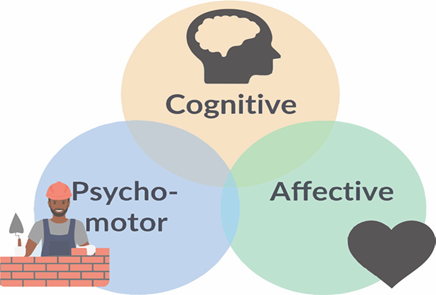
In educational sciences, taxonomy is defined as the science of classifying behaviours into categories or levels. Specifically, in the teaching domain, it is about the expected behaviours of the student after he/she has learnt a given content of knowledge. In teaching and learning, the teacher constantly assesses the expected students’ behaviours (objectives). Generally, these behaviours are classified into three categories or domains of manifestation of human behaviour which are cognitive, affective and psychomotor domains.
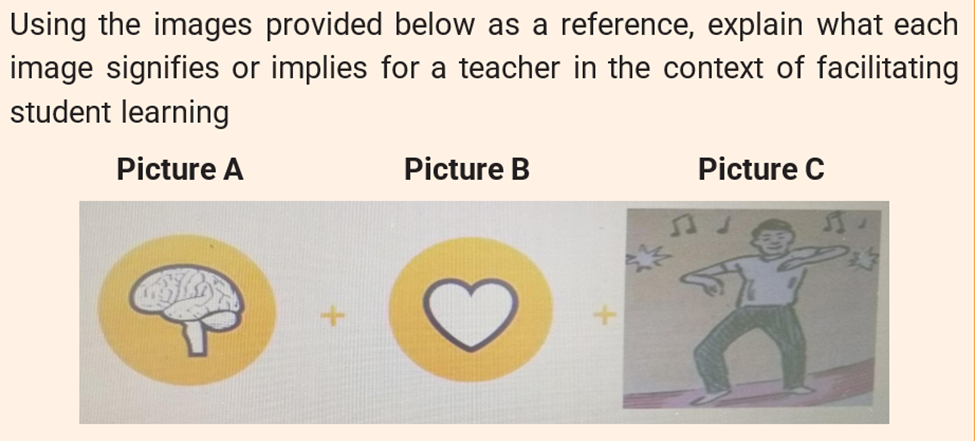
In pedagogy, taxonomy of educational objectives refers to the hierarchical classification of educational objectives. Taxonomy of educational objectives defines and distinguishes different levels of objectives. The taxonomy divides learning objectives into three broad domains: cognitive (knowledge-based), affective (emotion-based), and psychomotor (action-based), each with a hierarchy of skills and abilities. In other words, educational objectives are linked to any of the three domains of human behaviour, namely:
• The cognitive domain in relation to intelligence or the “brain”
• The affective domain, in relation to emotions, feelings or “heart”
• The psychomotor domain, in relation to movements or the “body”
These domains are used by educators to structure curricula, assessments, and teaching methods to foster different types of learning. Teaching aims at developing these three types of educational objectives: Cognitive objectives, psychomotor objectives, and affective objectives.
- Cognitive objectives relate to knowledge or thought. They aim essentially at the assimilation of course content. Examples: to explain the importance of educational objectives.
- Psychomotor objectives deal with movement and /or activities where gestures are used to express or interpret information or concepts. In general, these objectives are developed in Physical Education as well as other technical and vocational training courses. Examples: Draw, sing, high jump, disassemble an engine, etc.
- Affective objectives deal with values or attitudes. They occur at all levels of the teaching/learning process, but they are often neglected because they belong to the domain of attitudes. Examples: To fulfill someone’s commitments; to like mathematics, to stick to deadlines of appointments.
These objectives are also placed at various levels of complexity (from simple to complex) in their respective domains, according to their hierarchical classifications (their levels).
2.2. Three main taxonomies of educational objectives
There are three main taxonomies of educational objectives:
- Bloom’s Taxonomy of cognitive objectives and its Revised Version
- Krathwohl’s Taxonomy of Affective Objectives
- Dave’s Taxonomy of psychomotor objectives
2.3. Bloom Taxonomy of Cognitive Objectives and its revised version
Activity: Suppose that the topic of the lesson you will learn is: “The importance of trees.”
Respond to the following questions:
1. List the three types of trees you know.
2. Explain why trees are important for people.
3. Describe how you would plant and take care of a tree at school.
4. Compare trees planted in the village with those planted in town, what similarities and differences do you see?
5. Which tree is most useful to your community? Defend your answer.
6. Design a poster encouraging people in your area to plant more trees.
What did you notice about these questions? Were they at the same level of difficulty? Did some make you think more deeply than others? Explain Which questions are easier or difficult to answer?
Old Bloom’s taxonomy (1956)
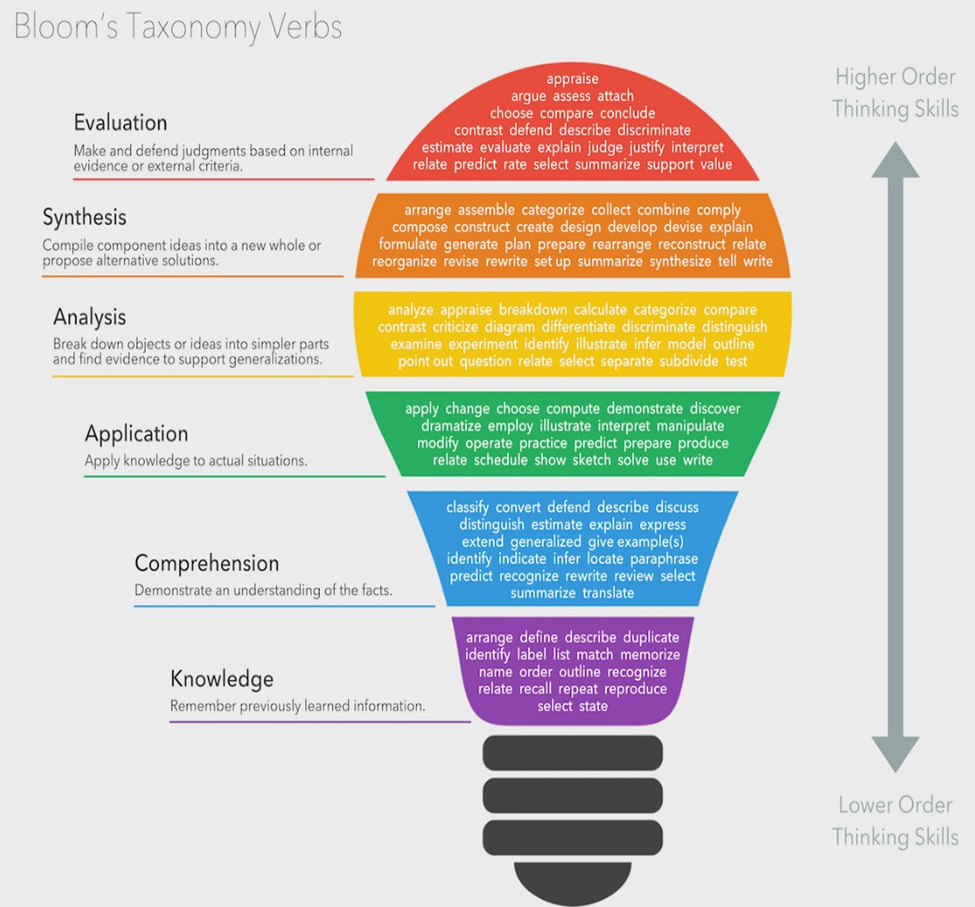
Cognitive objectives relate to knowledge acquired by learners, to the content taught. They focus on developing students’ intellectual abilities, such as thinking, reasoning, and problem-solving skills. Bloom’s taxonomy classifies learning objectives into levels of complexity and thinking skills. The taxonomy helps teachers design lessons that move learners from basic knowledge to higher-order thinking such as analysis, evaluation, and creation. This taxonomy supports effective lesson planning, assessment, and the development of critical thinking in learners. Bloom taxonomy of cognitive objectives has six levels: Knowledge, Comprehension, Application, Analysis, Synthesis, and Evaluation. The figure below shows all thinking levels of the old Bloom taxonomy and their meaning.
Revised Bloom taxonomy
In 2001, this taxonomy was revised by his former student Anderson. Levels were renamed and reordered using verbs as Remember, Understand, Apply, Analyze, Evaluate, and Create.
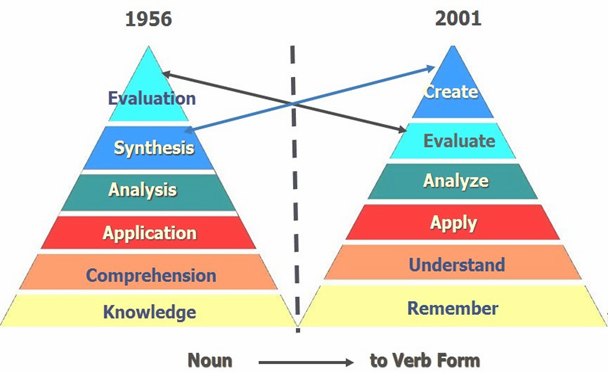
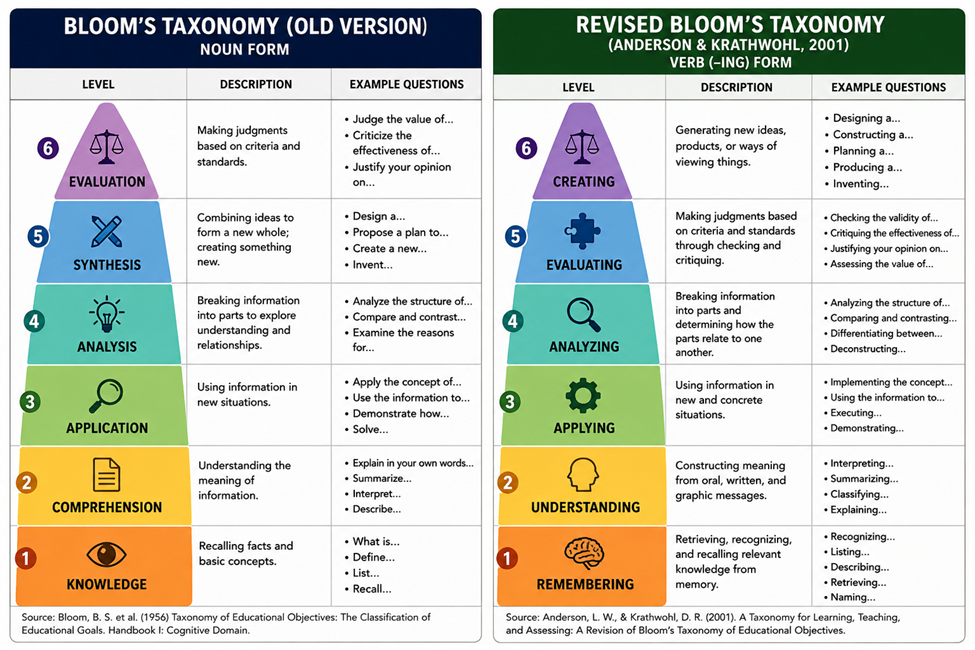
Remembering, understanding and applying are considered as the Lower -Order Cognitive levels of Thinking while Analyzing, Evaluating and Creating are known as the Higher-Order Cognitive levels of Thinking.
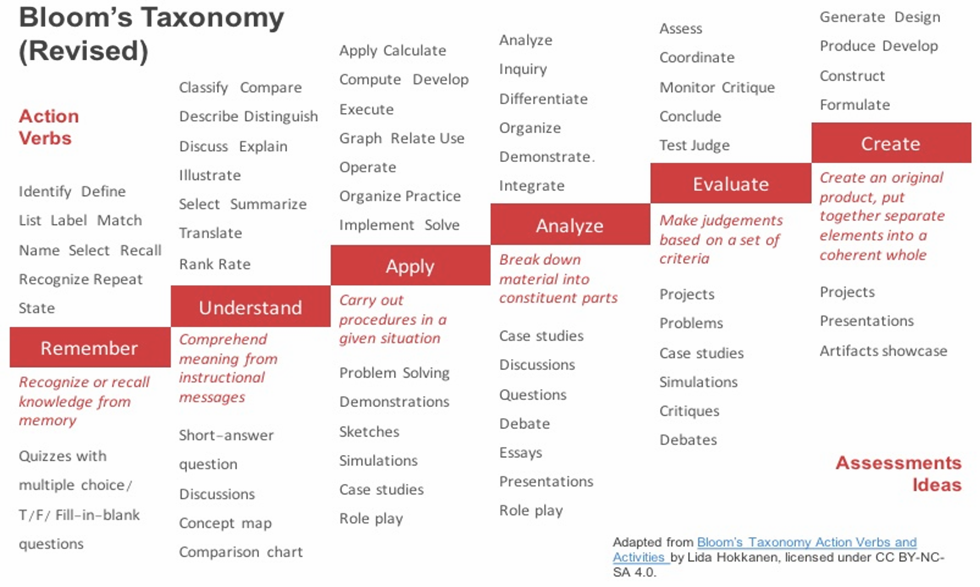
Note:
Teachers should use the revised Bloom’s taxonomy which has been found to satisfy the 21st century teaching and learning.
2.4. Krathwohl’s Taxonomy of Affective Objectives
Activity:
1. Think of one song you listened to this week. Just bring it to your mind.
2. Why did you play that song? Mood, lyrics, beat?
3. Would you put this song on the playlist you share with your close friends? Why or why not?
Which level of Krathwohl’s taxonomy does the answer to each question represent?
The taxonomy, developed by David Krathwohl in 1964, focuses on the emotional domain of learning and emphasizes the development of attitudes, values, and feelings. The taxonomy describes how learners engage with emotional responses to stimuli, such as how they feel about a subject, their willingness to engage in specific behaviors, or the value they place on ideas and concepts. It guides teachers in fostering not just intellectual but also emotional development in students. Krathwohl’s taxonomy of affective domain has five levels listed from the simplest behavior to the most complex: Receiving, Responding, Valuing, Organizing, and Characterizing.
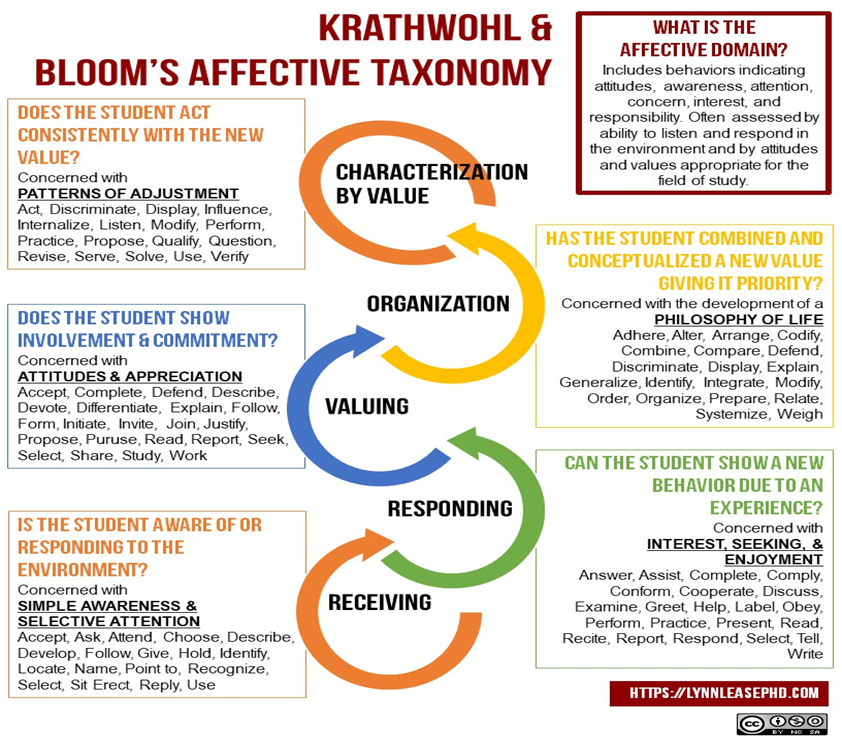
a. Receiving (Level of awareness): The lowest level; the student passively pays attention. Without this level, no learning can occur. Learners are simply aware of or willing to receive information. The learner is sensitised about the existence of certain phenomena and stimuli. He/she is incited to receive them and pay attention to them. It involves the passive process of attending to something and being open to it. Key action verbs: listen, pay attention, notice, observe, be aware. Examples: Listen attentively to a class discussion on environmental issues, observe the ethical behavior demonstrated by a role model, get knowledge of the existence of the school regulation, learners listen to the music on radio, etc.
b. Responding (Level of participation): The student actively participates in the learning process. Not only does the student attend to a stimulus, but he/she also reacts in some way. This could involve following instructions, providing feedback, or engaging in a specific activity. Examples: students will give a clap after a speech; they accept that the school regulation be respected or will participate in the drama festival. Participate in a group discussion about the importance of teamwork. Complete a survey to express opinions on school policies. Key action verbs: respond, participate, discuss, answer, contribute, react.
c. Valuing (Level of value development): The student attaches a value or importance to specific object, ideas, behaviours, concepts, phenomenon, or piece of information. The student associates a value or some values with the knowledge they acquired. The behaviour is motivated, not by the desire to please or to obey, but through the individual engagement to the fundamental value determining the behaviour. Examples: respect the school regulation on all occasions, sponsor one student to go for a cultural show at Serena Hotel, demonstrate a commitment to protecting the environment by recycling, respect for the opinions of others in class discussions, etc. Key action verbs: value, appreciate, prefer, demonstrate commitment to believe in, etc.
d. Organizing (level of value system): This involves commitment to a set of values. The student can put together different values, information, and ideas and accommodate them within their own schema. The student is comparing, relating, and elaborating on what has been learned. Students organize values into a coherent value system, integrating different values into a broader structure. This stage often involves prioritizing and reconciling conflicts between values. Example: Students will organize themselves in study groups of four people; Organize a community service project based on personal values of social responsibility. Key action verbs: organize, integrate, compare, prioritize, formulate.
e. Characterizing (level of internalizing values): It is the highest level; learners internalize values so that they consistently act in accordance with them. These values become part of the learner’s character, influencing behavior and decision-making across various situations. A student has value system to the extent that represents a philosophy of life. For example, the students will be always bound by the school rules and regulations, actively demonstrate leadership and integrity in all aspects of personal and professional life, consistently act in a manner that reflects respect for others and personal ethical standards. Key action verbs: act, demonstrate, influence, embody, internalize.
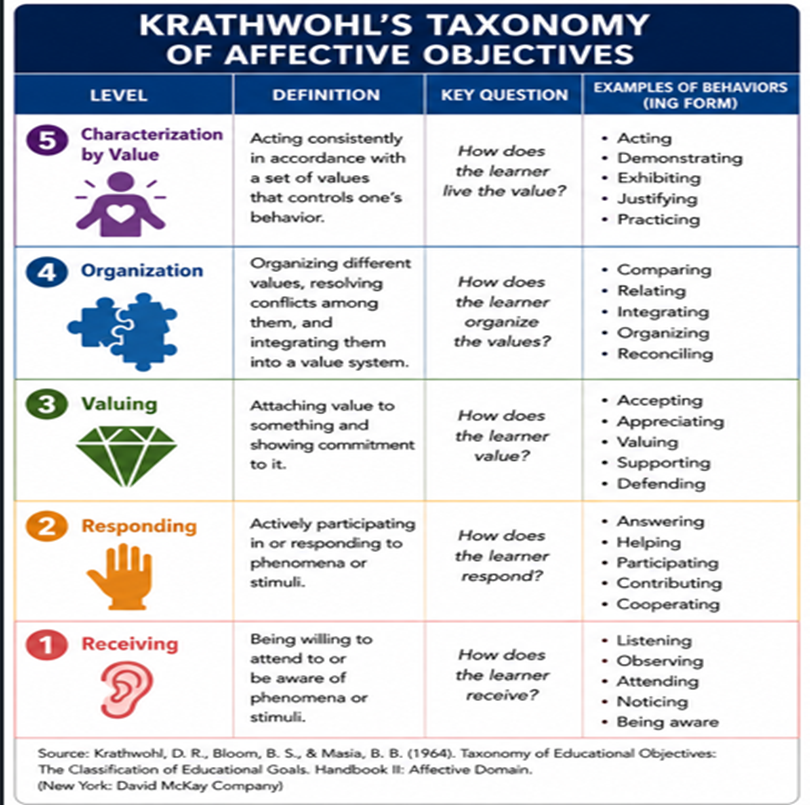
Affective objectives occur at all levels of the teaching/learning process, but they are often neglected because they belong to the domain of attitudes. It is difficult to assess these objectives, to find verbs of action.
2.5. Dave’s Taxonomy of Psychomotor Objectives
Activity: Suppose the topic of the lesson is: “Drawing a Chair.” Perform the following actions:
1. Watch the teacher draw a simple chair on the board. Did you pay attention to the shapes and lines?
2. Try to draw the chair by copying what you saw the teacher do.
3. Draw the chair independently without looking at the board.
4. Refine your drawing to improve proportions, angles, and neatness.
5. Add extra elements to your drawing, such as a desk, floor lines, or
shading.
6. Draw the chair accurately and consistently without any guidance or reference.
After responding:
Which of these steps were easiest for you? Which step challenged you the most? How did your drawing improve as you practiced at each level?
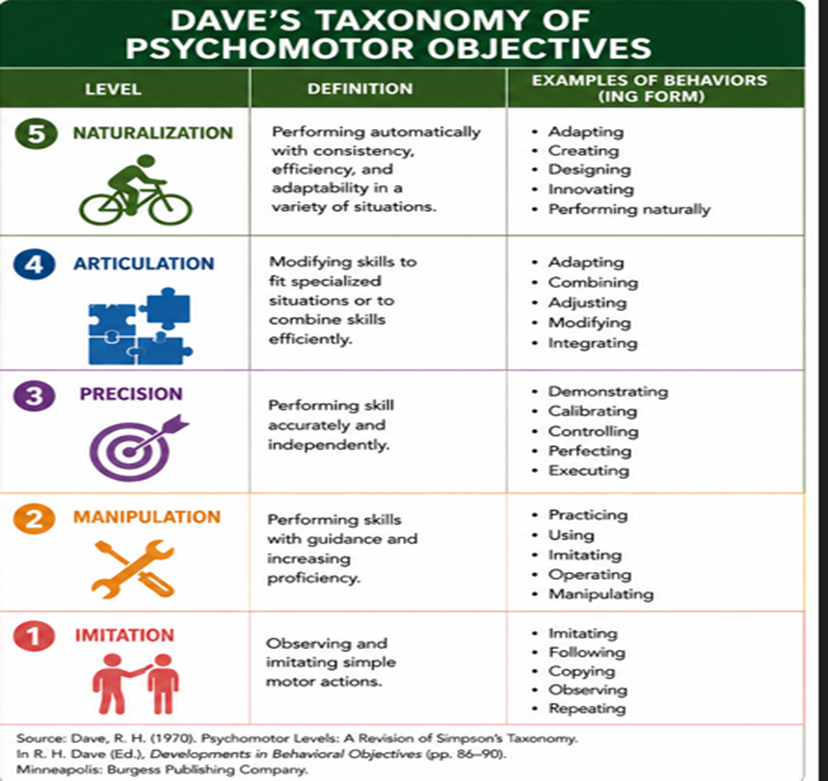
There is no taxonomy that is accepted universally for this domain. A very popular model for the psychomotor domain was established by R.H. Dave. The psychomotor domain encompasses the skills requiring the use and coordination of skeletal muscles, like physical activities of performing, manipulating, and constructing. Psychomotor skills are typically more observable, easier to describe, and measure in terms of evaluation. In general, these objectives are developed in Physical Education as well as other technical and vocational training courses. This taxonomy helps educators design and assess activities that involve physical movement, coordination, and manual skills, focusing on how learners develop proficiency in performing tasks that require fine and gross motor skills. Dave’s taxonomy has five levels: Imitation, Execution, Precision, Coordination and Naturalization.
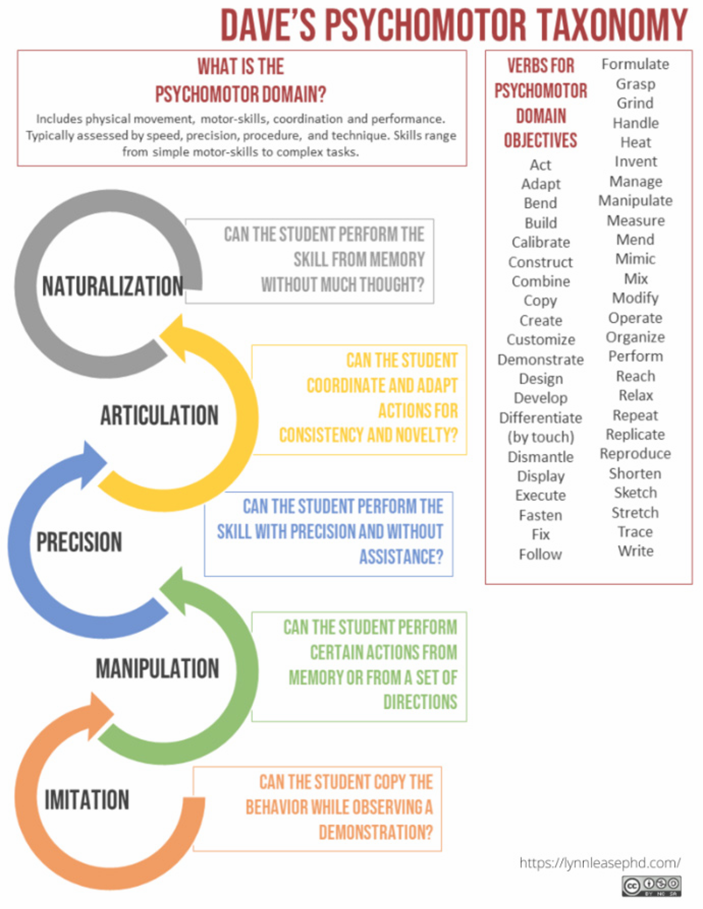
a. Imitation:
The learner is able to observe and replicate a motor skill, following the teacher’s demonstration. This level involves copying actions, and the skill is typically performed with some guidance. Performance may be of low quality. The learner repeats an observed action, but the neuromuscular coordination is still poor. For example, copying a work of art: the child takes a paper, rudely imitates a friend’s drawing. Key action verbs: imitate, follow, copy, repeat, duplicate.
b. Execution or manipulation:
Learners are able to perform the skill or task on their own, though still relying on basic procedures or instructions. The skill is performed with a greater degree of independence than in the imitation stage, but there is still some reliance on guidance. The learner becomes capable of imitating the teacher’s example. He/she starts differentiating movements and choosing the adequate behaviour. He/she reaches a certain level of ability in handling certain objects. Example: creating work on one’s own, after taking lessons or reading about it. Key action verbs: manipulate, handle, practice, use, perform.
c. Precision:
The learner performs the skill with increased accuracy, coordination, and control. At this level, the task is completed with greater refinement and attention to detail, often without the need for explicit guidance. The learner replicates the model with accuracy and precision. He/she reproduces the required model perfectly. He/she manages to replicate this action in the absence of the model. He/she directs the action and can modify its speed of execution about the situation. Key action verbs: perform, refine, enhance, adjust.
d. Coordination or articulation:
The learner coordinates and combines multiple skills to perform a complex sequence of actions smoothly and efficiently. At this stage, learners can adapt and adjust their movements based on the situation, integrating various motor actions into a cohesive whole. Coordinating a series of actions, achieving harmony and internal consistency. The learner harmonises his/ her action while at the same time being capable to adjust the speed, the duration, and the other factors, so that actions articulate well. Example: Producing a video that involves music, drama, color, sound, etc. The learner associates several words and knows how to write a text within a minimum time. Key action verbs: combine, integrate, coordinate, blend, synchronize.
e. Naturalization:
The learner performs the task with such a high level of proficiency that it becomes almost automatic or second nature. This level represents mastery of the skill, where the learner can perform the task smoothly and efficiently without thinking about the individual steps. Having high level performance become natural, without needing to think much about it. Things become automatic. Key action verbs: perform naturally, master, execute automatically, innovate, adapt. Examples: Michael Jordan playing basketball, Nancy Lopez hitting a golf ball, driving a car skilfully in varying traffic conditions, without needing to consciously focus on basic driving tasks or performing a complicated surgical procedure smoothly and efficiently, with minimal effort or conscious thought.
Note: When determining the objectives that learners should achieve at the end of their learning, the teacher must refer to the above domains of learning because, obviously, he/she must evaluate his/her educational action.
Activity on taxonomy of educational objectives:
1. Using Bloom’s revised taxonomy, design an instructional objective for a lesson of your subject that targets the “Analyze” level.
2. Give one classroom activity that can help students assess “Valuing” level in Krathwohl’s affective domain.
3. Describe how you would assess a learner’s skill at the “Precision” level in Dave’s psychomotor taxonomy during a practical art lesson.
4. For a subject of your domain, choose a topic and create one objective for each of the three domains (cognitive, affective, psychomotor) showing how they could be integrated in a single lesson.
5. Imagine you are teaching learners how to operate a microscope. Identify the psychomotor level they would be at if they can perform the task automatically without conscious thought and explain your choice.
3. Formulating instructional objectives
Activity: Teachers are planning a lesson for your senior two students. These are three examples of objectives formulated by them. Take a moment and read them carefully:
1. Learners will understand the lesson better.
2. By the end of the lesson, learners will list three causes of soil erosion
3. By the end of the lesson, senior two learners will be able to explain types of vegetation in the world.
4. Learners will know about good hygiene.
Which of the above objectives do you think is well formulated and why?
3.1. Meaning, rationale and functions of instructional objective
Meaning of instructional objective
An instructional objective is defined as a statement which describes an intended outcome of the teaching and learning process. It describes the kind of behaviour the learner is intended to display through thoughts, actions and feelings and the context in which the behaviour is to operate (REB, 2020). It describes what a learner is expected to be able to do after a lesson. In simple terms, an instructional objective answers the question: “What should students achieve by the end of instruction?”
Rationale of objectives
The rationale of objectives is given by Mager (2001) in his book How to define educational objectives while writing:” If you don’t know where you are going, then there is a risk to be found elsewhere”. In other words, “If you do not know where you are going, how will you know when you get there”.
Functions of objectives
- They serve as references and criteria to evaluate without any ambiguity whether the result is attained;
- They serve as headlights (a powerful light at the front of them) and help the teacher and the learner to know at any time their position/situation in regard with the result to achieve;
- They serve as means and criteria of self-assessment and improvement of action;
- They serve as criteria for choosing methods, strategies and techniques of pedagogical action.
In short, the educational objectives allow:
• To know where to go: to determine the difference between the initial situation and the final situation in order to see whether there is a change for the learner or not;
• To know how to go there: by determining the stages to follow and by choosing the most relevant techniques which will help to achieve what was determined before;
• To know where we are: it is a question of making an objective evaluation;
• Facilitate communication: between teachers and learners or among teachers themselves or even between teachers and other people in charge of the system, inspectors, supervisors, etc.
3.2. How to formulate instructional objectives?
Objectives are statements of change for students. They should specify the kind of behaviour and the content or area in which the behaviour is to operate. Instructional objectives are formulated or defined using verbs of action and specifying the content of the action which must be precise and limited. A well-written or formulated instructional objective should be SMART: Specific, Measurable, Achievable, Relevant, and Time-bound. It must also have ABCD components (Audience: Who is learning? Behaviour: What will they learn? Condition: Under what conditions? and the degree of performance: How well must they perform?)
A. SMART instructional objective
i. Specific: Objectives should clearly describe the attitudes, skills and knowledge or learning outcomes that the learner is expected to demonstrate after a given learning session.
ii. Measurable: The outcomes should be observable and assessable through appropriate tools or activities. The achievement of the objective can be measured by an assessment strategy such as observation, test items or problem-solving exercises.
iii. Achievable: The objective should be realistic, attainable, doable considering the available time, support, resources, and learner characteristics.
iv. Relevant: It should align with broader course goals and curriculum standards. It should be meaningful and worth pursuing, significance, appropriate for the learner’s current stage of development or subject objectives, aligns with real-world needs, the learner’s interests, and the overall educational or developmental context.
v. Time-bound: objectives are set for a particular lesson or learning session, making them time-specific. The learning objective should have a time limit, a specific timeframe or deadline for achieving a goal or completing a task. It means that the objective has a clear start and end time, which helps create a sense of urgency and focus. This is usually done by using the phrase “by the end of this lesson” or by the end of the week, by the end of the unit, within two months, during the semester, by the end of the semester, etc.
B. ABCD components of instructional objectives
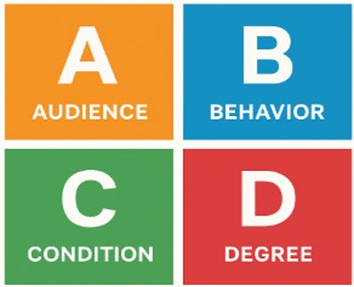
i. Audience (A): Instructional objectives should always specify the audience they are intended to serve. This refers to who the learning objective is aimed at - the group of learners or students. Usually, the audiences are participants in the learning session.
ii. Behavior (B): observable actions that are supposed to be accomplished by the end of the lesson. This component specifies what the learner is expected to do, to perform after the learning experience. A clear instructional objective should have an action verb that demonstrates the skills, knowledge and attitudes to be acquired. Examples of action verbs: explain, identify, analyze, list, draw, write, demonstrate, calculate, describe, etc. It is important to avoid general verbs such as ‘know’ and ‘understand’ as they may not be measurable.
iii. Condition (C): Instructional objectives should identify under which conditions a given task will be performed by the learner. The conditions may include time, tools, place, resources, environment and circumstances. Example: Using or without a calculator, without or referring to the notes, in a classroom setting, after reading the article, referring to a chart, or a map; while being monitored, on boat, in class, etc.
iv. Degree of performance (D): It specifies how well the learner should perform the behavior/task. Example: With accuracy or accurately, without error, correctly, with confidence, etc. The teacher may want to answer: How many? How fast? How well? It is, therefore, important for a teacher to give the specifics of how a learner will be able to perform a given task in terms of quality, quantity and/or time measurements.
C. Example of a SMART instructional objective with ABCD components:
By the end of the lesson, every senior four student will be able to accurately create a simple personal monthly budget using a budget template and classroom examples.
a. How is it SMART?
Specific: It focuses on creating a monthly personal budget.
Measurable: success is measurable through the accuracy and completeness of the student’s budget or the created personal and monthly budget.
Achievable: creating a simple budget is realistic task within a 40-minute lesson (by the end of the lesson) and appropriate for senior four learners using provided templates and examples.
Relevant: Budgeting is a practical life skill, aligns with financial literacy and
relevant to Economics curriculum.
Time-bound: The objective is set to be achieved, or the task is to be completed within one lesson (by the end of the lesson).
b. What are its ABCD components?
A (Audience): Every senior four student- the learners are targeted by the objective.
B (Behavior): create a simple monthly personal budget- an observable and measurable action.
C (Condition): using a budget template and classroom examples- the resources/context given.
D (Degree): Accuracy- indicates the quality expected by the end of the lesson
|
Activity: Choose a topic from the subject you will teach. Then, formulate a good instructional objective that is SMART and includes all the ABCD components.
|
4. Planning key pedagogical documents
|
Activity: Imagine you have to teach a lesson tomorrow without any plan. How do you think it would go? What challenges might you face? |
The teaching-learning process should never allow improvisation and randomness. The teacher must plan the teaching and learning activities on a regular basis before the real class lessons to ensure the success of the lesson.
4.1. Key pedagogical documents
|
Activity: 1. What do you understand by pedagogical documents? 2. List the main types of pedagogical documents you know.
|
Key pedagogical documents are the foundational tools and official references that guide teaching, learning, and assessment in educational systems. They ensure that instruction is aligned with national or institutional goals, curriculum standards, and learner needs. These documents vary slightly from one country or educational system to another, but the following are widely recognized and essential across most context:
- Curriculum framework: A national or institutional guide that outlines the philosophy, goals, and structure of the education system. It defines educational aims and competencies, key learning areas or subjects, learner profiles and guiding principles and cross-cutting issues.
- Subject syllabus for every subject
- Teacher’ s and learner’s subject textbooks: approved instructional materials aligned with the syllabus, used directly by students and teachers for teaching, instruction, learning and practice.
- Schemes of work for every subject
- Lesson plans for every lesson of each subject
- Class diary for every lesson to indicate daily teaching activities
- Exercise books for homework, tests and exams for each subject
- Lesson notebooks for each subject
- Marksheet for recording the marks for student’s scores (tests/quizzes, homeworks, and exams);
- Class register: to monitor student lesson attendance
- Timetable to indicate teacher’s respecting teaching time/ class
4.2. Planning the scheme of work
|
Activity: 1. What is a scheme of work? 2. What are the key elements of a scheme of work? 3. What is the importance of a scheme of work? |
A. 1 Meaning of the scheme of work
A scheme of work is a detailed plan that outlines how the content of a subject syllabus will be delivered by the teacher over a specific period of time, such as a term, semester, or school year. It breaks down the subject matter into manageable units or topics, specifying objectives, content, teaching methods, resources, assessment strategies, and the time allocation for each topic. The scheme of work is prepared by individual teachers or schools; a scheme of work is a long-term planning document that organizes the syllabus content into teachable units over a specific period (term or year).
A.2 Template of a scheme of work
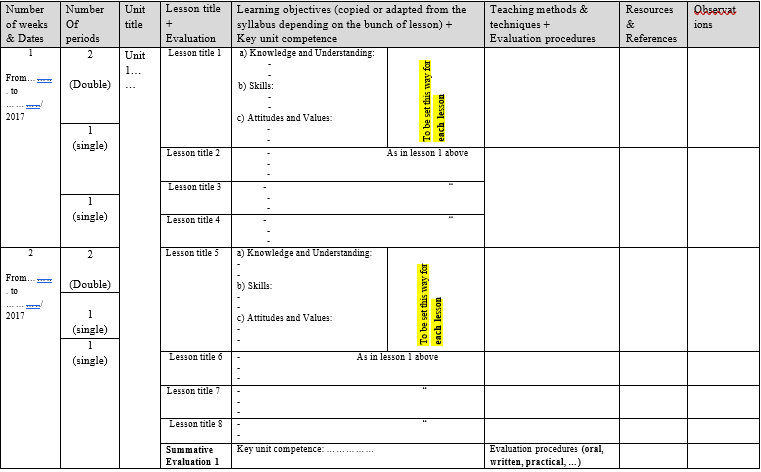
The template has been provided in the new Rwanda curriculum framework to facilitate teachers to prepare their lessons in the same ways as much as schools should be conditioned that any change does not deviate or alienate the principles underlying the implementation of the competence – based curriculum.
REB template of the scheme of work (REB, 2020)
Format of the CBC Scheme of work
Academic year: ……….. Term: ………… School: ……………………… Subject: ………….. Class + Combination: ………… Number of period per week: ……… Teacher’s name: ……………….
A.3 Common interruptions to consider in preparing the scheme of work
The scheme of work is elaborated based on the school calendar. The number of effective teaching periods varies according to both predictable and unpredictable interruptions. Effective teaching time must therefore be estimated before topics are selected. The most common interruptions that are likely to disrupt a scheme of work include: Public holidays, examinations (should be schemed for) if they are internal, revisions (should be schemed for), open days, sports days, planned school breaks e.g. mid-term break, etc.
A.4 Resources in the scheme of work
Teaching resources are all the materials, tools, and aids that a teacher uses to facilitate learning, support instruction, and enhance student understanding. These resources can be physical or digital, human or material, and are selected based on the subject content, learning objectives, student needs, and available time. Types of teaching resources include:
- Human resources: teachers, guest speakers, peers, or community members who contribute knowledge or experiences. Example: A police officer invited to speak about road safety.
- Textual resources: Textbooks, workbooks, teacher guides, reference books, storybooks, and academic journals. Example: A history textbook used to teach about independence movements.
- Visual resources: Charts, maps, posters, flashcards, photographs, drawings, and diagrams. Example: A map used in a geography lesson to teach about continents.
- Audio-visual resources: Videos, films, slide presentations, animations, and recorded lectures. Example: A documentary on climate change shown in science class.
- Digital and ICT resources: Computers, tablets, educational apps, online platforms, projectors, smartboards, and internet-based content. Example: Using Kahoot! or Quizizz for interactive assessment.
- Realia (Real objects): Physical items from the real world brought into the classroom to enhance understanding. Example: Fruits used in a nutrition lesson.
- Manipulatives: Objects students can handle to explore concepts, especially in mathematics or science. Example: Geometric shapes for teaching volume and area.
- Print and writing materials: Exercise books, handouts, worksheets, newspapers, and magazines. Example: A worksheet for practicing grammar.
- Demonstration materials: Lab equipment, models, or experiments used to demonstrate scientific or technical concepts. Example: A model of the human heart in a biology lesson.
Note: The teacher should not indicate a teaching aid which will not be available in class.
A.5 References in the scheme of work
References are the sources of information or ideas that are used in the preparation of the lesson. These may include books, journal articles, websites, reports, interviews, or other documents that were consulted or cited to support facts, theories, arguments, or explanations. It is necessary for the teacher to provide full and complete reference: indicate authors, year of publication, title of the book or article, publisher and relevant pages. Better to use APA referencing style 7th edition used by UR. Examples:
Bayingana, J., Birekeraho, S. J., Wairu, P., & Gitonga, T. (2016). Economics For Rwandan Schools. Senior Four. Student’s Book. Ronghorn.
Rwanda Basic Education Board (REB). (2021). Geography and Environment. Senior 3. Student’s Book. REB.
A.6 Observation column in the scheme of work
The observation column should be filled in immediately when the lesson is over during the week or at the end of the week. The teacher is supposed to indicate whether what was planned for the period has been covered, whether there was over planning or failure of lesson and reasons for either case, etc. Remarks such as excellent, done, ok, well done, satisfactory, taught, etc. might not be very useful to the teacher. Such remarks as “the lesson was not very well done because of inadequate teaching aids”, or “students were able to apply concept learnt in solving problems as evident from supervised practice”, etc. are appropriate. After the remarks, it is necessary to write the date when the lesson was taught.
|
Activity: Consider one of the subjects you plan to teach in secondary schools and prepare a scheme of work for term 3, school year 2025-2026. |
4.3. Preparing a lesson plan
|
Activity: Imagine you are asked to teach a 40-minute lesson tomorrow without any preparation. You enter the classroom and you do not know exactly what to teach first, how to organize your ideas, or how to end the lesson. Questions: 1. How would you feel in that situation. 2. What do you think a teacher should prepare before entering a classroom? |
What is a lesson plan?
A lesson plan is short-term, detailed plans for daily or week lessons, often including lesson objectives (aligned with the syllabus), teaching and learning activities, instructional materials, assessment techniques and timing and sequencing. It is the design of all daily lessons teaching and learning activities (REB, 2020). Preparing a lesson is to plan in advance:
- What will be taught,
- How to teach it,
- The resources to be used and
- Ways of assessment.
Advantages of a well- planned lesson
A teacher who has prepared his/her lesson is comfortable in the classroom, confident, does not hesitate and is not afraid of committing errors because he/she has checked, planned, and ordered everything. The discipline is maintained because he/she attracts students’ attention and keeps them working all the time, they do not have time to get bored and upset. His/her presentation is clear and orderly, the questions are well arranged, he/she progresses from simple to complex, from easy to difficult.
Disadvantages of an ill-prepared lesson
The teacher is anxious, he/she hesitates at each stage, which leads him/her to flip through the books all the time, resulting in a great waste of time. The lesson is not orderly, there is no logical progression, the learner fails to grasp the essential, he/she gets confused, and then drops out completely (Hattie & Clarke, 2020).
Note: The teacher should not be a slave to his/her lesson plan; he/she can go beyond it without losing the thread (line) of the essentials. Example: Teachers who do not want to answer questions raised by their students under the pretext that they (questions) are not part of what has been prepared. Teachers who are wasting their time moving away from the topic of the day and tackle those topics proposed here and now by the students.
4.4. Steps involved in developing a lesson plan
Step 1: Pre-lesson preparation or Indirect/distant lesson preparation: The teacher identifies the title of the lesson, instructional objectives to be achieved and searches lesson information by reading books, journals, theses, dissertations, etc. He/she gathers all necessary documentation.
Step 2: Immediate lesson preparation: The teacher prepares the lesson according to REB format/template.
CBC lesson preparation template/ REB Template of the lesson plan
School Name: Teacher name:
|
Term |
Date |
Subject |
Class |
Unit No |
Lesson No |
Duration |
Class size |
||||
|
|
|
|
|
|
|
|
|
||||
|
Type of Special Educational Needs to be catered for in this lesson and number of learners in each category |
|
||||||||||
|
Unit title |
|
||||||||||
|
Key Unit Competence: |
|
||||||||||
|
Title of the lesson |
|
||||||||||
|
Instructional Objective (s) |
|
||||||||||
|
Plan for this Class (location: in / outside) |
|||||||||||
|
Learning Materials |
|
||||||||||
|
References |
|
||||||||||
|
Timing for each step |
Description of teaching and learning activity |
Generic competences and cross cutting issues to be addressed + a short explanation |
|||||||||
|
|
|||||||||||
|
Teacher’ s activities |
Learners’ activities |
||||||||||
|
Introduction
|
|
|
|||||||||
|
Development of the Lesson
|
|
|
|||||||||
|
Conclusion
|
|
|
|
||||||||
|
Teacher self-evaluation |
|
||||||||||
What to write in the template?
|
Term |
Date |
Subject |
Class |
Unit No |
Lesson No |
Duration |
Class size |
||
|
Write 1, 2 or 3 depending on the school calendar |
Indicate Date, month and year of lesson delivery |
Indicate the correct name from the subject syllabus |
Indicate the Class level and combination or name of the stream where
|
Write the unit number |
lndicate the Lesson number |
Write the duration of the period |
Write the total number of registered students |
||
|
Type of Special Educational Needs to be catered for in this lesson and number of learners in each category |
Write the number of learners succeed. |
||||||||
|
Unit title |
From the subject syllabus |
||||||||
|
Key Unit Competence: |
From the subject syllabus |
||||||||
|
Title of the lesson |
From the subject syllabus and subject textbook |
||||||||
|
Instructional Objective (s) |
It must be SMART |
||||||||
|
Plan for this Class (location: in / outside) |
Indicate |
||||||||
|
Learning Materials |
Indicate |
||||||||
|
References |
Use APA referencing style, 7th edition |
||||||||
|
Timing for each step |
Description of teaching and learning activity Write a short summary of the teacher and learners will be doing in each step of the lesson |
Generic competences and cross cutting issues to be addressed + a short explanation |
|||||||

|
Introduction
Indicate the time |
Write the title of the topic of revision or introduction Make a revision if the lesson is related to the previous one, if not introduce the lesson
Here, clarify all the activities you Key content of the revision or introduction must be written |
Write the title of the topic of revision or introduction
Clarify all the activities that learners Key ans |
Generic competences
Identify relevant generic
Cross cutting issues
Identify relevant cross-cutting issues and describe ho you
lesson |
|
Development of the Lesson
Indicate the time |
Write the title of the new lesson Share instructional objectives and write them on the board under the title of the new lesson Precise all the activities you Teacher’s activities must be related to the learning objectives |
Write the title of the new lesson
Precise all the activities learners Learners’ activities must be related to the learning objectives
Key content of the lesson must be indicated |
Generic competences
Identify relevant generic
Cross cutting issues Identify relevant cross-cutting issues and describe ho you
lesson |


|
Conclusion Indicate the time |
Summary Explain all the activities you
Assessment
Clarify all the activities you
Assessments given must be related to the learning objectives |
Summary Clarify all the activities that learners
Assessment
Make clear all the activities that learners Indicate key ans
|
Generic competences Identify relevant generic
Cross cutting issues Identify relevant cross-cutting issues and describe how you
lesson |
|
Teacher self- evaluation |
|
||


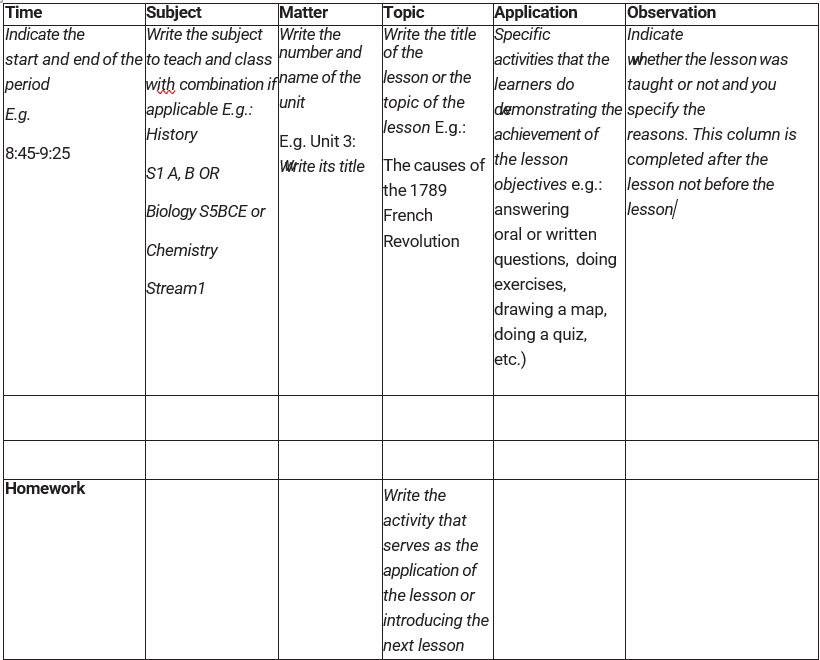
4.5. Planning a class diary
Activity:
1. Write down at least seven things you will record every day in your class diary?
Why do you think keeping a class diary is important?
What is a class diary?
A class diary is a tool used by teachers, to reflect on teaching and learning experiences, class activities, progress over time. It serves as a record of what has been taught, what the student has learned, and any reflections or insights related to the content and classroom dynamics.
Template of the class diary (REB, 2020)
REPUBLIC OF RWANDA

Ministry of Education
CLASS DIARY
Teacher’s name: …………
Class: ………..
………., the ……….
|
Times |
Subject |
Matter |
Topic |
Application |
Observation |
|
|
|
|
|
|
|
|
|
|
|
|
|
|
|
|
|
|
|
|
|
|
|
|
|
|
|
|
|
|
|
|
|
|
|
|
|
|
|
|
|
|
|
|
|
|
|
|
|
|
Homework |
|
|
|
|
|
What to write in the class diary?
Teacher names: Write your names
Class: Indicate all classes you teach: S1A, B, C; S3B, S5 HLE, etc. , or name of the stream.
…………, the………..: indicate the day, date, month and year such as Tuesday, the 21st May 2026
|
Activity: Choose a topic from the subject you will teach in secondary schools and prepare a lesson plan and make its a class diary. |
5. Delivering a lesson
|
Activity: Answer the following questions: 1. How will you introduce, develop, and conclude your lessons? 2. How will you develop generic competences and integrate cross-cutting issues into your lessons? 3. How will you use the chalkboard or whiteboard during lesson delivery? |
5.1. Main steps of a lesson delivery
Three main steps of a lesson delivery are: 1) Introduction or revision, 2) development of the lesson or body of the lesson and 3) lesson conclusion which includes summary of the lesson and lesson assessment (REB, 2020).
Step 1: Introduction of the lesson or revision of the previous lesson
In this stage, the teacher introduces the new topic of the lesson to motivate or to arouse students’ interest in the new lesson. It may be a story, a joke or an example attracting students’ attention upon important concepts to be learned; or the teacher makes a revision of the previous lesson, a reminder of the prior knowledge or concepts taught in previous lessons; a reminder of students’ experience and / or comments made during practical work and which are directly related to the topic of the day; etc.
It requires the teacher to motivate his/her learners to acquire new knowledge, skills and values. This part of the lesson may help the learners to remember what they learned and to launch the motivation process. This part ends by announcing the lesson of the day and writing its title on the board.
Step 2: Lesson development/ body of the lesson
This is an essential part of the lesson where the teacher teaches the lesson of the day. The teacher should strictly and logically present the content. The content is divided in a number of parts/sections as many as the number of instructional objectives. At the end of each section, there is a short summary for a better mastery of the new content. These partial summaries draw the attention of the students to what they must know in each part or section. Partial summaries are usually followed by a short assessment, which is called formative (continuous) assessment in technical terms.
The content should be organised in a hierarchical order: i.e. follow a sequence that facilitates learning: from concrete to abstract, from simple to complex, from easy to difficult and from near to the distant. Envisage how to proceed for each section. Anticipate the types of questions to be asked and when they would be asked. Envisage the diagrams and sketches/drawings, pictures (teaching aids in general) to be developed and when to use them, when will a particular teaching aid be used?
Step 3: Lesson conclusion: Summary and assessment
A final summary of the lesson should be made at the end of the lesson. The teacher must ensure that his/her learners have acquired new knowledge, skills and values. The summary of the lesson is provided by learners with the help of the teacher.
The final summary is usually followed by an assessment, which is called the summative assessment. Assessment is a significant stage in lesson planning and delivery. As the teacher prepares his/her lesson, he/she must ask himself/herself what he/she is going to do to achieve the lesson objectives. He/she will specify clearly the competences his/her learners need to acquire and their indicators. During this final stage, the teacher will ask a set of questions to assess whether the competences or lesson objectives have been achieved at the end of the lesson. The lesson is assessed and evaluated to ensure:
- Its theoretical retention.
- Ascertain its understanding; and
- Generalize the meaning of the concepts learned.
The importance of end of lesson assessment is to show the student that learned concepts are not useless; he/she may need it to solve problems in his/her everyday life.
5.2. Developing generic competences and integrating crosscutting issues during lesson delivery
Activity:
1. What do you understand by generic competences and what are they in the Rwandan context as provided by REB?
2. How will you develop each generic competence into learners during lesson delivery?
3. What to you understand by crosscutting issues and what are they in the Rwandan as provided by REB context?
4. How will you develop each cross-cutting issue during lesson delivery?
5.3. Understanding generic competences and crosscutting issues
Developing generic competences and integrating cross-cutting issues into a lesson requires deliberate planning that aligns learning activities, content, teaching strategies, and assessments with broader educational goals.
a. Generic competences
Generic competences are broad, transferable skills that learners should develop across subjects. They are applicable to a range of subjects and situations including employment. Generic competences involve and promote the development of higher order thinking skills. They are seen as generic competences because they apply across all curricula and can be developed in all subjects. The generic competences that are developed within all subjects in Rwandan secondary education are: Critical thinking, creativity and innovation, research and problem solving, communication, co-operation, interpersonal relations, and life skills, lifelong learning.
Generic competences help prepare students for the world of work. They are also vital for enabling students to become lifelong learners who can adapt to our fast-changing world and the uncertain future.
b. Cross-cutting issues
Cross-cutting issues are topics that transcend subject boundaries and reflect societal concerns. They refer to important curriculum content that does not belong to any one subject or learning area exclusively, but which is best taught and learned in several subjects. These topics should therefore be integrated throughout all or some subjects of learning. They are identified as important and cut across most or all aspects of development. There are eight (8) cross-cutting issues (REB, 2015): Peace and values education, genocide studies, gender education, inclusive education, comprehensive sexuality education, financial education, environment and sustainability, standardization culture.
5.4. How to develop generic competences and integrate cross cutting issues in a lesson?
- Analyze the lesson objectives and content: Begin by reviewing your specific lesson objectives and content. Ask yourself: Which generic competences can naturally be developed through the topic? Which cross-cutting issues are related to the lesson content or context? For example, if teaching a Social Studies lesson on community resources; generic competence may include communication, cooperation, and critical thinking while cross-cutting issues may involve environmental sustainability and financial education.
- Include the identified generic competences and crosscutting issues in the lesson plan and lesson delivery. For instance, include them in:
- Instructional objectives: if they are part of the content
- Learning activities: Design activities that foster identified competences and allow learners to engage with cross-cutting issues. Examples: Group work for developing cooperation, role-play or debates to build communication and respect for diverse opinions (peace education, gender), case studies that relate to environmental or financial issues and problem-solving tasks that encourage critical and creative thinking.
- Teaching methods: Use learner-centered methods that support the development of these competences: Discussion for communication and critical thinking; inquiry-based learning for research and problem-solving; project-based learning to promote lifelong learning and collaboration.
- Teaching and learning materials: Use resources that reflect diversity, inclusivity, and relevance to cross-cutting issues. Example: Use stories or images that include people with disabilities or reflect gender equity.
 Assessment: Assess both the subject content and the development of competences and awareness of cross-cutting issues. Use rubrics for group work (assess cooperation). Include reflection questions (e.g., How can we manage natural resources sustainably?). Observe participation in discussions (communication, peace and values).
- Reflect and adjust: After the lesson, reflect on whether the competences were developed, how effectively the cross-cutting issue was integrated and what can be improved next time.
5.5. Use of the blackboard/white board during lesson delivery
Activity: How will you better use the chalkboard/ whiteboard to support teaching and learning?
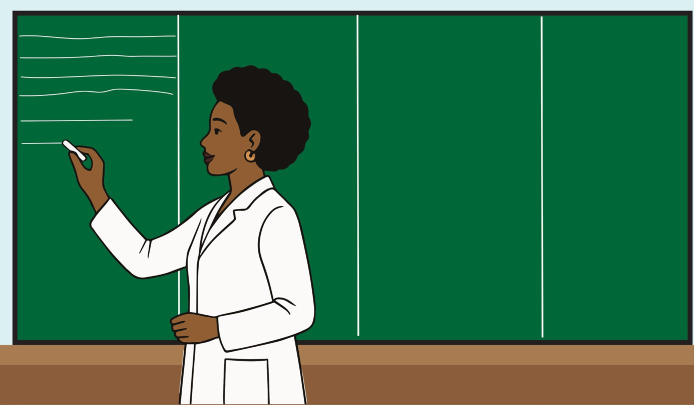
The chalkboard/whiteboard is a visual teaching aid. It is a medium of interaction between the teacher and the learner.
- Erase the chalkboard/ whiteboard completely at the start of the lesson and after the lesson so that the following teacher will find the board clean.
- Divide the chalkboard/ whiteboard into sections depending on its breadth, and use different sections of the board for different purposes:
· Left edge of the board for the outline of the class plan
· Middle zones for developing the lesson content
· Right edge for lesson conclusion
- Write from the left to the right. When beginning a lesson, write the date at the top left corner of the chalkboard. Write the subject, the unit, the topic of the lesson and the lesson objectives at the appropriate time. This will help both you and the students to stay on track.
- Keep your writing clean and organized so the students can see connections. Don’t write too much. A cluttered chalkboard/whiteboard may confuse your students. Make sure your writing is large enough to be seen by students in the back of the room. Avoid writing too small or squished together.
- Don’t just write things down silently, explain what you’re writing as you go. This helps reinforce concepts and allows students to follow along with your reasoning. Do not write irrelevant information, focus on the key points. Do not stand in front of the material you write.
- Don’t erase the topic of the lesson and instructional objectives. Don’t erase the zone if you will need the material in that zone again later. Don’t erase the material on the board too soon after you wrote it.
- Use different colors of chalk to emphasize important points, formulas, or keywords: green and yellow colors are better for headings while white chalks are good for all other material.
- Do not use more than three colors. Provide your students with opportunities to write on the chalkboard. Many students enjoy the chance to display what they know and even to play the role of the teacher. Allow students sufficient time to copy what you wrote before you erase it.
- If you’re teaching a subject that involves diagrams (e.g., math, science, geography), draw them as you explain. This helps students visualize the material.
- While writing on the board, ask students questions to keep them engaged. This can also provide immediate feedback on whether they understand the material.
- Give students opportunities to come to the board to solve problems, share or write their ideas. This can create a more interactive and engaging classroom environment. Students like to play the role of the teacher in class.
- While writing on the board, avoid turning your back on the class for extended periods.
- Engage with students as you write and talk to them to maintain eye contact.
- Don’t be afraid to make mistakes on the board, correcting them in front of the class can be a valuable learning experience.
- Write key ideas, a summary or key takeaways on the board as the lesson goes on.
|
Activity: 1. Select a lesson topic from one of the subjects you will teach in secondary schools. 2. Identify the generic competences and crosscutting issues relevant to your lesson objectives, content and activities that you can develop and integrate in each step of your lesson. 3. Develop the lesson plan 4. Share it with your colleagues for feedback. 5. Reflect on the feedback received and how they can improve your lesson delivery. |
5.6. Classroom management
Activity:
Using the mid map, identify four key words that come to mind when you think about classroom management.
5.7. Meaning and classroom management strategies
Meaning of classroom management
Classroom management refers to the strategies, practices, and techniques that teachers use to maintain an organized, productive, and respectful learning environment. It encompasses everything from setting clear expectations and maintaining discipline or managing student behaviour, organizing classroom activities to fostering student engagement and managing classroom resources. The goal of classroom management is to minimize disruptions and maximize learning time, creating a space where all students feel safe, respected, and engaged.
a. Effective strategies for classroom management
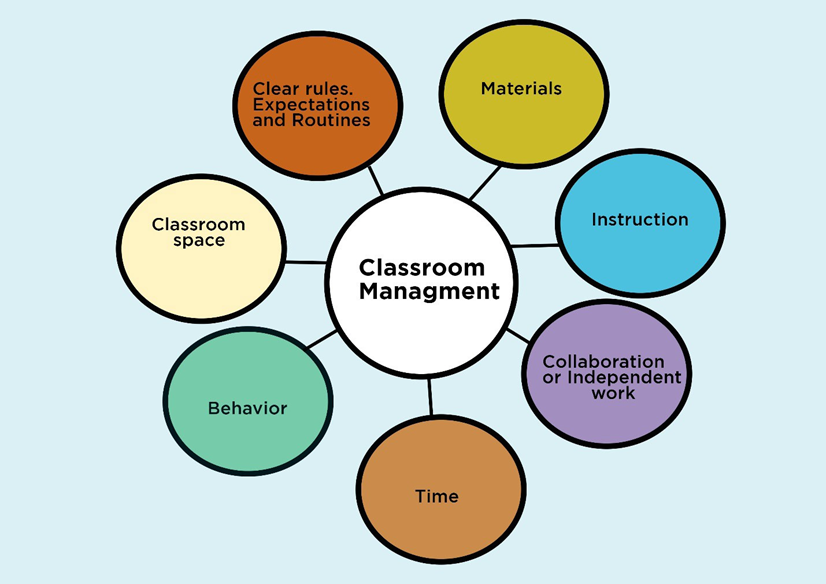
There are different classroom management strategies that a teacher can use:
i. Establishing clear rules, expectations and routines:
Clearly define and communicate rules at the beginning of school year, term or lesson. Involve students in developing classroom norms to foster ownership and responsibility. Clearly define what behaviors are acceptable and unacceptable during lessons, transitions, and free time and make sure students understand them. Apply the rules consistently to ensure fairness. If students know what to expect, they’ll be more likely to follow the rules. Create routines for common classroom activities (e.g., entering the classroom, handing in assignments, transitions between activities). When routines are established, students will know what to do without constant reminders. Set time limits for activities and use visual or auditory signals (e.g., bells, timers) to help students transition smoothly between tasks.
ii. Creating a positive learning environment:
Build respectful and supportive teacher-student relationships where students feel valued, respected, and part of a community. When students feel respected and valued, they’re more likely to engage and behave well. Promote a culture of inclusion, fairness, and encouragement. Encouraging positive behaviors through rewards, praise, and encouragement. Keep lessons engaging and interactive. When students are interested and actively involved, they’re less likely to misbehave.
iii. Creating an environment that encourages collaboration or independent work, depending on the lesson:
Designing lessons that are engaging, interactive, and appropriately challenging for students. Celebrate successes and provide constructive feedback. Using a variety of teaching strategies and tools (e.g., group work, hands-on activities, multimedia) to keep students engaged and focused. If a lesson isn’t going well or students are disengaging, be flexible and adjust your approach. Sometimes, shifting activities or teaching strategies can re- engage students.
iv. Organizing the physical space or classroom set up:
Arrange desks, chairs and materials in a way that supports interaction, accessibility, smooth transitions and minimizes distractions; and in a way that encourages cooperation and focus. Ensure the room is clean, well-lit, and free of unnecessary distractions. Avoid distractions by minimizing disorder and keeping learning materials within reach.
v. Time management:
Start and end lessons on time. Planning and managing the flow of the lesson to ensure that time is used effectively for instruction and student participation. Creating routines for transitions between activities to avoid wasted time. Use timers or visual schedules if needed to support pacing.
vi. Behavior management:
Address misbehavior or disruptions calmly and quickly (as soon as they occur) to prevent escalation. A quick and calm response helps maintain control without disrupting the class. Provide immediate, specific feedback to reinforce good behavior and correct issues. Using preventive strategies such as proximity control (simply moving closer to a student who is off task can help redirect their attention), non-verbal cues (eye contact, hand gestures, or other non-verbal cues to let students know you’re paying attention and want them to stay on track) or redirecting. Keep students engaged in the lesson to prevent behavioral issues. Use strategies like positive reinforcement, and consequences- that are transparent and age appropriate- to guide student behavior. For instance, when students break the rules, follow through with the consequences you’ve established. Be consistent with how you apply consequences to prevent confusion. Use restorative approaches (e.g., conflict resolution or mediation) when appropriate. Involve parents, school leaders if behavior challenges persist.
vii. Engaging students in learning:
Use varied teaching methods and strategies (e.g., discussions, demonstrations, group work, discussions, hands-on activities) to maintain interest. Differentiate instruction to meet diverse learning needs and abilities. Give learners opportunities to take responsibility (e.g., classroom roles, peer mentoring).
viii. Maintain professionalism and take care of yourself:
Stay calm, even in challenging situations. Keeping your emotions in check, models emotional regulation for students. How to do it?
- Manage stress: Classroom management can be challenging, and stress can impact your effectiveness. Take breaks when you need to and ensure you’re maintaining your own well-being.
- Reflect and improve: After each lesson, reflect on what went well and what could be improved. This will help you continue to grow as a teacher and develop better management strategies over time.