Resources for unit 6
| Site: | UR - Elearning Platform |
| Course: | CE80241: Theories and practices of Teaching and Learning |
| Book: | Resources for unit 6 |
| Printed by: | Guest user |
| Date: | Wednesday, 21 October 2026, 3:59 AM |
Description
Dear student,
Engage with the learning materials of unit 6 and do all related activities.
Table of contents
- 1. Assessment and Evaluation
- 2. Types of assessment
- 3. Assessment approaches: Assessment of, as, and for learning
- 4. Assessment strategies
- 4.1. Formative assessment strategies
- 4.2. Summative assessment strategies
- 4.3. Diagnostic assessment strategies
- 4.4. Authentic assessment strategies
- 4.5. Self-assessment strategies
- 4.6. Peer assessment strategies
- 4.7. Performance-based assessment strategies
- 4.8. Interactive/Online assessments strategies
- 4.9. Observational assessment strategies
- 5. Importance of assessment in the teaching and learning process
- 6. Assessment principles
- 7. Types of assessment questions
1. Assessment and Evaluation
Activity: Read the following classroom situations and indicate whether each situation
represents assessment or evaluation.
1.
- Learners complete a quiz and immediately discuss corrections with the teacher.
- End-of-term examination results are used to decide promotion to the next class.
- A teacher compares learners’ final project scores to determine the best performer.
- A school ranks students according to their final examination scores.
- During a class session, the teacher marks students’ presentations
- Learners complete classroom exercises and discuss corrections with the teacher
1.1. Assessment
Assessment is a broader process of gathering information about students’ learning through various means (tests, observations, projects, portfolios, class participation, assignments, presentations, etc.). Assessment focuses on collecting evidence of learning (both quantitative and quantitative). For instance, a teacher assessing reading comprehension may give a reading test (quantitative) but also listen to students read aloud and check their book reviews (qualitative). This makes assessment more holistic. Assessment is used to measure learning progress, provide feedback, and improve teaching and learning. It must be aligned with the instructional objectives or learning outcomes and teaching/learning activities.
1.2. Evaluation
Evaluation is the process of making judgments or value decisions about the quality, effectiveness, or worth of a learner’s performance, an instructional program, or an educational system, often based on the information gathered through measurement and assessment. It answers the question “How good is it?” or “What does it mean?” Example: After assessing students in a history course through tests, projects, and participation, the teacher concludes that a student has mastered the subject at an “excellent” level (grading A), while another is “below average” (grading D). Here, judgment is made about the quality of learning, that is evaluation.
1.3. Relationship between Evaluation and Assessment
- Evaluation comes after assessment. It uses the evidence collected from assessments to make judgments about learning or program effectiveness. Assessment provides the raw information; evaluation interprets it to reach conclusions and decisions. Example: After assessing a student through tests, essays, and class discussions, the teacher evaluates whether the student deserves an A, B, or C grade or whether teaching strategies need to be adjusted.
- Assessment is more student-centered, focusing on individual learning progress, while evaluation is broader and often involves judgment about the entire teaching and learning process.
- Assessment informs evaluation by providing data about student learning, while evaluation helps improve future assessments and instructional practices.
- Both are used to identify areas of improvement for students and adjust teaching strategies accordingly.
- Teachers can modify instruction based on assessment data, and they can evaluate the overall effectiveness of their approach through regular evaluations.
- Both assessment and evaluation are key to ensuring that education is responsive, effective, and aligned with students’ needs and goals.
1.4. Some examples that differentiate assessment from evaluation
Example 1: Assessment: A teacher gives a quiz after teaching a math lesson on fractions. This quiz checks the students’ understanding of the specific content taught in that lesson, such as adding and subtracting fractions. Evaluation: At the end of the term, the teacher evaluates the overall performance of the class by reviewing the results of all quizzes, exams, projects, and participation. The teacher evaluates whether the teaching methods used throughout the semester were effective in helping students achieve the course objectives.
Example 2: Assessment: During the semester, the teacher provides ongoing feedback on students’ essays. This feedback could include comments on writing style, argument clarity, grammar, etc. The feedback helps the students understand where they are improving and what areas need work. Evaluation: At the end of the subject delivery, the teacher evaluates the overall effectiveness of the lessons/Unit delivered on writing. Did students improve their writing skills from the beginning of the subject teaching to the end? Were the teaching strategies (e.g., group works, role playing, presentations, et.) effective in helping students develop their writing?
2. Types of assessment
There are three main types of assessment: Diagnostic, Formative, summative and diagnostic assessment.
- Formative assessment: Ongoing and usually informal, takes place during the learning process. It helps to monitor student progress and guide teaching adjustments. Examples include quizzes, peer reviews, group activities, presentations or observations.
- Summative assessment: Conducted at the end of a learning period, it measures the cumulative knowledge and skills a student has acquired. Examples include final exams, end-of- term projects, standardized tests,etc..
- Diagnostic assessment: Given before instruction begins, it helps identify students’ prior knowledge and learning needs. This can guide the design of lessons and help teachers understand what students already know and what they need to learn.
3. Assessment approaches: Assessment of, as, and for learning
The terms assessment of learning, assessment as learning, and assessment for learning refer to different purposes and approaches to assessment in education. These distinctions help clarify how assessment can be used in various ways to support and evaluate student progress.
a. Assessment of Learning (Summative Assessment)
Assessment of learning measures and evaluates students’ learning at a specific point in time, typically at the end of a lesson, unit, or module. It is used to determine how much students have learned and the extent to which students have achieved the learning objectives or standards. It is often summative in nature, and provides final judgment on student performance, often in the form of grades, scores, or certificates and helps to determine achievement levels or mastery of a subject. Examples of assessment of learning:
- Final exams: Tests that cover a wide range of material from the subject.
- End-of-unit tests: Assessments given at the end of a unit to evaluate if students grasped the main concepts.
- Final projects or presentations: A culminating assessment that demonstrates a student’s overall understanding and skills.
- Standardized tests: Large-scale tests used to evaluate learning at a national or state level.
b. Assessment as Learning (Student self-Assessment)
Assessment as learning, part of formative assessment, involves students monitoring and gathering information about their own learning. They do this through self- and/or peer- assessments to help understand how they are progressing in their learning, and what they can do to improve. Students actively participate in the assessment process and become more aware of their strengths and areas for improvement. It involves students in the assessment process and helps them use the information to guide and improve their own learning. Examples of assessment as learning:
o Reflection journals: Students write about what they’ve learned, what they found challenging, and where they need to improve.
o Peer reviews: Students evaluate their classmates’ work and receive feedback, which helps them reflect on their own work.
o Rubrics for self-assessment: Students assess their own assignments or projects using rubric to determine how well they met the criteria.
o Learning logs: Ongoing records where students track their learning progress, challenges, and adjustments made throughout a unit or semester.
c. Assessment for Learning (Formative Assessment)
It is an ongoing process that takes place during learning, providing feedback to help students improve and enabling teachers to adjust instruction accordingly. The focus is on progress and growth rather than final outcomes. This type of assessment identifies students’ strengths and weaknesses, supporting real-time learning by informing instruction and guiding necessary adjustments to enhance understanding and performance. Examples of assessment for learning:
- Quizzes: Short, low-stakes tests that provide feedback on students’ understanding of the material, allowing for adjustments in teaching.
- Classroom observations: Teachers observe students’ participation, collaboration, or problem-solving, providing informal feedback.
- Concept mapping: Students create diagrams that show the relationships between key concepts, helping both teachers and students see areas of misunderstanding.
- Exit tickets: At the end of a lesson, students quickly write what they learned or any questions they still have, helping teachers adjust future lessons.
- Peer feedback: Students provide feedback to each other during assignments or projects, helping one another improve before final submissions.
4. Assessment strategies
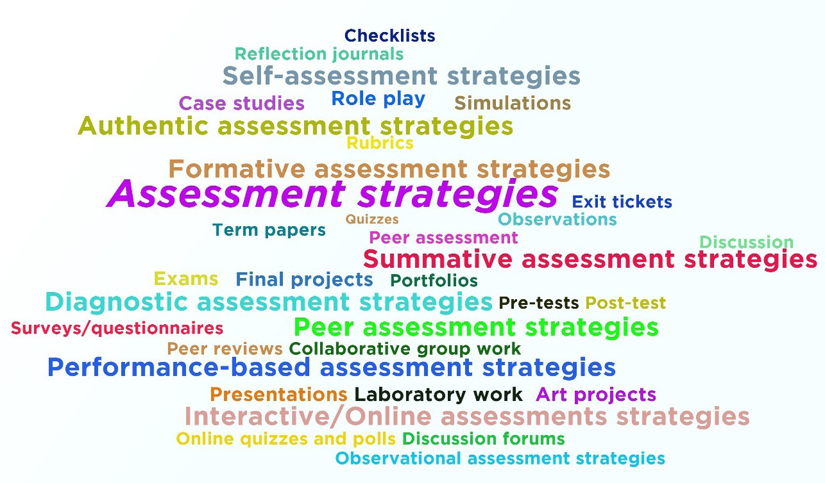 Assessment strategies refer to various methods and tools teachers use to gather information about students’ learning progress. These strategies help determine how well students understand the material and achieve instructional objectives. There are different approaches to assessment, and the best strategies often combine multiple methods to get a fuller picture of student learning.
4.1. Formative assessment strategies
Formative assessment is used during the learning process to monitor student progress and provide ongoing feedback. Examples of strategies:
- Quizzes: Short, frequent quizzes on the material can help both teachers and students identify areas where more focus is needed.
- Exit tickets: At the end of the lesson, students write a quick summary or answer a question on what they learned. This helps teachers gauge whether the students grasped the key concepts.
- Peer assessment: Students assess each other’s work based on given criteria, helping them think critically and engage with the learning material.
- Observations: Teachers can assess student behavior and performance in class through direct observation, noting participation, collaboration, and engagement.
- Discussion: Informal discussions or group work can serve as a form of assessment. Teachers can listen to students’ contributions to gauge understanding.
4.2. Summative assessment strategies
This type of assessment is conducted at the end of a learning unit or subject/ module to evaluate overall student performance. Examples of strategies:
- Exams: A traditional method that tests students’ knowledge on a wide range of topics covered during the subject or module.
- Final projects: Projects or presentations at the end of a unit or subject, module that showcase students’ understanding of a topic.
- Term papers: A written assignment requiring students to demonstrate comprehensive knowledge on a subject.
- Portfolios: A collection of students’ overtime work, which can include drafts, revisions, and final products, allowing for assessment of both the final outcome and the learning process.
4.3. Diagnostic assessment strategies
Diagnostic assessment is used before teaching begins to identify students’ existing knowledge and skills, helping to tailor instruction to meet their needs. Examples of diagnostic assessment strategies:
- Pre-tests: A test administered before starting a unit to measure what students already know about the subject.
- Post-test: assess the gains in knowledge or skills that students have made as a result of the instruction. It helps determine if the students have understood and can apply the material taught during the learning period.
- Surveys/questionnaires: These can help identify students’ interests, learning preferences, and prior knowledge.
4.4. Authentic assessment strategies
They measure students’ ability to apply learned skills and knowledge in real- world situations. Examples:
- Case studies: Students analyze real-life scenarios, solving problems based on what they’ve learned.
- Role play: Students act out real-world situations that require the use of learned knowledge, like acting a historical event or practicing a job- related task.
- Simulations: These can be computer-based or real-world. In science, students could use a virtual lab to simulate chemical reactions that are too dangerous or costly to conduct in a real lab. In geography, learners might use GIS (Geographic Information System) software to simulate the impact of natural disasters on human settlements.
4.5. Self-assessment strategies
This allows students to reflect on their own learning and progress, encouraging
them to take ownership of their education. Examples of strategies:
- Reflection journals: Students regularly write in journals to reflect on their learning, set goals, and assess their progress.
- Checklists: Students use checklists to evaluate their own work based on set criteria.
- Rubrics: Students use rubrics to self-assess their projects or assignments, checking if they meet the specific criteria.
4.6. Peer assessment strategies
Peer assessment encourages students to evaluate each other’s work. It promotes collaborative learning and critical thinking. Examples:
- Peer reviews: Students review each other’s essays, projects, or presentations, providing constructive feedback.
- Collaborative group work: Peers assess each other’s contributions to a group project, often via peer evaluations.
4.7. Performance-based assessment strategies
Involves students demonstrating their learning through active performance, usually in the form of practical tasks or activities. Examples:
- Presentations: Students create and deliver a presentation to demonstrate understanding and mastery of a topic.
- Laboratory work: In science, students may perform experiments and be assessed on both the process and outcome.
- Art projects: In the arts, students may be tasked with creating something that showcases their skill, like a painting or a musical performance.
4.8. Interactive/Online assessments strategies
With the advent of technology, many teachers use digital tools to assess students. Examples:
- Online quizzes and polls: Platforms like Kahoot, Quizlet, or Google Forms allow for instant feedback and easy tracking of student responses.
- Discussion forums: Students can engage in online discussions, which can be assessed for depth of analysis, engagement, and understanding of the topic.
4.9. Observational assessment strategies
Teachers observe and assess students’ progress and behavior in real-time. Examples:
- Behavior checklists: teachers monitor students’ participation and engagement during class activities, noting progress and behavior.
- Anecdotal records: teachers jot down brief notes about students’ performance, learning behaviors, and any significant interactions during lessons.
5. Importance of assessment in the teaching and learning process
Assessment plays a crucial role in education, serving a variety of functions that help stakeholders (learners, parents, educational authorities, institutions, and employers) throughout the teaching and learning process.
Guiding instruction:
Assessment helps teachers understand where students are in their learning. It provides valuable information about what students know, what they don’t yet understand, and what areas need more focus. This helps teachers tailor their instruction to meet the specific needs of their students. For instance, formative assessments (like quizzes or group discussions) give teachers
real-time data that can guide adjustments in teaching strategies, content delivery, or pacing. Summative assessments (like exams or final projects) give teachers a clear picture of how well students have grasped the overall content.
Improving student learning:
Assessment provides students with feedback on their progress, helping them understand their strengths and areas for improvement. When feedback is timely and constructive, it can motivate students to improve and guide them toward better learning strategies. For example, self-assessment and peer- assessment encourage students to reflect on their own learning, recognize their achievements, and identify areas that need work.
Motivating students:
When assessments are used effectively, they can motivate students to work harder and take ownership of their learning. Knowing that they will be assessed helps students stay focused and committed to their studies. Assessment for learning (formative assessments) encourages students to engage in continuous improvement rather than focusing solely on final grades. Clear expectations through rubrics and assessments allow students to see the criteria for success, which can motivate them to meet or exceed those standards.
Providing evidence of achievement:
Assessment provides concrete evidence of student achievement. It allows teachers, parents, and administrators to track students’ progress and understand whether learning objectives are being met. For instance, summative assessments give a snapshot of what students have achieved after a lesson, unit, or module. This evidence can be used for academic records, reporting to parents, or even determining whether students are ready to move to the next grade or level of study.
Supporting decision-making:
Assessment helps in making important educational decisions, both for individual students and for groups of students. This can include decisions about teaching methods, grouping students for specific interventions, or even determining whether students are ready to advance. For instance, diagnostic assessments at the start of a unit or course help teachers make decisions about the best approach for teaching the material. Summative assessments can inform decisions about graduation, retention, or certification.
Identifying gaps in knowledge and skills:
Assessment helps identify gaps in students’ understanding or skills. This is particularly important for both individual and group learning. Formative assessment helps pinpoint specific areas where students are struggling, allowing teachers to provide additional support or adjust teaching strategies. It ensures that students don’t just passively memorize content but truly understand the material and are able to apply it effectively.
Promoting accountability:
Assessment holds students accountable for their learning. It helps students understand that they are responsible for mastering content and improving their skills. Regular assessments encourage students to stay on track and reflect on their learning progress. Teachers and schools can use assessment data to evaluate their own effectiveness and make necessary adjustments to better support student achievement.
Informing educational policy and planning:
At a larger scale, assessment data can inform educational policies and help plan curricula, allocate resources, and make decisions about teaching practices. For instance, standardized tests and national assessments help policymakers track overall educational performance and make decisions about funding, resources, or curriculum changes. Local assessments allow schools and educators to identify trends, strengths, and areas that need improvement in their own communities.
Facilitating communication with stakeholders:
Assessment provides a way to communicate student progress to various stakeholders—parents, administrators, and even the students themselves. For example, parent-teacher meetings often use assessment data to discuss a student’s progress, achievements, and areas needing attention. Report cards and other formal assessments provide parents with clear, measurable data on their child’s academic progress.
Building confidence:
When students do well on assessments, it boosts their confidence and self-esteem. Achieving good results on assessments shows students that they are capable and reinforces a growth mindset. For example, regular positive feedback and successful assessments can motivate students to engage more deeply with their learning and set higher goals for themselves. Assessment for learning encourages a focus on progress and improvement, helping students see their learning as an ongoing process rather than just a final outcome.
6. Assessment principles
Activity:
As a future teacher, what will you take into consideration while designing different types of assessments?
6.1. Meaning of assessment principles
A. Assessment principles are the foundational guidelines or rules that govern how assessments should be designed, implemented, and interpreted to ensure fairness, effectiveness, and accuracy. These principles aim to improve both teaching and learning by ensuring that assessments are valid, reliable, and beneficial to all students.
6.2. Key principles of assessment:
- Validity: Validity refers to the extent to which an assessment measures what it is intended to measure. An assessment is valid only if it accurately reflects the learning objectives and content it is supposed to assess. Example of validity: A math test on algebra should not include questions unrelated to algebra, such as geometry or statistics.
- Reliability: Reliability refers to the consistency of the assessment results over time and across different groups of students. Reliable assessments produce stable and consistent results, meaning that if the test was repeated under similar conditions, it would yield the same results. Example: If two teachers grade the same essay, their scores should be similar if the assessment is reliable.
- Fairness: Fairness refers to the idea that assessments should be equitable and not favor any group or individual over another. Fair assessments provide all students, regardless of their background, with an equal opportunity to demonstrate their knowledge and skills. To be fair, a teacher has to avoid bias (cultural, gender, socioeconomic, etc.) in assessment design, providing accommodations for students with disabilities and ensuring that assessment methods are accessible to all learners. Example of fairness: A multiple-choice test should not include language that may be confusing or unfamiliar to students from diverse linguistic backgrounds.
- Transparency: Transparency means that the assessment criteria, purpose, objectives and process are clear to students. When students understand what is expected of them, they are more likely to perform well and feel confident in their ability to succeed. Marking rubrics or marking criteria should be detailed so that students know how their work will be evaluated. Example of transparency: A teacher gives students rubric outlining the expectations for activity given, so students know exactly what aspects of their work will be assessed (e.g., creativity, accuracy, or presentation).
- Inclusivity: Inclusivity refers to ensuring that assessments accommodate the diverse needs of all learners, including students with disabilities, different learning styles, and varied levels of preparedness. Inclusive assessments allow all students to demonstrate their learning, ensuring that no one is unfairly disadvantaged by the assessment process. The teacher can provide alternative assessment methods (e.g., oral presentations for students who struggle with written tasks) or adjusting time limits for students with specific learning needs. Example of inclusivity: A student with dyslexia may be given extra time on a reading comprehension test.
- Feedback: Feedback is the information provided to students about their performance, indicating strengths and areas for improvement. Effective feedback helps students understand their progress and learn from their mistakes, guiding future learning. Effective feedback should be: Timely: Provided soon after the assessment to allow for reflection and improvement. Constructive: Focuses on specific actions students can take to improve. Actionable: Provides clear suggestions for how students can address weaknesses. Example of feedback: After a quiz, a teacher provides individual feedback pointing out common mistakes and offering resources for further study.
- Authenticity: refers to the relevance of an assessment to real-world contexts, making the assessment tasks meaningful and applicable to students’ lives or future careers. The teacher can use real-life scenarios or practical tasks that require problem-solving and critical thinking and encourage the application of knowledge in relevant contexts. Authentic assessments motivate students by demonstrating how their learning applies outside of the classroom, thus fostering deeper engagement. Example of authenticity: In a science class, instead of just testing theoretical knowledge, a teacher might have students conduct experiments to solve a real-world problem (e.g., designing a water filtration system).
- Purposefulness: Every assessment should have a clear purpose, whether it is to measure learning, inform instruction, or support accountability. The teacher decides whether the assessment is formative (providing feedback for improvement) or summative (measuring overall achievement) and aligns assessment design with the course’s learning outcomes or objectives. Example of purposefulness: A final exam in a history class should focus on evaluating the key historical concepts and events taught throughout the course, ensuring that the assessment matches the learning objectives.
- Sustainability: refers to designing assessments that are practical and manageable for both students and teachers, without overloading them. An overburdened system of assessment can lead to fatigue, stress, or a diminished quality of learning. Assessments should be realistic in terms of time, resources, and expectations. The teacher has to balance the number of assessments with the available time for preparation and feedback and designing assessments that are feasible for both students and teachers. Teachers of sustainability: A teacher might choose to assign a series of smaller projects or quizzes rather than one large, high-stakes exam to allow students to pace their learning.
7. Types of assessment questions
Activity:
Read the following assessment questions and identify the type of question used in each case.
|
Question |
Type of Assessment Question |
|
1. Define democracy. |
__________ |
|
2. Rwanda gained independence in: A. 1959 B. 1962 C. 1994 D. 2000 |
__________ |
|
3. Match the leaders in Column A with their countries in Column B. |
__________ |
|
4. Explain two causes of conflict in society. |
__________ |
|
5. True or False: Assessment is the same as evaluation. |
__________ |
|
6. Fill in the blank: The process of collecting information about learning is called __________. |
__________ |
Assessment questions come in various types, each serving a specific purpose in evaluating students’ knowledge, skills, and values. These different types of questions help assess different levels of learning, from simple recall of facts to more complex types of information. Assessment questions are divided into two many categories: Closed- ended questions and open-ended questions and they may be oral or written.
7.1. Closed-ended questions or objective assessment items
Closed-ended questions provide a limited set of possible answers, usually requiring a simple, direct response. They have predetermined or predefined answers for respondents to choose from the one that best fits. Types of closed-ended questions include the following:
i. Yes/No questions
Yes/No questions are framed as interrogative sentences that require the respondent to choose between “Yes” or “No”. They are useful for gathering simple facts or confirming information. Example: Answer by Yes or No. Is the capital of Italy Rome? Answer: Yes.
ii. True/False questions
True/false questions are declarative statements that require learners to determine whether the statement is true or false. These questions test basic knowledge and understanding. They assess students’ ability to recognize correct information quickly. Example: Answer by True or False. Rwanda is a landlocked country. Answer: True.
iii. Multiple-Choice Questions (MCQs)
A Multiple-Choice Question consists of a question or incomplete statement (called the stem) followed by several possible answers called options, typically including one correct answer and several distractors (incorrect or less appropriate options). Normally the suggested number of answers does not exceed five and not below four. The learner is requested to choose either the correct answer or the wrong one. They are useful for assessing knowledge, comprehension, and sometimes higher order thinking skills, depending on the quality of the questions.
Example: Which of the following is the largest planet in our solar system?
A. Earth B. Mars C. Jupiter D. Saturn Answer: C. Jupiter
iv. Matching questions/items
Matching questions/ items require learners to pair items in one column with related items in another column based on a specific relationship (such as definitions, examples, causes, dates, or functions). Matching questions are structured in the following way:
- Instructions: A clear direction that tells students what the relationship is and how to match the items (e.g., Match the following terms with their correct definitions).
- Premises (Column A): A list of items such as terms, events, or questions.
- Responses (Column B): A list of possible matches, such as definitions, descriptions, or corresponding answers.
Matching questions/ items are efficient for assessing multiple pieces of information. They are efficient for testing a large amount of related information and are useful for assessing recall, association/relationships, and comprehension.
Example: Match the following countries (Column A) with their capitals (Column B).
|
Column A: Country |
Column B: Capital |
|
1. France |
A.Tokyo |
|
2. Japan |
B. Paris |
|
3. Canada |
C. Nairobi |
|
4. Australia |
D. Ottawa |
|
5. Kenya |
E. Canberra |
|
|
F. Kampala |
Answers:
1 → B. Paris
2 → A. Tokyo
3 → D. Ottawa
4 → E. Canberra
5 → C. Nairobi
Advantages of closed-ended questions
- They are efficient: They are easier and faster to answer, making them suitable for surveys or quick assessments. Learners respond quickly because answers are already provided or limited.
- Responses are simple to quantify and analyze statistically, which makes them ideal for large-scale data collection.
- They guide and help the learner to remember
- The teacher sets the marking scheme easily
- They require little time to mark: Teachers can mark them objectively and quickly.
- They are more objective because the number of answers is precise and limited, predefined, precise and limited, they reduce bias in both answering and grading
- Suitable for large classes and examinations with many learners.
- Ensures uniformity: All learners respond to the same options, making comparison easier.
- Reliable for testing factual knowledge: Effective for checking recall, recognition, and understanding of facts.
- Reduces ambiguity: Answers are specific and standardized.
Disadvantages of closed-ended questions
- Limited depth: They do not allow for nuanced responses or explanations (answers that show careful thinking, detail, and a deep understanding), because they restrict the respondent to a set of options.
- Limit creativity and expression: Learners cannot explain ideas in their own words.
- Lack of detail: These questions do not allow the respondent to elaborate on their reasoning, feelings, or opinions.
- They do not develop learners’ communication skills like speaking, listening and writing skills
- They are difficult to set: Constructing good objective questions requires skill and time.
- Encourage guessing: Learners may choose correct answers by chance. They favor random answers
- Do not measure deep understanding well: Difficult to assess reasoning and critical thinking fully.
- May encourage memorization: Learners may focus only on recalling facts.
7.2. Open-ended questions/ subjective assessment questions
Open-ended questions allow learners to answer in their own words, offering a broader and more detailed response rather than choosing from predetermined options. They require more elaborate answers, encouraging students to think critically, explain reasoning, express opinions, or demonstrate deeper understanding. The number of answers for an open-ended question is not limited because it varies from one learner to the other and it depends on the question asked. Open-ended questions are recommended:
- To carry out a quick assessment as teaching is going on.
- To assess complex and difficult learning which needs to be summarized.
- To assess a portion of a wide course which needs to be summarized.
- To assess the learning objectives with high taxonomic level.
Open-ended questions are essential for assessing higher thinking skills, allowing learners to demonstrate not only what they know but also how they think and communicate. There are two types of open-ended questions: short answers and long answers questions.
A. Short-answer questions
Short-answer questions require students to provide brief, concise responses, typically ranging from a word or phrase to a few sentences. These questions are designed to assess the recall of facts, understanding of key concepts, or ability to summarize ideas without the need for extended writing. Examples: What is photosynthesis? What is the capital city of Rwanda? Name two causes of environmental degradation.
Fill-in-the-blank questions are also a type of short answer question: Students complete a sentence or statement with the correct word or phrase. Example: The capital of Rwanda is ..
B. Long answer questions
They require long answers often formulated as follows: What do you think about...? Tell me about...? Discuss...; What is your opinion about...? etc.
Types of long answer questions
- Essay questions: Students provide a detailed, structured written response to a question, typically involving analysis, interpretation, or argumentation. They test deep understanding, critical thinking, and the ability to communicate complex ideas. They allow for in-depth exploration of topics; evaluates higher-order thinking. Example: Discuss the impact of climate change on global agriculture and propose potential solutions. Answer: (Student’s detailed, well- organized response).
- Problem-solving questions: Students are asked to solve a practical problem or a scenario using knowledge, reasoning, calculation, etc. and ask the respondent to propose a solution. They test creativity, critical thinking, and problem-solving abilities. These questions assess the ability to apply concepts to real-world situations. They test application of knowledge in practical contexts. Example: If a car travels 60 km per hour for 3 hours, how far does it travel? (Answer: the student does calculations and provides the answer).
- Performance-based questions: Students demonstrate their knowledge and skills through a task or activity rather than through traditional written responses. The questions assess practical application, creativity, and skills in action. They are more authentic and reflective of real-world tasks. Example: Perform a science experiment to test the reaction between baking soda and vinegar and explain the results. Answer: (Student demonstrates and explains the experiment results).
- Case study questions: Students analyze a specific situation, problem, or case and provide a response based on their understanding of the material. These questions assess critical thinking, problem-solving, and application of knowledge. They encourage deep analysis and the application of concepts to real-world scenarios. Example: Given a case study on a business facing financial challenges, suggest strategies for improving its financial position. Answer: (Student provides a detailed response with analysis).
- Diagram or labeling questions: Students are given a diagram (e.g., body part, machine, or process) and asked to label parts or describe components. They assess recognition, recall, and understanding of visual concepts. They are useful for subjects like biology, engineering, or geography. Example: Label the parts of the plant in the diagram (Labels might include root, stem, leaf, etc.).
Disadvantages of open-ended questions
- Time-consuming to answer: Open-ended questions often require lengthy, detailed responses, which can be challenging for students under time constraints during tests or exams.
- Difficult to mark objectively: Scoring open-ended responses can be subjective and inconsistent, especially if clear rubrics are not used. This may lead to bias or variation in grading.
- They are not always easy to mark, since student responses may vary widely in depth, organization, and interpretation. This requires the teacher to develop clear marking criteria or rubrics to ensure fairness and consistency in evaluation
- Require strong language skills: Students with limited writing or language proficiency may struggle to express their understanding effectively, even if they know the content well.
- Increased teacher workload: Evaluating open-ended answers takes significantly more time and effort compared to marking closed-ended or multiple-choice questions.
- Risk of off-topic responses: Without clear guidance, students may misinterpret the question or provide responses that stray from the intended focus, making it harder to assess learning accurately.
- May discourage some learners: Some students may feel overwhelmed or anxious when faced with open-ended tasks, particularly if they lack confidence in their ability to structure responses.
- Limited use in large-scale testing: In standardized or large-scale assessments, open-ended questions are less practical due to the time and resources required for grading.
- It is not easy to set the marking scheme
- The validity of the contents can be neglected since the number of questions is very limited.
7.3. Oral assessments
An oral assessment is a type of open-ended question in which a student is asked to verbally respond to questions or present information. It is often used to assess a student’s knowledge, communication skills, critical thinking, and ability to articulate their understanding of a subject in real time.
i. Types of oral assessments
- Question-and-answer sessions: The examiner asks the student a series of questions, and the student responds verbally. These sessions test the student’s recall, understanding, and ability to explain concepts in their own words. Example: A student might be asked about key concepts in a history exam, such as Can you explain the significance of the Industrial Revolution?
- Presentations: The student is asked to present a specific topic, which could be related to course content or a research project, to an examiner or panel. This type of oral exam assesses the student’s ability to organize and present information clearly and coherently. Example: A student may present on a scientific discovery, explaining its background, findings, and implications.
- Viva voce (or oral defence): This is often used in higher education, where students defend their thesis or research findings in front of an examiner or a panel. Oral defence tests the depth of a student’s research, understanding of their topic, and ability to engage in critical discussion. Example: In a PhD defence, the candidate might be asked detailed questions about their research methodology, data analysis, and conclusions.
- Role-play or simulation: The student is given a hypothetical situation (often related to their field of study) and asked to respond or act as though they are in that scenario. Role plays test a student’s ability to apply knowledge in real-world or practical situations. Example: A medical student might simulate a patient consultation, where they explain a diagnosis and treatment options to a patient.
- ii. Advantages of oral examinations
- Assesses communication skills: Oral exams allow teachers to assess not only students’ knowledge but also their ability to communicate clearly, and express ideas effectively (verbal expression, clarity of thought, and ability to articulate ideas) which are important skills beyond written knowledge.
- Immediate interaction: The examiner can engage in dialogue with the student, ask follow-up questions and clarify answers in real time, providing a deeper understanding of the student’s knowledge and deeper exploration of topics.
- Immediate feedback: Students often receive immediate feedback from the examiner, which can be constructive and guide their learning.
- Adaptability: Examiners can adjust the difficulty or direction of questions based on the student’s responses, tailoring the assessment to individual ability levels.
- Reduce memorization: Unlike written exams, which may focus on rote memorization, oral exams allow students to demonstrate their understanding and reasoning processes.
- Test Higher-Order Thinking: Oral exams encourage students to think critically and respond in real-time, making them suitable for testing analysis, synthesis, and application of knowledge.
- Encourage critical thinking: Students must think on their feet and demonstrate understanding rather than just recalling memorized answers.
- Reduce cheating: Since the interaction is direct and spontaneous, it’s harder for students to cheat compared to written exams.
iii. Disadvantages of oral examinations
- Subjectivity in grading: Scoring may vary depending on the examiner’s judgment, potentially leading to inconsistent or biased results. It depends on the examiner’s interpretation of the student’s responses. Besides, Examiners might unintentionally favor students with better verbal communication skills, which may not always correlate with their actual understanding of the content (potential for bias).
- Anxiety and nervousness: Some students may perform poorly due to stress or fear of speaking, which may not accurately reflect their knowledge.
- Time-consuming: Oral exams take more time per student compared to written tests, making them less practical for large groups.
- Limited scope: It may be difficult to cover a wide range of content within the limited time of an oral exam.
- Resource intensive: Requires a quiet, private setting and skilled examiners, which may be challenging to organize regularly.