Unit 4 Gender responsive and inclusive pedagogy
| Site: | UR - Elearning Platform |
| Course: | CE80241: Theories and practices of Teaching and Learning |
| Book: | Unit 4 Gender responsive and inclusive pedagogy |
| Printed by: | Guest user |
| Date: | Wednesday, 21 October 2026, 3:59 AM |
Description
Dear student,
Kindly take your time and engage with the learning materials of this unit 7
Table of contents
- 1. Introduction
- 2. Gender responsive pedagogy
- 3. Key concepts related to gender
- 4. Gender-responsive pedagogy
- 5. Inclusive pedagogy
- 6. Categories of learners with special educational needs
- 7. Categories of learners with SEN
- 7.1. Learners with visual difficulties
- 7.2. Learners with hearing impairment
- 7.3. Learners with physical disabilities
- 7.4. Learners with specific learning difficulties
- 7.5. Learners with Dyslexia
- 7.6. Learners with discalculia
- 7.7. Learners with dysgraphia
- 7.8. Learners with Dyspraxia
- 7.9. Learners with Dysphasia, or Aphasia
- 7.10. Learners with Autism Spectrum Disorder
- 7.11. Gifted and talented learners
- 8. Core principles of gender-responsive and inclusive pedagogy
- 9. Benefits of gender-responsive and inclusive pedagogy
- 10. Challenges to implementing gender-responsive and inclusive pedagogy
- 11. Conclusion
- 12. Gender-Responsive and Inclusive Pedagogy in Rwanda
1. Introduction
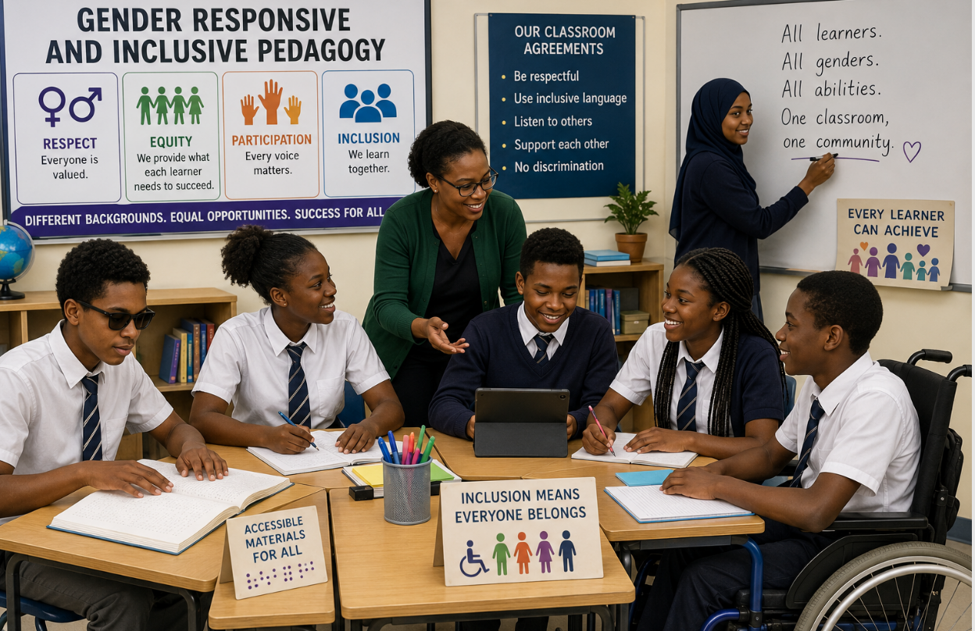 Gender responsive and inclusive pedagogy refers to teaching approaches that ensure all learners, regardless of gender, ability, background, or social status, are treated fairly and given equal opportunities to participate and succeed in learning. This unit helps you understand how you can create a safe, equitable, supportive, and non-discriminatory learning environment that meets the needs of every student. It introduces key gender-related concepts and how they can be applied in schools to address bias and promote equality. It also explores the principles of inclusive pedagogy, the characteristics and support of learners with special educational needs, the principles, strategies, and barriers to gender responsive and inclusive pedagogy with a focus to the case of Rwanda.
2. Gender responsive pedagogy
Activity: Understanding gender concepts in school
Instructions
Read each school situation carefully and identify the gender concept it represents from the list below.
Concepts
- Gender equity
- Gender stereotype
- Gender awareness
- Gender blindness
- Gender sensitivity
- Gender equality
- Gender balance
Situations
- A teacher ensures that both boys and girls are equally represented in the student leadership committee.
- During class discussions, the teacher notices that girls are quieter and intentionally encourages them to participate more.
- The school assumes that all learners have the same needs and ignores challenges faced by girls during menstruation.
- Boys are always chosen to carry equipment because people believe girls are weak.
- A school provides additional support to pregnant learners so they can continue their studies successfully.
- In a science club, the number of boys and girls participating is nearly equal.
- Teachers receive training on how to avoid discrimination and use inclusive language in class.
Follow-up questions
- Which situations promote fairness and inclusion in schools?
- Which situations may negatively affect learners? Explain briefly.
- Why is it important for teachers to understand gender-related concepts?
3. Key concepts related to gender
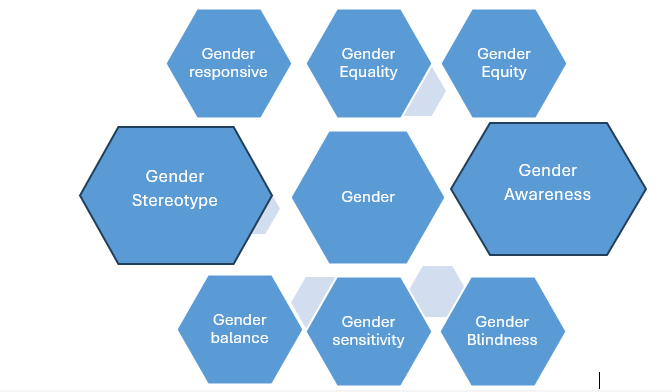
Key concepts to be discussed include gender, gender equality, gender equity, gender awareness, gender blindness, gender sensitivity, gender stereotypes, gender balance and gender responsive.
3.1. Gender
Gender refers to the socially and culturally constructed roles, responsibilities, behaviors, norms, expectations, and stereotypes that are believed to belong to women and men in a given society. These expectations and roles are learned and can change over time and vary within and between cultures. Some examples of gender characteristics, in most of the world, women do more housework than men. In education, more girls study social sciences than science subjects.
3.2. Gender equality
Gender equality refers to the state in which people of all genders (women, men, boys, and girls, everyone, regardless of their gender identity) have equal rights, responsibilities, opportunities, and access to resources. It focuses on treating everyone the same, regardless of their gender, to ensure that they can enjoy the same benefits and opportunities in areas such as education, employment, health care, political participation, etc.
Gender equality is a state where all individuals have equal conditions for realizing their full human rights and for contributing to, and benefiting from, economic, social, cultural, and political development. It is based on women and men being full partners in their home, their community, and their society. Equality does not mean that women and men will become the same but that women’s and men’s rights, responsibilities and opportunities will not depend on whether they are born male or female and implies that the interests, needs and priorities of both women and men are taken into consideration, recognizing the diversity of different groups of women and men.
Gender equality in schools
Gender equality in schools refers to ensuring that all students, regardless of their gender, have the same opportunities to succeed, participate, and access resources in the educational environment. It involves creating a school culture where both boys and girls, as well as non-binary students, are treated equally and are not subjected to discrimination, stereotypes, or bias based on their gender.
This includes:
· Equal access to education: Every student should have the same opportunities to learn, whether in terms of subjects, extracurricular activities, or resources.
· Fair treatment: Gender equality in schools means challenging gender stereotypes and biases in teaching practices, classroom interactions, and school policies, ensuring that no student is disadvantaged because of their gender.
· Supportive environment: Schools should offer a safe space where all students feel respected and valued, free from gender-based bullying, harassment, or violence.
· Encouraging participation: Encouraging both boys and girls to participate in all academic fields, such as STEM (science, technology, engineering, and mathematics), and leadership roles, breaking down traditional gender roles.
3.3. Gender equity
Gender equity is the process of being fair to men and women (treating them in a way that is right or reasonable). It basically involves putting in place measures aimed at compensating for the historical and social disadvantages that prevent women and men from operating on the same level. A typical example of a gender equity measure can be found under article 10 of the Constitution of the Republic of Rwanda which provides as one of the fundamental principles of the Rwanda State, ensuring that women occupy of at least thirty percent (30%) of positions in decision-making organs.
Gender equity in schools
Gender equity in schools involves recognizing that different students may have different needs, experiences, and challenges based on their gender, and taking steps to provide tailored support to ensure fairness and equal opportunities for all students. In the context of schools, gender equity may involve:
- Targeted support for disadvantaged genders: For example, if girls are underrepresented in STEM subjects, schools may provide extra encouragement or mentorship programs to support their participation and success in these fields.
- Addressing gender-based barriers: Recognizing that some students may face specific obstacles based on their gender, such as unequal access to extracurricular activities, or gender-based bullying, and taking steps to reduce these barriers.
- Inclusive curricula and teaching practices: Ensuring that teaching materials, methods, and classroom activities do not perpetuate gender stereotypes and instead promote inclusivity and fairness for all genders.
- Safe and supportive environments: Creating a school culture where students feel free to express their gender identity without fear of discrimination or harassment, such as providing gender-neutral bathrooms or supporting students with diverse gender identities.
Gender equity challenges in schools
Examples of gender equity challenges in schools:
• Young girls who drop out of school take care of their young siblings.
• Young girls who drop out of school become nannies.
• Young girls who are not allowed to participate in school clubs like their brothers because of being busy with domestic chores.
• Young girls who are absent from school because there are no hygienic facilities.
• Girls being involved in sweeping while boys are playing or reading story books.
• Boys who drop out from school and perform child labour such as making bricks, mining, keeping animals etc.
• Social norms that boys are better at maths and science than girls.
• Girls are viewed as temporary residents in the parental home so returns on education will be enjoyed by the husband’s family.
3.4. Gender awareness
Gender awareness refers to knowing that men, women, boys and girls have different roles, responsibilities and needs. It refers to the understanding and recognition of the social, cultural, and historical factors that influence gender roles and relationships. It involves being aware of how gender impacts individuals' experiences, behaviors, opportunities, and challenges.
Gender awareness in schools
Gender awareness in schools refers to understanding and acknowledging the diverse gender identities and roles students may have. It involves recognizing how gender impacts students’ experiences, interactions, and educational outcomes. Gender awareness in schools is characterized by the following:
- Equal participation in class: Teachers encourage both boys and girls to answer questions, lead discussions, and participate in activities equally.
- Gender-inclusive teaching materials: Textbooks and examples show both men and women in different professions and leadership roles.
- Avoiding gender stereotypes: Teachers avoid statements like “boys are better at science” or “girls are better at cooking.”
- Equal access to subjects and activities: All learners are encouraged to study science, technology, sports, arts, and leadership regardless of gender.
- Fair distribution of responsibilities: Classroom duties such as cleaning, carrying materials, or leading groups are shared fairly among learners.
- Preventing gender-based bullying and discrimination: Schools create rules and awareness programs to stop teasing, harassment, or unfair treatment based on gender.
- Providing safe and supportive facilities: Schools ensure separate and safe toilets, menstrual hygiene support, and accessibility for all learners.
- Training teachers on gender sensitivity: Teachers receive training on how to use inclusive language and treat all learners fairly.
- Encouraging leadership opportunities: Both girls and boys are given equal chances to become class leaders, prefects, or club presidents.
- Including discussions on gender equality: Lessons and school clubs discuss respect, equality, human rights, and shared responsibilities between genders.
3.5. Gender blindness
Gender blindness refers to the inability to perceive that there are different gender roles, need, responsibilities of men, women, boys and girls, and as a result failure to realize that policies, programmes and projects can have different impact on men, women, boys and girls. Gender blindness is the lack of recognition or acknowledgment of the differences between genders, often leading to the assumption that treating everyone the same will result in equality. Gender blindness can overlook the unique challenges and needs of individuals based on their gender, leading to unintended disparities. It is essentially failure to consider the impact of gender on people's lives, which can perpetuate existing inequalities.
Gender blindness in schools
It refers to ignoring or being unaware of the different needs and challenges that students face based on their gender. In a gender-blind environment, students may be treated identically, regardless of the unique barriers they may face due to their gender identity. For example, this could result in overlooking the fact that girls might face obstacles in participating in STEM (science, technology, engineering, and math) activities, or that boys might be discouraged from pursuing traditionally feminine interests like the arts.
Examples of gender blindness in schools include situations where gender differences, needs, or inequalities are ignored, leading to unfair treatment or unequal opportunities:
- Using teaching examples that favor one gender: Textbooks showing only men as scientists or leaders and women only as caregivers.
- Ignoring participation imbalance: Teachers allowing boys to dominate discussions while not encouraging girls to speak.
- Giving the same responsibilities based on stereotypes: Asking girls to clean classrooms while boys carry heavy items without questioning the practice.
- Lack of support for menstrual hygiene: Schools not providing facilities or understanding for girls during menstruation.
- Discouraging certain subjects by gender: like saying boys should take science and girls should take arts or home economics.
- Ignoring gender-based bullying or harassment: Treating teasing or discrimination as “normal behavior” instead of addressing it.
- Unequal access to sports and leadership: Providing more sports opportunities or leadership roles to one gender.
- Using non-inclusive language: Referring to all learners as “boys” or assuming only males can hold certain roles.
- Failure to consider safety needs: Not addressing safety concerns that may affect girls or boys differently.
- Assuming all learners have the same experiences: Teaching without recognizing that social expectations and challenges may differ by gender.
3.6. Gender sensitivity
It is the opposite of gender blindness. Gender sensitivity is the awareness and understanding of the different needs, roles, and experiences of people based on their gender. It involves recognizing gender disparities and responding to them thoughtfully in ways that promote fairness and respect. Gender-sensitive practices in education, the workplace, or other environments seek to avoid reinforcing stereotypes and create a more inclusive, equitable atmosphere for all genders. It is considering the impact of policies, projects and programmes on men, women, boys and girls and trying to mitigate the negative consequences thereof. It is about recognizing different needs of women, men, boys and girls and acknowledges gender power dynamics but does not necessarily address these other than to try and integrate an understanding of these dynamics within programme design.
Gender sensitivity in schools
It is the recognition and understanding of gender-based differences and the effort to address these disparities with care. It involves being aware of how gender inequality can manifest in schools and actively working to create fair and respectful environments. Gender-sensitive schools create policies and practices that support all genders and are mindful of issues like sexual harassment, gender bias in teaching, and unequal access to resources.
3.7. Gender balance
Gender balance refers to the equal representation or participation of different genders in a particular context, such as in a classroom, workforce, or leadership roles. Achieving gender balance means ensuring that both men and women (and people of all gender identities) have an equal presence and opportunity to contribute, without domination or exclusion of one gender.
Gender balance in schools
Gender balance in schools refers to the fair and equal representation of all genders in various aspects of the educational environment, including participation in academic subjects, extracurricular activities, leadership roles, and classroom dynamics. It is about ensuring that every student, no matter what their gender, has the opportunity to participate fully in all aspects of school life, breaking down gender barriers and promoting fairness and equity in education. Achieving gender balance means ensuring that no gender dominates or is excluded from opportunities, and that all students, whether male, female, non-binary, or gender-diverse, are equally supported in their academic, social, and personal development. For instance,
- Ensuring that students of all genders have equal opportunities to pursue and excel in subjects that are traditionally gendered, like encouraging girls to take STEM (science, technology, engineering, and mathematics) courses and supporting boys in pursuing the arts, humanities, and social sciences.
- Providing equal opportunities for students of all genders to take on leadership roles in the classroom, school government, clubs, and sports teams. Gender balance in leadership ensures that no gender is systematically underrepresented in decision-making processes.
- Promoting equal access to extracurricular activities, such as sports, drama, debate clubs, and student councils.
- Encouraging all genders to participate in a wide variety of activities helps to break down gender stereotypes and ensures diverse involvement.
- Inclusive teaching and learning practices: being aware of and actively preventing gender biases in their classroom interactions and teaching methods. Gender-balanced classrooms ensure that all students feel equally encouraged, supported, and valued, regardless of their gender.
- Confronting and challenging harmful stereotypes that may influence how students perceive their abilities or interests. For example, if a classroom only encourages boys to take leadership roles, or girls are always expected to assist with caregiving roles, these practices should be restructured to promote more equitable involvement from all genders.
- Fostering an inclusive school environment where all students, regardless of gender, feel safe, respected, and free from discrimination or harassment. Schools need to be spaces where students can express their gender identity without fear of judgment.
3.8. Gender stereotypes
Gender stereotypes are preconceived ideas or generalized beliefs about the characteristics, behaviors, roles, and attributes that are considered appropriate for individuals based on their gender. These stereotypes are often rooted in traditional and cultural norms and can limit the way individuals express themselves or pursue opportunities.
For example:
- Boys might be stereotyped as being strong, aggressive, or interested in activities like sports and technology.
- Girls might be stereotyped as being nurturing, emotional, or interested in activities like arts and caregiving.
These stereotypes can influence how people view themselves and others, affecting their choices, behaviors, and opportunities.
Gender stereotypes in schools
Gender stereotypes in schools are preconceived expectations about how boys and girls should behave, look, or think based on their gender. In schools, gender stereotypes can manifest in a variety of ways, such as:
- Academic stereotypes: The belief that boys are naturally better at math or science, while girls are better at subjects like literature or languages. This stereotype can lead to gender biases in classroom interactions and discourage students from pursuing subjects they are interested in or capable of excelling in.
- Behavioral expectations: Boys may be expected to be assertive, competitive, and outgoing, while girls might be expected to be quiet, nurturing, and cooperative. These expectations can restrict students' behavior, stifle self-expression, and lead to gender-based bullying or exclusion.
- Career stereotypes: Certain professions or careers are often seen as “appropriate” for specific genders. For instance, boys may be encouraged to pursue engineering or technology careers, while girls might be steered toward healthcare, teaching, or caregiving roles. These stereotypes limit the scope of career aspirations and opportunities for students, perpetuating gender inequality in various fields.
- Social and cultural roles: Girls might be expected to take on more domestic or caregiving roles, such as cleaning, cooking, or looking after younger siblings, while boys may be pushed toward more public or leadership roles. These roles can reinforce traditional family dynamics and restrict the personal growth of both boys and girls.
Teachers and school leaders can reinforce gender stereotypes in other ways during teaching and learning:
Teachers and school leaders can reinforce gender stereotypes in other ways during teaching and learning:
- Asking more difficult questions to boys.
- Asking more questions to boys.
- Have higher expectations for boys than for girls
- Giving more opportunities to boys to solve problems at the blackboard
- Believing that boys are more able to do math and science than girls.
- Using examples that are more appealing to boys than to girls
Impact of gender stereotypes on learners:
- Limited opportunities: Students may be less likely to pursue their interests and talents if they believe they are not "supposed" to do something because of their gender. For example, a boy who loves dance might avoid pursuing it because he fears it’s “not masculine.”
- Low self-esteem: Constant exposure to gender stereotypes can lead students to feel inadequate or insecure if they do not meet societal expectations of their gender. This may result in anxiety, stress, or a lack of confidence in certain areas.
- Perpetuation of inequality: Gender stereotypes often contribute to the ongoing societal inequality between men, women, and non-binary individuals. For example, the stereotype that women are not suited for leadership positions leads to a lack of female representation in political or corporate leadership roles.
- Reinforcement of traditional gender roles: These stereotypes promote the idea that certain behaviors, careers, or activities are "appropriate" for one gender and "inappropriate" for another, leading to an ongoing cycle of traditional gender roles.
Overcoming gender stereotypes in schools
- Promote equal opportunities: Schools can ensure that all students have equal access to subjects, extracurricular activities, and leadership opportunities, regardless of their gender.
- Encourage diverse role models: Expose students to diverse role models of all genders who break traditional stereotypes, such as female scientists, male nurses, or non-binary athletes.
- Use inclusive language: Teachers and staff should be mindful of the language they use, avoiding gendered phrases that perpetuate stereotypes (e.g., "boys will be boys" or "girls are always so sensitive").
- Create an inclusive curriculum: Teaching materials should reflect diverse gender experiences and challenge traditional stereotypes by including diverse perspectives, stories, and examples.
- Foster critical thinking: Encourage students to question stereotypes and explore their own identities, interests, and aspirations without being confined by societal expectations.
3.9. Gender responsive
Gender responsive is about considering the specific needs and challenges faced by different genders and taking intentional steps to address them. In education, being gender-responsive means developing strategies, practices, and solutions that account for gender-related disparities. It involves creating environments, curricula, and initiatives that support gender equality and equity by adapting to the unique requirements of different genders.
4. Gender-responsive pedagogy
Activity: Write down:
1. Two challenges faced by boys at school or in class.
2. Two challenges faced by girls at school or in class.
3. How will you address those challenges?
4.1. Meaning of gender inclusive pedagogy
Gender responsive pedagogy means teaching in ways that ensure every learner has equal opportunities to learn, participate, and succeed regardless of gender. It aims to remove barriers that may disadvantage certain learners because of gender. It focuses on how teaching practices can be adapted to address and challenge gender inequalities in the classroom. It seeks to create learning environments that are sensitive to students' gender identities and experiences, ensuring equal access to educational opportunities for all students regardless of gender.
Gender responsive pedagogy recognizes and addresses different learning needs, interests, experiences, and challenges of learners of all genders in order to promote equal participation, inclusion, and achievement in education. It involves creating a classroom environment where boys and girls are treated fairly, gender stereotypes are avoided, teaching methods and materials are inclusive, and all learners are encouraged to participate confidently.
Gender inclusive pedagogy calls for teachers to take an integrated gender approach in the processes of lesson planning, teaching, class management and performance evaluation. The goal is to break down gender stereotypes, challenge societal norms, and foster an environment where both male and female students (and students of all gender identities) can thrive academically and socially.
4.2. Teaching strategies for gender responsive pedagogy
Teachers can use different teaching strategies for gender responsive pedagogy to ensure all learners, regardless of gender, participate equally, feel valued, and achieve their learning potential.
- Use of inclusive and gender sensitive language: Teachers should avoid using gendered language (e.g., “he” or “she” as generic pronouns), and stereotypes in examples. Instead use gender- neutral language. For example, referring to students as “they” or “students” instead of “boys” or “girls” helps to ensure that no one feels excluded based on gender (Petkova, 2024)
- Representation in learning materials: Ensure that teaching materials (books, images, videos, etc.) include diverse representations of all genders, roles, and identities. For instance, including stories or biographies of women in history, or showcasing male nurses and female scientists, can help students see beyond traditional gender roles. Use learning materials that show both men and women in diverse roles such as leaders, scientists, caregivers, and technicians. This helps learners develop fair perceptions of gender roles.
- Encourage critical thinking: Encourage students to critically analyze societal norms, stereotypes, and biases around gender and other social categories.
- Support gender diversity in collaborative learning: Group work is an opportunity for students to collaborate across gender lines. Teachers should ensure that all students are included and encouraged to contribute equally during group activities. When learners work in mixed-gender groups, they learn to respect each other, share responsibilities, and value different perspectives. The teacher ensures that roles within groups are fairly distributed rather than assigned based on gender assumptions.
- Provide safe channels for expression: In a gender-responsive classroom, students should feel comfortable sharing their experiences and perspectives. Offering anonymous feedback channels or opportunities for private conversations can give students the chance to express concerns about gender issues or harassment.
- Promote inclusive participation: teachers deliberately encourage both boys and girls to contribute during lessons by asking balanced questions and giving equal opportunities to speak. This helps reduce dominance by one gender and builds confidence for all learners.
- Applying fair classroom management practices, such as distributing tasks, leadership roles, and responsibilities equally among boys and girls. This prevents gender bias in participation and leadership development.
- Creating a safe and supportive classroom environment. Teachers should actively prevent gender-based bullying, challenge discriminatory remarks, and support learners who may face gender-related barriers, such as girls during menstruation or boys discouraged from certain subjects.
- Continuous reflection and assessment are also essential. Teachers should regularly review their own teaching practices to identify and correct any unconscious gender bias, ensuring that their methods remain inclusive and responsive.
- These strategies ensure that teaching promotes equity, respect, and equal learning opportunities for all genders.
Activity: Discuss the following classroom scenarios and answer the corresponding question
1. Scenario A: Boys in the class are often restless and disengaged during reading lessons.
2. Scenario B: Girls rarely participate in science experiments and hesitate to answer questions.
3. Scenario C: Some students feel excluded because certain classroom activities favor one gender’s interests.
Question:
UsUsing your knowledge of gender responsive pedagogy, propose at least three strategies you could use to address these challenges and create a more inclusive classroom.
5. Inclusive pedagogy
This section discusses key concepts of inclusion, categories of learners with special educational needs and how to support them.
5.1. Key concepts of Inclusion
Activity: Carefully read the situation below and answer the questions individually.
Situation
In a classroom, the teacher is teaching a lesson on climate. The class has:
- a learner who learns best through pictures and diagrams,
- a learner who understands better when concepts are explained orally,
- a learner who is shy and rarely speaks in class,
- a learner who has difficulty reading fast,
- and a learner who is very active and prefers group activities.
The teacher uses only one method: reading from the textbook and asking written questions.
Questions
- Do you think all learners in this class are able to learn effectively? Explain your answer.
- Which learners might face difficulties in this lesson? Why?
- If you were the teacher, what different methods would you use to help all learners understand the lesson?
- Why it is important for teachers to use different teaching methods in one class.
- What you think “inclusive pedagogy” means based on this activity.
5.2. Inclusive pedagogy
Students have different learning needs, and effective teaching must include strategies that help every learner succeed, which is the core idea of inclusive pedagogy. Inclusive pedagogy means teaching in a way that includes every learner and ensures no one is left behind. Inclusive pedagogy ensures all learners, regardless of their differences, have equal opportunities to participate, learn, and succeed in education.
It focuses on meeting the diverse needs of learners in one classroom, including differences in ability and disability, gender, language, learning pace, socio-economic background, and cultural identity. Inclusive pedagogy is based on the belief that every learner can learn, but they may need different forms of support.
Inclusive pedagogy involves designing and using teaching and learning methods, strategies and practices that accommodate the diverse needs of all students, including those from marginalized groups, regardless of their gender, ethnicity, ability, socio-economic status, or any other characteristics. It seeks to create learning environments where every student feels valued, respected, supported, and has equal opportunities to participate and succeed. Inclusive pedagogy focuses on removing barriers to learning and fostering an environment where every student can succeed. The main goal is to ensure that all students, regardless of their gender, ability, cultural background, or other factors, have equitable access to education and can engage fully with the curriculum and have equal opportunities to succeed academically by tailoring teaching to meet their diverse needs, strengths, and learning styles.
Inclusive pedagogy is more specific to what happens in the classroom. It refers to the teaching methods and strategies that teachers use to ensure that all learners are actively engaged, supported, and able to learn effectively within that inclusive system. It focuses on how teaching is adapted to meet diverse learning needs. Inclusive pedagogy is the classroom practice (teaching and learning level). For example, a teacher who uses group work, differentiated tasks, and varied teaching methods to support all learners is practicing inclusive pedagogy.
In inclusive pedagogy:
- Teachers adapt their teaching strategies to accommodate different learning styles and abilities. This could involve varying the content, process, or product of learning activities to meet individual needs (Differentiated instruction).
- Teachers design lessons that provide multiple means of representation (e.g., visuals, text, videos), engagement (e.g., hands-on activities, group work), and expression (e.g., oral presentations, written work) so that all students can participate and demonstrate their learning. Teachers makes sure, in their teaching approaches, methods, and strategies, that learning is accessible, and relevant, and engaging for all students. (Universal Design for Learning (UDL).
- Teachers create a classroom environment where students feel emotionally and socially supported. This involves building a culture of respect, addressing bullying, and providing opportunities for students to work together and learn from each other (Supportive learning environment).
- Teachers use strategies that encourage all students to actively engage in the learning process, including group discussions, hands-on activities, and problem-solving tasks. Teachers ensure that all students, regardless of their learning differences or personal characteristics, are actively engaged in learning (Active participation).
5.3. Inclusive education
Inclusive education is a broader educational policy and system approach that seeks to provide all students, regardless of their background, abilities, gender, or any other characteristic, with equal access to learning opportunities and resources. that seeks to provide all students, regardless of their background, abilities, gender, or any other characteristic, with equal access to learning opportunities and resources. It refers to the overall practice of ensuring that all learners, including those with different abilities, genders, languages, and backgrounds, are educated together in the same learning environment without discrimination. It focuses on access, participation, and removal of barriers within the entire education system, including school policies, infrastructure, curriculum, and support services.
Inclusive education aims to create an environment where all students, including those with disabilities, students from diverse cultural backgrounds, and students who face other barriers to learning, can fully participate in the academic, social, and extracurricular aspects of school life.
Inclusive education is about creating an educational system where every student has access to the same opportunities and can succeed according to their individual needs. It challenges traditional educational practices that often marginalize students who are different and instead focuses on creating a welcoming, supportive, and equitable environment for all learners. It benefits not just those who might traditionally be excluded from education but also enriches the educational experience for all students by promoting diversity, understanding, and mutual respect.
Inclusive education is the big picture (system and policy level), For example, a school that provides ramps, special needs support, and equal admission policies is practicing inclusive education.
Components of Inclusive Education
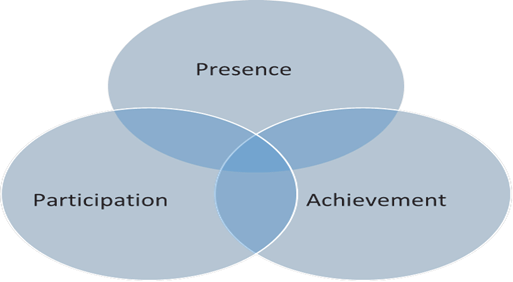
• Equal presence: making sure all learners are present in school. Teachers should be instructed to do daily attendance of the children disaggregated by sex. If there is an attendance issue specific to boys or girls, talk with individual parents or through SGA meetings
• Equal participation: Teachers should ensure that both girls and boys are participating actively and given chances to lead in classroom activities, classroom discussions, and different clubs.
• Equal achievement/ Performance: Parents, teachers and school leaders should ensure both boys and girls have equal opportunity to access learning materials and that there are not any achievement gaps. You may think it is too difficult to address the needs of a diverse range of children, as there are so many challenges.
Inclusive education is about treating all learners as individuals. It is about making sure that all learners can learn. When we think about inclusive education, often we just think about getting children into school, i.e. making sure they are present in school. However, we also need to ensure that children are participating in lessons and school life, and that they are achieving academically and socially because of coming to school.
Key differences between Inclusive Education and Inclusive Pedagogy
|
Criteria |
Inclusive education |
Inclusive pedagogy |
|
Scope |
Is the overarching system or framework that ensures all students have access to educational opportunities, support, and an inclusive environment.
Is the broad goal of making education accessible and equitable for all students, fostering an inclusive school culture.
|
refers specifically to the teaching practices and strategies used by teachers within that system to ensure that all students can learn effectively. Is the specific set of teaching strategies used to create inclusive learning experiences for all students within that system. |
|
Focus |
focuses on the policies, structures, and systems that create an inclusive learning environment. It includes physical access to the school, learning resources, support systems, and inclusive school culture.
|
is about the practical classroom teaching methods and strategies that teachers use to create inclusive, engaging, and supportive learning experiences for all students.
|
|
Implementation |
involves school-wide efforts to ensure all students, including those with disabilities, diverse backgrounds, and different needs, are included in the educational process.
|
is implemented by individual teachers who design and deliver lessons that meet the needs of a diverse group of learners within the classroom.
|
5.4. Special Education
Special Education refers to educational programs and services designed specifically to meet the needs of students with disabilities, learning difficulties, or exceptional abilities. This approach recognizes that some students require a different teaching method, environment, or support to access the curriculum effectively.
Key features of special education:
- Individualized instruction: Special education focuses on individualized instruction, tailoring teaching methods, strategies, and assessments to suit each student's unique learning needs. This often involves creating an Individualized Education Plan (IEP) that outlines specific educational goals and accommodations for the student.
- Specialized teachers and support: Special education teachers are trained to work with students who have a variety of disabilities, including physical disabilities, learning disabilities, emotional and behavioral disorders, autism, and intellectual disabilities. These teachers use specialized teaching strategies and materials.
- Separate classes or settings: Students receiving special education services may be placed in a separate classroom or educational setting that is designed to accommodate their learning needs. This allows for more focused support and a quieter, less distracting environment for students who struggle in a regular classroom.
- Support services: In addition to specialized teaching, students may receive therapies (speech, occupational, physical), counseling, or behavior support services depending on their needs.
5.5. Integrated Education
Integrated Education refers to an approach where students with disabilities are educated alongside their peers in general education classrooms. The goal of integrated education is to provide students with disabilities equal access to the same educational opportunities as other students, in an inclusive environment that promotes diversity and understanding.
Key features of integrated education:
- Inclusive classrooms: In integrated education, students with disabilities are placed in general education classrooms, with necessary modifications or accommodations. This allows students to interact with their peers and be part of the broader school community.
- Collaboration between teachers: Teachers in integrated education often work together, with general education teachers collaborating with special education teachers or support staff. This collaboration allows for tailored support within the mainstream classroom.
- Support services: Students in integrated education may still receive additional support services, such as specialized instruction, speech therapy, or counselling, but these services are delivered within the general education setting or through a pull-out system for specific support.
- Diverse learning strategies: Teachers in integrated classrooms use various teaching methods, such as differentiated instruction, to meet the diverse needs of students. This includes using visual aids, technology, hands-on activities, or alternative assessments to support learning.
5.6. Comparison of Special Education vs. Integrated Education
|
Aspect |
Special Education |
Integrated Education |
|
Classroom Environment |
Separate or specialized classrooms for students with disabilities |
General education classrooms with some modifications or support |
|
Social Interaction |
Limited interaction with peers without disabilities |
Promotes interaction with peers without disabilities |
|
Support Services |
Provides specialized support, therapies, and individualized plans |
Support is provided within the general education setting, sometimes through co-teaching or pull-out services |
|
Teaching Approach |
Focuses on individualized instruction and tailored curriculum |
Emphasizes differentiated instruction, collaboration between general and special education teachers |
|
Philosophy |
Aimed at meeting the needs of students with disabilities in a more structured and focused environment |
Aimed at promoting inclusion, diversity, and equal access to education for all students |
|
Stigma |
May reinforce stigma or labeling of students with disabilities |
Aims to reduce stigma and promote acceptance of diversity |
|
Challenges |
Potential isolation, lack of social interaction, and limited access to general curriculum |
Requires adequate resources, teacher training, and peer acceptance to be effective |
5.7. The shift towards Integrated Education or Inclusive education?
In recent years, there has been a global shift towards inclusive education that focuses on integrating students with disabilities into general education classrooms rather than segregating them into special education settings. The UN Convention on the Rights of Persons with Disabilities (CRPD), ratified by many countries, including Rwanda, stresses the importance of inclusive education for all children, regardless of their physical, intellectual, or emotional challenges.
In Rwanda, as part of its vision for inclusive education, the government has made strides in integrating students with disabilities into mainstream schools, including the development of accessible facilities and promoting inclusive teaching practices. This aligns with the country’s Education Sector Strategic Plan (ESSP), which emphasizes equity and inclusion.
5.8. Integrated and inclusive education
The terms integrated education and inclusive education are often used interchangeably, but they have distinct meanings and approaches when it comes to educating students, particularly those with disabilities. While both aim to provide equal educational opportunities, they differ in the extent to which they embrace diversity and provide support.
Integrated education involves placing students with disabilities or special needs into general education classrooms alongside their peers without disabilities. Students with disabilities may still receive additional support in separate settings (e.g., pull-out programs) for specialized instruction or therapy. Students with disabilities may have to adjust to a curriculum that doesn't fully accommodate their needs. It’s about bringing students with disabilities into mainstream education but doesn’t necessarily address full participation and equality. Example: A student with a disability may attend a regular school, but they might still be sent to a special education class for specific lessons, therapy, or individualized instruction outside of the general classroom.
Inclusive education, on the other hand, goes beyond simply integrating students with disabilities into general education settings. It focuses on creating an environment that fully supports and adapts to the diversity of all students, whether they have disabilities or not. Inclusion is about ensuring that all students, regardless of ability, background, or identity, are treated equally and participate fully in all aspects of the school community.
Key differences between integrated and inclusive education
|
Aspect |
Integrated Education |
Inclusive Education |
|
Philosophy |
Students with disabilities are placed in general education classrooms, but the system may still be segregated. |
All students, regardless of ability, are seen as equally capable of learning together in an adapted system. |
|
Focus |
Physical placement of students with disabilities in regular classrooms. |
Full participation of all students in all aspects of school life. |
|
Curriculum |
The general curriculum is typically not modified; students may receive support separately. |
The curriculum is adapted to meet the diverse needs of all learners, ensuring everyone can succeed. |
|
Support |
Support is often provided outside the general classroom (e.g., pull-out programs, separate lessons). |
Support is embedded within the classroom, with teachers working together to support all students. |
|
Teacher Collaboration |
General and special education teachers may work separately, with special educators providing support outside the classroom. |
Teachers collaborate actively to ensure every student’s needs are met in the same classroom environment. |
|
Social Inclusion |
Students with disabilities may not be fully included in social activities and school culture. |
Students with disabilities participate fully in academic, extracurricular, and social activities. |
|
Goal |
Integration of students with disabilities, but with the potential for continued separation. |
A systemic approach to make schools accessible and welcoming to all students, fostering true inclusion. |
Both inclusive education and inclusive pedagogy work together to ensure that all students, whether they have disabilities, come from diverse cultural backgrounds, or have different learning styles, are given the support and opportunities they need to succeed. Example: Imagine a school with an inclusive education policy that provides students with different learning abilities access to the same classroom, learning materials, and extracurricular activities. The teachers in this school would then use inclusive pedagogy, such as differentiated instruction, collaborative learning, and Universal Design for Learning, to make sure that every student can engage with the material and participate fully, regardless of their abilities or backgrounds.
6. Categories of learners with special educational needs
Activity: GS Murambi has over 1,000 learners. Among them, some use wheelchairs, some wear glasses, some communicate through sign language, and others struggle to afford learning materials.
Based on this scenario:
1. Identify the possible categories and characteristics of each category among the learners at GS Tindo.
2. What types of support can you provide to these learners,
considering their specific disabilities and needs?
6.1. Meaning of Special Educational Needs (SEN)
Special Educational Needs (SEN) refers to the learning difficulties or disabilities that require special support, adaptations, or educational services to help a learner achieve their full potential in school and society. A learner is considered to have special educational needs when they experience difficulties in learning, communication, behavior, physical functioning, sensory functioning, or social participation that make it harder for them to benefit from regular educational programs without additional support.
According to UNESCO, special educational needs refer to educational needs arising from disabilities or learning difficulties that make it necessary for learners to receive additional educational support to access and benefit from education effectively.
The concept of special educational needs emphasizes that education systems should adapt to meet the diverse needs of learners rather than expecting all learners to fit into a single teaching approach. This may involve providing specialized teaching methods, assistive technologies, modified curricula, individualized educational plans, additional learning resources, or support from special education professionals.
7. Categories of learners with SEN
Learners with special educational needs can be categorized into several areas, each encompassing a range of specific conditions.
7.1. Learners with visual difficulties
Visual difficulties or visual impairment refers to the loss of vision, whether total (blindness) or partial (low vision). Visual difficulty can be any problem in vision that can cause one to see less, inability of the eye or brain or both to visualize things in the normal way. Visual impairment may affect a learner's ability to access information, move independently, communicate, and participate fully in educational activities.
Characteristics of learners with visual difficulties
The characteristics of learners with visual impairment vary depending on the degree of vision loss, age of onset, and availability of support services. Generally, learners with visual difficulties are characterized by different behaviors including: Problems reading the notes, charts, maps from the chalkboard or scanning information quickly; discomfort and fatigue; avoiding tasks and activities that require good vision; tendency to seat next to the teacher at the front; reading by putting books close to the eyes; sitting too close to the TV or holding toys and books too close to the face (Korir, 2015). These learners often depend more on hearing, touch, and movement to gather information and understand concepts. Learners often rely heavily on verbal explanations and auditory cues to understand their environment and lessons. Many learners with visual impairment develop strong listening skills and auditory memory. Challenges in observing social behaviors may affect peer relationships and participation in social activities.
Strategies for teaching learners with visual difficulties
Learners with visual impairment have the same intellectual capacity as their sighted peers but access information differently. Their learning depends heavily on auditory, tactile, and experiential methods. Effective teaching requires accessible learning materials, clear verbal instruction, tactile resources, assistive technologies, mobility support, and inclusive classroom practices. By creating a supportive and accessible learning environment, teachers can enable learners with visual impairment to participate fully and achieve academic success. Teachers can do the following to help learners with visual difficulties:
- Use verbal explanations effectively: Describe everything that is written on the board, explain visual materials verbally, use precise and descriptive language, read aloud important information. Example: Instead of saying, "Look at this diagram," explain each part of the diagram verbally.
- Effective communication: Teachers should speak to the class when they enter and leave the room so that learners with visual impairment know what is happening.
- Provide learning materials in accessible formats: Braille textbooks and notes, large-print materials, audio recordings, digital documents compatible with screen readers. Example: Provide lesson notes in braille or electronic format before class.
- Use tactile teaching materials: Raised maps and diagrams, three-dimensional models, real objects and specimens and tactile graphics. Example: When teaching geography, use raised-relief maps that learners can explore by touch.
- Adapt classroom organization: Keep furniture in fixed positions, remove obstacles from walkways, ensure safe movement around the classroom, inform learners about changes in classroom arrangements. Example: Notify learners whenever desks or materials are relocated.
- Make sitting arrangements: For learners with some visual difficulties, it is important that they sit in a position in the classroom where they can see the board as clearly as possible.
- Provide orientation and mobility support: Familiarize learners with classroom layouts, teach routes within the school environment, encourage independent navigation where possible. When a learner with visual impairment starts in a new school orients them to where the main facilities and obstacles are, and where to find the learning materials. Example: Guide learners through the classroom and school before the start of the term.
- Use assistive technology: Integrate tools like screen readers, braille displays, braille note-takers, text-to- speech software, magnification software, audio books, talking calculators and tactile graphics to support learning. Example: Allow learners to use screen-reading software during computer lessons.
- Allow additional time: Provide extra time for reading and writing tasks, extend examination time where necessary, reduce unnecessary time pressure. Example: Permit additional time for braille reading during assessments.
- Promote peer support and inclusion: Encourage cooperative learning, pair learners with supportive classmates, facilitate inclusive group activities. Example: Assign peers to assist with locating materials during practical activities.
- Teach through multiple senses: Combine auditory, tactile, verbal, and kinesthetic methods; use songs, discussions, role plays, and physical demonstrations. Example: When teaching shapes, allow learners to feel physical models while discussing their properties.
- Scaffold learning: Provide support and guidance as needed, gradually reducing assistance as students become more independent.
- Always use names when addressing students: because students with visual impairment cannot rely on visual cues to know who the teacher is speaking to. When a teacher says, for example, “John, answer question one,” instead of simply saying “Answer question one,” the learner immediately knows that the instruction is directed to them. This reduces confusion, prevents unnecessary waiting or anxiety, and ensures active participation in learning activities. By consistently using names, the teacher ensures that learners with visual impairment are fully part of classroom interactions in the same way as their peers, rather than being unintentionally overlooked. This practice supports independence, confidence, and equal participation in learning.
- Foster a respectful and understanding environment: Create a classroom culture where students with visual impairments feel safe and included.
- Encourage independence: Allow learners to perform tasks independently whenever possible, teach self-advocacy skills, avoid excessive assistance. Example: Encourage learners to organize their own materials and navigate familiar environments independently.
- Adapt assessment methods: Use oral examinations when appropriate, provide braille or large-print test papers, allow the use of assistive devices during assessments. Example: Administer assessments in accessible formats that measure knowledge rather than visual ability.
7.2. Learners with hearing impairment
Hearing impairment refers to a partial or complete inability to hear sounds. It ranges from mild hearing loss to profound deafness and can affect a learner's communication, language development, academic performance, and social interactions.
Characteristics of learners with hearing impairment
The characteristics vary depending on the degree of hearing loss, age of onset, and availability of support services. Learners with hearing impairment have the following characteristics: Difficulty in hearing high pitched speech sounds such as /s/, /f/, /z/, /t/, /k/, /t/; difficulty in following verbal instructions and participating in group discussions; inappropriate rhythm in speech and poor articulation that limit participation in useful conversation with others; asking many repetitions of what has been said and a feeling of inferiority and may withdraw from the hearing community if misunderstood; May become aggressive or impulsive if not given appropriate support by the hearing learners; cupping the ear in the direction of sounds (Hove, 2014). Difficulty learning subjects that heavily depend on language, such as reading and writing; challenges in understanding complex instructions and classroom discussions, slower acquisition of literacy skills due to limited exposure to spoken language, possible difficulties with spelling, grammar, and sentence construction. Performance may be lower than potential when appropriate accommodations are not provided. May experience difficulties interacting with hearing peers, feelings of isolation or exclusion may occur in inclusive classrooms, challenges in participating in group discussions and social activities, may prefer interacting with peers who use similar communication methods. May experience frustration when communication is difficult. Reduced self-confidence due to repeated communication failures. Feelings of loneliness, anxiety, or dependence on others. Can develop positive self-esteem when supported appropriately. May appear inattentive because they cannot hear instructions clearly. Frequently watch speakers' faces to gather information. May respond inappropriately when messages are misunderstood. Sometimes demonstrate withdrawal from classroom participation. Strong reliance on visual learning. Enhanced observation skills and attention to visual details. Learn effectively through demonstrations, pictures, videos, diagrams, and practical activities.
Strategies to teach learners with hearing difficulties
Learners with hearing impairment possess the same intellectual potential as their hearing peers but often face challenges related to communication and language access. Effective teaching requires the use of visual methods, clear communication, assistive technologies, written instructions, peer support, and inclusive classroom practices. By removing communication barriers and providing appropriate accommodations, teachers can help learners with hearing impairment achieve their full academic and social potential.
- Use visual teaching methods: Employ pictures, charts, diagrams, maps, and graphic organizers. Use demonstrations and practical activities. Present information through videos with captions. Write key points on the board. Example: When teaching geography, use maps, photographs, and diagrams instead of relying solely on verbal explanations.
- Ensure clear communication: Face learners while speaking. Maintain eye contact. Speak clearly at a moderate pace. Avoid covering your mouth when talking. Use simple and understandable language. Example: Stand where learners can clearly see your face during instruction.
- Use sign language where appropriate: Learn basic sign language signs. Work with sign language interpreters when available. Encourage classmates to learn simple signs to facilitate interaction. Example: Use signs alongside spoken language when introducing new concepts.
- Provide written instructions: Write assignments and instructions on the board. Distribute handouts containing lesson summaries. Provide written directions for classroom activities. Example: Instead of giving only oral instructions, provide a written checklist of tasks.
- Arrange appropriate seating: Seat learners near the teacher. Ensure good lighting for lip-reading and sign language visibility. Minimize visual and auditory distractions. Example: Place the learner in the front row with a clear view of the teacher and instructional materials. You can also organize the classroom so that all learners are sitting in a U-shape to make hearing easy; use sign
- Check understanding frequently: Ask learners to explain instructions in their own words. Use short quizzes and feedback activities. Observe learners' responses during lessons. Example: After explaining a task, ask the learner to demonstrate what is expected.
- Encourage peer support: Pair learners with supportive classmates, promote cooperative learning activities, encourage inclusive participation in group work. Example: Assign a peer buddy to assist with notetaking and classroom communication.
- Utilize assistive technologies: Because the grammar of sign languages is very different from written languages, use assistive technologies including hearing aids, cochlear implants, FM systems and sound-field systems, speech-to-text applications, captioned multimedia resources. Example: Use captioned educational videos during lessons. Work together with an audiologist for proper support.
- Adapt teaching materials: Simplify complex language where necessary, highlight key vocabulary, use visual glossaries and illustrated materials. Example: Introduce new terms using pictures and definitions.
- Adapt assessment methods: focus more on content than on grammar when assessing the writing of learners who primarily use sign language for communication.
- Create a conducive and inclusive classroom environment: Classroom to be far from extraneous noise like noise from busy roads, airports, etc. Foster respect for diversity, prevent teasing and discrimination, encourage equal participation in classroom activities, celebrate achievements and strengths. Example: Conduct awareness activities that help all learners understand hearing impairment.
7.3. Learners with physical disabilities
Physical disability is the long-term loss or impairment of part of the body’s physical function. It refers to a condition that limits a person's physical functioning, mobility, dexterity, stamina, or motor skills. It may result from congenital conditions, diseases, injuries, or neurological disorders that affect movement and physical coordination. Examples include Cerebral Palsy, Spina Bifida, muscular dystrophy, limb loss, and paralysis.
Physical disability affects individuals differently. Some learners may require mobility aids such as wheelchairs, crutches, walkers, or prosthetic devices, while others may need assistance with writing, communication, or daily school activities.
Characteristics of learners with physical disabilities
-
- Limited mobility: Learners may have difficulty walking, standing, climbing stairs, or moving around the classroom and school environment.
- Poor motor coordination: Some learners experience difficulties with balance, coordination, and controlled body movements.
- Dependence on mobility aids: They may use wheelchairs, crutches, walkers, braces, or prosthetic limbs for movement.
- Difficulty writing: Learners may struggle to hold pencils, write legibly, draw diagrams, or complete written tasks.
- Slow task completion: Activities requiring precise hand movements may take longer.
- Challenges handling learning materials: Manipulating books, rulers, scissors, laboratory equipment, or technological devices may be difficult.
- Fatigue and reduced stamina during learning activities: Physical exertion may lead to tiredness more quickly than in other learners, concentration and task completion.
- Normal intellectual ability: Most learners with physical impairments have average or above-average intelligence. Their physical condition does not necessarily affect cognitive ability.
- Communication difficulties: Some physical impairments, particularly neurological conditions, may affect speech production and communication: Slow or unclear speech, difficulty controlling facial muscles, challenges expressing ideas verbally, need for augmentative and alternative communication (AAC) devices.
- Low self-esteem: Repeated experiences of dependency or exclusion may affect self-confidence.
- Frustration: Learners may become frustrated when unable to complete tasks independently.
- Anxiety and stress: Concerns about acceptance, accessibility, and academic performance may affect emotional well-being.
Pain or discomfort: Certain conditions may cause chronic pain or discomfort that affects learning.
Strategies for teaching learners with physical disabilities
Learners with physical impairments often face challenges related to mobility, motor coordination, communication, and participation in school activities. However, most possess the same intellectual potential as their peers. Effective teaching requires accessible environments, assistive technologies, flexible instructional methods, adapted assessments, emotional support, and opportunities for independence. By removing physical and attitudinal barriers, teachers can ensure that learners with physical impairments participate fully and achieve their educational goals.
- Create an accessible learning environment: Ensure ramps, wide doorways, handles easy to operate and positioned at a low height and accessible toilets are available; arrange desks to allow free wheelchair movement, remove obstacles from pathways, position learning materials within easy reach. Address accessibility challenges both inside and outside the classroom.
- Adapt writing and note-taking activities: Allow the use of computers, tablets, or speech-to-text software, provide printed notes and handouts, permit audio recording of lessons, use scribes when necessary. Example: Allow a learner with limited hand movement to type assignments instead of handwriting them.
- Provide additional time: Extend time for assignments, tests, and examinations, allow rest breaks during lengthy activities, reduce unnecessary time pressure. Provide specific accommodations during examinations, such as separate venues, extended time or a scribe for those unable to write their answers. Example: Grant extra examination time for learners who write slowly.
- Use assistive technology including adaptive keyboards and mice, speech-recognition software, communication devices, electronic note-taking tools. Example: Use speech-to-text applications for learners who experience difficulty writing.
- Differentiate Instruction: Present information through multiple methods, use visual, auditory, and practical learning experiences, offer alternative ways of demonstrating learning. Example: Permit oral presentations instead of written reports when appropriate.
- Encourage cooperative learning: Organize group work that promotes participation, assign meaningful roles in group activities, foster peer support and collaboration. Example: Ensure the learner contributes ideas and decision-making during group projects.
- Adapt physical education and recreational activities: Modify sports and games to accommodate physical abilities, emphasize participation rather than competition, use adaptive equipment when available. Example: Adjust game rules to allow wheelchair users to participate actively.
- Promote independence: Encourage learners to perform tasks they can manage independently, teach self-advocacy skills, avoid excessive assistance. Example: Allow learners to organize their own materials whenever possible.
- Provide emotional and social support: Encourage positive peer relationships, address bullying and discrimination promptly, recognize achievements and strengths, foster a supportive classroom climate. Encourage learners to share any accessibility concerns they may have. Incorporate into lessons or classroom displays examples of role models who have physical disabilities. Avoid interfering with the learner’s movement in any way. Example: Celebrate academic accomplishments and leadership skills rather than focusing on limitations.
- Collaborate with families and specialists: Communicate regularly with parents or guardians, work with therapists, medical professionals, and special educators, implement recommendations from individualized support plans. Example: Coordinate classroom accommodations with advice from occupational therapists.
- Adapt assessment methods: Allow oral, practical, or computer-based assessments, provide assistive devices during examinations, focus assessment on learning outcomes rather than physical limitations. Where appropriate, offer complete oral tests or written tests, whichever best meets the learner’s needs. Example: Use oral questioning instead of extensive written responses when appropriate.
- Manage fatigue and health needs: Schedule demanding tasks when learners are most alert, allow short breaks during lessons, be flexible when health conditions affect attendance or participation. Example: Permit rest periods for learners who experience muscle fatigue.
7.4. Learners with specific learning difficulties
Learning disability is a general term describing specific kinds of learning problems. It is a condition that affects how a person receives, processes, understands, remembers, or uses information. It can cause a person to have difficulty learning and using certain skills. Learners with learning difficulties or disabilities are individuals who experience significant and persistent difficulties in acquiring and using skills such as reading, writing, mathematics, listening, reasoning, and problem-solving. These difficulties are caused by differences in the way the brain processes information and are not due to low intelligence, lack of effort, poor teaching, or sensory impairments. Learners with learning difficulties are intelligent enough to learn but face unexpected challenges in processing and expressing information in specific academic areas. Learning disabilities are neurologically based and may affect one or more areas of academic learning. A learner may be strong in some subjects while struggling greatly in others.
Characteristics of learners with learning disabilities
Although learning disabilities vary from one learner to another, the following are common learning difficulty types, characteristics and strategies that teachers can use to teach them. Learners with learning difficulties often struggle with reading, writing, and mathematics, as well as with memory, attention, and social skills.
7.5. Learners with Dyslexia
Dyslexia is a specific learning disability that primarily affects reading, spelling, writing, and language processing skills. It is neurological in origin and affects the way the brain processes written and spoken language. Dyslexia is not related to intelligence, vision problems, or lack of educational opportunities. Learners with dyslexia often experience difficulties in acquiring literacy skills. Despite having normal intelligence and access to education, dyslexia impairs a person’s ability to read, write, and spell.
Characteristics of learners with Dyslexia
The characteristics of dyslexia vary from one learner to another and may range from mild to severe. Learners with dyslexia may display:
Reading difficulties characteristics
- Slow and inaccurate reading: Learners with dyslexia often read more slowly than their peers and may make frequent mistakes when reading words.
- Difficulty decoding words: They may struggle to connect letters and letter combinations with their corresponding sounds.
- Problems recognizing familiar words: Even common words may not be recognized automatically, requiring extra effort to read.
- Frequent reading errors: Learners may omit letters or words, add extra letters or words, reverse letters or words, mispronounce unfamiliar words.
2. Spelling difficulties characteristics: Frequent spelling mistakes, inconsistent spelling of the same word, difficulty remembering spelling rules, letter reversals and omissions. Examples: A learner may write "freind" instead of: “friend”, "becos" instead of "because."
3. Writing difficulties characteristics: Poor handwriting, difficulty organizing ideas in writing, slow written work, problems with punctuation and grammar, difficulty copying from the board.
4. Phonological processing difficulties: inability to recognize and manipulate sounds in spoken language such as difficulty identifying rhyming words, problems breaking words into syllables, difficulty identifying beginning and ending sounds, challenges blending sounds to form words.
5. Memory difficulties
- - Short-term memory challenges: Learners may have difficulty remembering instructions, sequences, and information presented verbally.
- - Working memory difficulties: They may struggle to hold and manipulate information while performing tasks. Examples: Forgetting multi-step instructions, difficulty recalling spellings and vocabulary.
6. Language difficulties characteristics: Difficulty retrieving words during conversations, challenges learning new vocabulary, problems understanding complex language structures, difficulty following lengthy verbal explanations.
7. Organizational difficulties characteristics: Difficulty managing time, problems organizing books and materials, challenges planning assignments and projects, forgetfulness regarding homework and deadlines.
8. Emotional and social characteristics
- - Frustration and anxiety: Repeated academic difficulties may cause stress and frustration.
- - Low self-esteem: Learners may feel less capable than their peers despite having normal intelligence.
- - Avoidance behaviors: Some learners may avoid reading and writing tasks.
- - Reduced confidence: Fear of making mistakes may limit classroom participation.
9.Strengths often associated with dyslexia: Many learners with dyslexia demonstrate strengths in creativity, problem-solving, critical thinking, visual-spatial reasoning, practical and hands-on learning, oral communication.
Strategies for teaching learners with Dyslexia
- Use structured literacy instruction: Structured literacy involves systematic and explicit teaching of phonemic awareness, phonics, vocabulary, fluency, reading comprehension. Example: Teach letter-sound relationships directly and sequentially.
- Provide multisensory learning experiences: Multisensory learning strengthens memory and understanding. Engage multiple senses simultaneously seeing, hearing, touching, moving. Example: Provide activities such as tracing letters in sand, using letter tiles, clapping syllables, writing words while saying sounds aloud.
- Teach phonological awareness skills: Help learners identify sounds in words, blend sounds into words, segment words into sounds, recognize rhyming patterns. Example: Ask learners to identify the first sound in a word before reading it.
- Use assistive technology: Useful tools include text-to-speech software, audiobooks, speech-to-text applications, electronic dictionaries, word prediction software. Example: Allow learners to listen to digital versions of textbooks.
- Provide additional time: Extend time for reading assignments, allow extra examination time, reduce pressure during timed activities. Example: Provide additional time to complete reading comprehension tests.
- Simplify and clarify instructions: Give one instruction at a time, use short and clear sentences, repeat important information, check understanding regularly. Example: Provide written and verbal instructions together.
- Use visual supports: Graphic organizers, mind maps, charts and diagrams, color coding. Example: Use a story map to organize reading comprehension activities.
- Adapt reading materials: Use larger fonts, increase spacing between lines, highlight key information, provide simplified texts when necessary.
- Support writing development: Use writing templates, provide sentence starters, allow typing instead of handwriting, focus on content before correcting spelling errors. Example: Permit learners to submit assignments using a computer.
- Teach vocabulary explicitly: Provide definitions and examples, use visual representations, review vocabulary frequently. Example: Create word walls for important concepts.
- Encourage peer support: Use cooperative learning activities, pair learners with supportive peers, promote collaborative reading and writing tasks.
- Build confidence and motivation: Praise effort and progress, celebrate strengths and achievements, set realistic goals, avoid public criticism of reading or spelling errors. Example: Recognize improvements in reading fluency rather than focusing only on mistakes.
- Adapt assessment methods: Allow oral responses, use project-based assessments, permit assistive technology during tests, focus on knowledge rather than spelling accuracy alone. Example: Assess understanding through oral presentations when appropriate.
- Maintain regular communication with parents and specialists: Share progress with families, collaborate with special education teachers, implement recommended interventions consistently. Example: Work together to reinforce reading strategies at home and school.
7.6. Learners with discalculia
Dyscalculia is a specific learning disability that affects a learner's ability to understand, learn, and perform mathematical concepts and calculations. It involves difficulties with number sense, mathematical reasoning, arithmetic operations, and understanding numerical relationships. Dyscalculia is not caused by low intelligence, poor teaching, or lack of effort. Learners with dyscalculia often experience persistent challenges in mathematics.
Characteristics of learners with dyscalculia
The characteristics of dyscalculia vary depending on the severity of the condition and the learner's age.
- Difficulties with number sense: Number sense refers to the ability to understand and work with numbers: difficulty recognizing and understanding numbers, problems identifying the value of numbers, difficulty comparing quantities (greater than, less than, equal to), poor understanding of numerical relationships. Examples: Difficulty understanding that 8 is larger than 5; confusion when arranging numbers in order.
- Difficulty learning basic arithmetic operations: difficulty understanding addition, subtraction, multiplication, and division, frequent errors in calculations, inability to remember arithmetic facts, reliance on counting fingers long after peers have mastered basic facts. Examples: Difficulty recalling that 5 + 3 = 8, confusing multiplication and division operations.
- Problems with mathematical reasoning: Difficulty solving word problems, challenges identifying appropriate mathematical operations, problems understanding mathematical concepts and procedures, difficulty applying mathematical knowledge to new situations. Examples: Inability to determine whether to add or subtract in a word problem, difficulty explaining mathematical reasoning.
- Difficulties understanding mathematical symbols: Confusion between symbols such as:
and ×; < and > ; ÷ and −; difficulty interpreting mathematical notation. Examples: Using the wrong operation sign when solving problems, misreading equations.
- Memory difficulties related to mathematics: difficulty remembering multiplication tables, problems recalling mathematical formulas, forgetting procedures used to solve problems, challenges retaining numerical information. Examples: forgetting steps in long division, difficulty remembering place value rules.
- Difficulties with sequencing and patterns: problems recognizing numerical patterns, difficulty counting forward and backward, challenges understanding sequences. Examples: difficulty continuing number patterns, problems counting by twos, fives, or tens.
- Difficulties with time, measurement, and money: Struggle with concepts related to time (days, weeks, months, seasons, quarters), difficulty reading clocks, problems understanding calendars and schedules, challenges estimating quantities and distances, difficulty handling money and making change. Examples: Confusion about elapsed time, difficulty calculating the total cost of purchases.
- Spatial and visual difficulties: difficulty aligning numbers correctly, problems interpreting graphs, charts, and tables, confusion with place value organization. Examples: Writing numbers in incorrect columns, difficulty understanding coordinate systems.
- Emotional and behavioral characteristics:
- Mathematics anxiety: Learners often experience fear and stress when faced with mathematical tasks.
- Low self-esteem: Repeated difficulties may reduce confidence in academic abilities.
- Avoidance of mathematics: Learners may avoid participating in mathematical activities.
- Frustration: Difficulty understanding mathematical concepts may lead to discouragement.
Academic characteristics: Mathematics performance significantly below expected levels, strong performance in non-mathematical subjects, difficulty completing mathematical assignments independently.
Strategies for teaching learners with dyscalculia
Learners with dyscalculia experience significant difficulties in understanding numbers, mathematical operations, problem-solving, measurement, time, and numerical reasoning. Despite these challenges, they possess normal intellectual abilities and can succeed when provided with appropriate support. Effective teaching involves the use of concrete materials, multisensory instruction, visual supports, step-by-step guidance, assistive technology, individualized interventions, and positive encouragement. By addressing learners' specific needs and building their confidence, teachers can help them develop meaningful mathematical understanding and skills.
- Use concrete materials and manipulatives: Concrete materials help learners visualize mathematical concepts. Learners can physically manipulate objects to understand abstract concepts.
- Teach concepts step by step: Break tasks into smaller components, introduce one concept at a time, move gradually from simple to complex ideas. Example: Teach addition before introducing subtraction and more advanced operations.
- Use multisensory teaching methods: Engage multiple senses during instruction.
- Some activities may include touching and moving objects, speaking mathematical facts aloud, writing numbers while saying them, using visual aids and demonstrations.
- Multisensory learning improves understanding and retention.
- Strengthen number sense: Some activities include number recognition exercises, number ordering activities, estimation tasks, comparing quantities. Example: Use number lines to demonstrate numerical relationships.
- Use visual supports: Visual aids make mathematical relationships easier to understand. Examples: Number charts, place value charts, graphic organizers, diagrams and illustrations.
- Provide repeated practice and review: Review concepts frequently, practice skills regularly, reinforce previously learned material. For instance, begin each lesson with a brief review of earlier concepts.
- Teach problem-solving strategies explicitly? identify important information, underline key words, choose the appropriate operation, check answers for reasonableness. Example: Model how to solve a word problem step by step.
- Use assistive technology: Use tools like talking calculators, mathematics learning applications, interactive educational software, digital manipulatives. Example: Allow learners to use calculators for complex calculations while focusing on conceptual understanding.
- Relate mathematics to real-life situations: Give activities like shopping simulations, time management exercises, cooking measurements, classroom budgeting activities. Real-life applications increase understanding and motivation.
- Adapt assessments: Provide accommodations such as extra time during tests, oral explanations of questions, use of calculators where appropriate, reduced emphasis on speed. Example: Assess understanding through practical demonstrations rather than only written tests.
- Provide individualized support: Offer additional instruction when needed, monitor progress regularly, adjust teaching approaches based on learner needs. Example: Provide small-group or one-on-one mathematics support sessions.
- Encourage peer learning: Pair learners with supportive classmates, use cooperative learning groups, promote discussion of mathematical ideas. Example: Allow learners to solve problems collaboratively before working independently.
- Reduce mathematics anxiety: Create a supportive classroom atmosphere, celebrate small successes, focus on progress rather than mistakes, avoid embarrassing learners for incorrect answers. Example: Praise effort and problem-solving attempts even when answers are not completely correct.
- Collaborate with parents and specialists: Communicate regularly about progress, share effective strategies for home practice, work with special educators and psychologists when appropriate. Example: Provide parents with practical activities to reinforce number concepts at home.
7.7. Learners with dysgraphia
Dysgraphia is a specific learning disability that affects a learner's ability to write effectively. It impacts handwriting, spelling, written expression, and the organization of ideas on paper, despite having adequate intelligence and learning opportunities.
Characteristics of learners with Dysgraphia
Learners with dysgraphia may demonstrate the following characteristics:
- Poor handwriting: Handwriting may be illegible, messy, or difficult to read, letters may vary in size, shape, and spacing; learners may mix uppercase and lowercase letters inappropriately, writing may appear inconsistent and untidy.
- Slow writing speed: They often take much longer than their peers to complete written tasks, copying notes from the board can be particularly challenging, they may struggle to keep pace during classroom activities requiring extensive writing.
- Difficulty with fine motor skills: Problems holding and controlling a pen/pencil correctly, excessive pressure or very light pressure when writing, hand fatigue, discomfort, or pain during writing activities.
- Spelling difficulties: Frequent spelling errors, even with familiar words, inconsistent spelling of the same word within a single piece of writing, difficulty remembering spelling patterns and rules.
- Problems organizing written work: Difficulty arranging thoughts logically on paper, written work may lack structure, coherence, or sequence, challenges in planning, drafting, and revising written assignments.
- Difficulty copying text: Struggles to accurately copy words, sentences, or notes, may omit words, letters, or punctuation marks; frequently loses place while copying.
- Avoidance of writing tasks: May become frustrated or anxious when asked to write, often avoids assignments requiring extensive handwriting, may appear unmotivated when the real difficulty is writing itself.
- Better oral than written expression: Can explain ideas clearly when speaking but struggles to express the same ideas in writing, written work often does not reflect their actual knowledge or understanding.
- Difficulty with grammar and punctuation: Frequent errors in sentence construction, omits punctuation marks or uses them incorrectly, difficulty applying grammatical rules while writing.
- Reduced academic performance: Written assignments, examinations, and note-taking activities may be negatively affected, performance may be lower than expected given their intellectual ability.
Strategies for teaching learners with dysgraphia
Learners with dysgraphia experience significant difficulties with handwriting, spelling, and written expression, but these challenges do not reflect their intelligence or potential. Through explicit instruction, assistive technology, multisensory teaching approaches, accommodations, and positive support, teachers can help learners participate successfully in classroom activities and achieve their academic goals. Effective teaching strategies should focus on reducing writing barriers while helping learners develop writing skills and confidence.
- Provide alternative methods of expression: Allow learners to answer questions orally, use presentations, discussions, or recorded responses as alternatives to written assignments; permit the use of computers or tablets for completing tasks.
- Teach handwriting explicitly: Provide direct instruction in letter formation and spacing, use guided practice and modelling, break handwriting skills into small, manageable steps.
- Strengthen fine motor skills: Incorporate activities such as:
Tracing letters
Drawing and coloring
Manipulating clay or playdough
Cutting with scissors
Bead threading
These activities improve hand strength and coordination.
- Use assistive technology: Word processors with spell-check features, speech-to-text software, typing programs to improve keyboarding skills, audio recording tools for capturing ideas.
- Provide writing supports: Offer graphic organizers for planning ideas, use writing templates and sentence starters, provide checklists for editing and revising work.
- Reduce the amount of copying required: Provide printed notes, handouts, or digital copies, allow learners to photograph board notes, use peer note-sharing when appropriate.
- Allow extra time: Give additional time for written assignments and examinations, reduce pressure associated with writing speed, permit work to be completed in stages.
- Break writing tasks into smaller steps: Separate the writing process into: brainstorming, planning, drafting, revising, editing. Provide feedback at each stage.
- Focus on content before handwriting quality: Assess understanding and ideas separately from handwriting. Avoid penalizing learners excessively for handwriting difficulties. Encourage creativity and knowledge expression.
- Use multisensory teaching approaches: Teach letters and spelling through visual, auditory, and kinesthetic methods. Use sand trays, finger writing, letter tiles, and tactile materials. Engage multiple senses to strengthen learning.
- Provide positive reinforcement: Recognize effort and progress rather than focusing solely on errors. Celebrate small improvements in handwriting and written expression. Build learners' confidence and motivation.
- Create an inclusive learning environment: Encourage peer support and cooperation. Avoid embarrassing learners about handwriting difficulties. Foster a classroom culture that values different learning styles and abilities.
7.8. Learners with Dyspraxia
Dyspraxia, also known as Developmental Coordination Disorder (DCD), is a neurological condition that affects the planning, organization, and coordination of movement. Learners with dyspraxia often have difficulty performing motor tasks, coordinating physical movements, organizing activities, and sometimes processing information efficiently. Their intelligence is usually within the average range or above, but they may struggle to demonstrate their abilities due to coordination and organizational difficulties.
Characteristics of learners with dyspraxia
- Poor gross motor coordination: Learners may experience difficulties with large body movements and physical activities. Examples: Frequently bumping into objects or people, difficulty running, jumping, catching, or throwing a ball, poor balance and coordination, appearing clumsy during physical activities.
- Poor fine motor skills: They often struggle with tasks requiring precise hand and finger movements. Examples: Difficulty holding pencils, scissors, or rulers, poor handwriting quality, slow completion of written work, difficulty buttoning clothes, tying shoelaces, or manipulating small objects.
- Difficulty planning and organizing tasks: Learners may have trouble sequencing actions and organizing activities. Examples: Difficulty following multi-step instructions, challenges organizing school materials, problems completing tasks in the correct order, frequently forgetting required materials.
- Delayed development of motor skills: Motor milestones may develop later than expected. Examples: Delayed crawling, walking, or riding a bicycle. Difficulty learning new physical skills.
- Problems with Spatial Awareness: They may struggle to judge distances and positions accurately. Examples: Difficulty navigating crowded spaces, problems arranging work neatly on a page, frequently knocking over objects.
- Difficulty with handwriting: Handwriting often presents significant challenges.
- Examples: Slow, untidy, or illegible handwriting. Inconsistent letter formation and spacing. Fatigue during writing tasks.
- Challenges with time management: Learners may struggle to estimate or manage time effectively. Examples: Taking longer than expected to complete tasks. Difficulty transitioning between activities. Frequently arriving late to activities or lessons.
- Difficulties with concentration and memory: Some learners experience challenges with attention and working memory: Forgetting instructions quickly, difficulty remembering sequences of tasks, losing track of activities during lessons.
- Emotional and social difficulties: Repeated struggles may affect self-confidence and social participation. Examples: Low self-esteem, frustration when performing motor tasks, avoidance of sports and group activities, anxiety about participating in classroom tasks.
- Sensory processing difficulties: Some learners may be overly sensitive or under-responsive to sensory information. Examples: Sensitivity to noise, touch, or textures, difficulty processing sensory input efficiently. becoming overwhelmed in busy environments.
Strategies for teaching learners with dyspraxia
Learners with dyspraxia often experience difficulties with coordination, movement, organization, handwriting, and task planning. However, with appropriate accommodations, structured instruction, assistive technology, multisensory teaching approaches, and a supportive learning environment, they can successfully participate in learning activities and achieve their academic and personal potential.
- Provide clear and step-by-step instructions: Break tasks into smaller, manageable steps. For example: Give one instruction at a time, use simple and clear language. demonstrate tasks before expecting independent performance.
- Use visual supports: Visual aids help learners understand and remember instructions. Examples: Pictures and diagrams, visual schedules, flowcharts and checklists, demonstration videos.
- Allow extra time: Learners with dyspraxia often need more time to process information and complete tasks. Teachers should: Extend deadlines when appropriate, allow additional examination time, avoid rushing learners.
- Use assistive technology: Technology can reduce the impact of motor difficulties. Examples: Computers and tablets for writing, speech-to-text software, audio recording devices, electronic organizers and calendars.
- Support handwriting development: Provide alternatives and support for written tasks. Examples: Use pencil grips, provide lined or graph paper, teach keyboarding skills, reduce the amount of copying from the board.
- Adapt classroom materials: Modify learning materials to make them easier to use. Examples: Large-print worksheets, pre-highlighted notes, simplified layouts, worksheets with adequate spacing.
- Develop organizational skills: Teach strategies for planning and organization. Examples: Color-coded folders and notebooks, daily planners and timetables, checklists for assignments, clearly labeled storage spaces.
- Encourage multisensory learning: Engage multiple senses during instruction. Examples: Hands-on activities, manipulatives and models., role-playing and demonstrations, visual, auditory, and tactile teaching methods.
- Create a supportive physical environment: Arrange the classroom to reduce unnecessary obstacles and distractions. Examples: Ensure clear walking paths, seat learners where they can easily see demonstrations, provide stable and comfortable seating.
- Promote participation in physical activities: Encourage involvement in physical activities while adapting tasks as necessary. Examples: Modify sports activities, focus on participation rather than competition, allow practice opportunities before group activities.
- Provide positive reinforcement: Recognize effort and improvement rather than focusing solely on performance. Teachers should praise persistence and progress, celebrate small achievements, encourage self-confidence and resilience.
- Foster social inclusion: Support positive peer relationships and classroom participation. Examples: Use cooperative learning groups, encourage peer support, prevent teasing or exclusion, promote respect for individual differences.
7.9. Learners with Dysphasia, or Aphasia
Dysphasia is a language disorder that affects the ability to produce and understand spoken language. Learners with dysphasia or aphasia experience difficulties in understanding and using language, which may affect speaking, listening, reading, and writing. While aphasia generally refers to a severe language impairment (complete loss of language abilities), dysphasia often refers to a partial impairment. However, the terms are frequently used interchangeably.
Dysphasia (Aphasia) occurs when areas of the brain responsible for language production and comprehension are damaged or do not function properly. It is commonly caused by brain damage resulting from conditions like stroke, traumatic brain injury, or neurological diseases such as dementia. Dysphasia can impair speech production, understanding spoken language, reading, and writing. Learners with dysphasia may have difficulty expressing their thoughts (Speech production), understanding spoken language, reading, writing, finding the right words, or processing language effectively. Learners with dysphasia or aphasia may have normal intelligence, but their language difficulties can significantly affect communication and academic performance.
Characteristics of learners with Dysphasia, or Aphasia
- Difficulty expressing thoughts verbally: Learners may know what they want to say but struggle to express it clearly. They may experience limited vocabulary during conversation, difficulty forming complete sentences, frequent pauses while speaking, use of incorrect or substitute words, speaking in short or fragmented phrases.
- Difficulty understanding spoken language: Some learners may struggle to comprehend verbal instructions and conversations. They may experience difficulty following directions, problems understanding questions, misinterpretation of spoken information, requiring repetition of instructions.
- Word-finding difficulties: Learners often have trouble retrieving the correct words, substituting one word for another, long pauses when searching for words, frustration during communication.
- Reading difficulties: Difficulty recognizing words, problems understanding written text, slow reading speed, difficulty answering questions about reading passages.
- Writing difficulties: Problems spelling words correctly, difficulty organizing ideas in writing, incomplete sentences, errors in grammar and punctuation.
- Difficulty following conversations: Learners may find it challenging to keep track of discussions, losing the thread of conversations, difficulty understanding complex discussions limited participation in group activities.
- Reduced communication confidence: Communication difficulties may affect self-esteem. They may show reluctance to speak in class, anxiety during oral presentations, withdrawal from social interactions, fear of making mistakes.
- Slow language processing: such as delayed responses to questions, difficulty keeping up with classroom discussions, need for extra time to understand information.
- Frustration and emotional challenges: Communication barriers can create emotional difficulties such as frustration when misunderstood, anger or sadness related to communication problems, reduced motivation to participate in language-based activities.
- Academic difficulties: Language difficulties can affect learning across subjects such as poor performance on language-based tasks, difficulty understanding test questions, challenges in completing written assignments, problems learning new vocabulary.
Strategies for teaching learners with Dysphasia, or Aphasia
Learners with Dysphasia, or Aphasia often struggle with communication, vocabulary, language processing, and academic tasks that depend heavily on language. Effective teaching involves using clear language, visual supports, multisensory methods, adapted instruction, positive reinforcement, and collaboration with families and specialists. Through these supportive strategies, learners with dysphasia can participate meaningfully in learning and achieve their educational potential.
- Use simple and clear language: Teachers should communicate in a way that is easy to understand. Use short, clear sentences, avoid complex vocabulary, when possible, speak slowly and clearly. Emphasize key information.
- Give instructions in small steps: Present one instruction at a time, check understanding after each step, repeat instructions, when necessary, use sequential teaching methods. Breaking tasks into manageable parts improves understanding.
- Use visual supports: Use pictures, diagrams, charts, and illustrations; provide visual schedules, demonstrate tasks whenever possible, use graphic organizers. Visual information helps reinforce understanding.
- Allow extra processing time: Wait patiently after asking questions, avoid rushing responses, provide extended time for assignments and tests, allow pauses during conversations. Learners need sufficient time to understand and respond.
- Encourage alternative communication methods: Learners should be allowed to communicate in various ways. For instance, use gestures and facial expressions, encourage drawing or pointing, allow the use of communication boards or technology, accept non-verbal responses when appropriate.
- Support vocabulary development: Examples: Pre-teach important vocabulary, use word walls and picture dictionaries, review new words frequently, teach vocabulary in meaningful contexts. Systematic vocabulary instruction can improve communication.
- Adapt reading and writing activities: Modify language demands to suit learners' needs. For instance: provide simplified texts, use guided reading activities, offer sentence starters and writing frames, allow oral responses instead of written responses when appropriate.
- Promote active participation: Learners should be encouraged to engage in classroom activities. For instance, ask questions that require short responses initially, use small-group discussions, provide opportunities for success, encourage participation without forcing communication.
- Use multisensory teaching approaches: Combine visual, auditory, tactile, and kinesthetic activities, use real objects and demonstrations, incorporate hands-on learning experiences. Engaging multiple senses enhances learning
- Provide positive reinforcement: Praise communication efforts, focus on successful communication rather than mistakes, recognize improvements and achievements, create a supportive classroom atmosphere. Encouragement builds confidence and motivation.
- Foster peer support and inclusion: Pair learners with supportive peers, use cooperative learning activities, promote respect and understanding among classmate, encourage inclusive participation, positive social interactions support language development.
- Collaborate with specialists and families: Work closely with speech and language therapists, communicate regularly with parents or caregivers, implement recommended intervention strategies consistently, monitor progress collaboratively. A team approach enhances learner support.
7.10. Learners with Autism Spectrum Disorder
Autism Spectrum Disorder (ASD) is a neurodevelopmental condition that affects how individuals communicate, interact socially, process information, and respond to their environment. The term spectrum reflects the wide variation in strengths, challenges, and support needs among individuals with autism (the wide range of symptoms, skills, and levels of support that individuals with autism may require (WHO, 2023). Some learners may require substantial support, while others may function independently and perform exceptionally well in certain areas.
Characteristics of learners with Autism Spectrum Disorder
Characteristics of Autism Spectrum Disorder (ASD) vary from person to person, in severity and presentation but they often appear in three main domains: social communication, behavioral patterns, and sensory processing.
- Difficulties in social interaction: Learners with ASD often experience challenges in understanding and participating in social relationships. They present limited interest in social interactions, difficulty making and maintaining friendships, challenges understanding social rules and expectations, may prefer solitary activities, difficulty interpreting facial expressions, gestures, and body language.
- Communication difficulties: Communication challenges may affect both verbal and non-verbal communication. They present delayed speech and language development, difficulty initiating or maintaining conversations, literal interpretation of language, challenges understanding jokes, sarcasm, idioms, or figurative language, limited use of gestures and eye contact, repetition of words or phrases (echolalia).
- Repetitive behaviors and restricted interests: Many learners with ASD display repetitive patterns of behavior and intense interests: Repetitive movements such as hand-flapping, rocking, or spinning, strong attachment to routines and predictability, intense focus on specific topics or activities, repeatedly talking about preferred interests, distress when routines are changed.
- Sensory processing differences: Learners may respond differently to sensory information. Examples: Over-sensitivity or under-sensitivity to sounds, lights, smells, textures, or touch, discomfort in noisy or crowded environments, strong reactions to certain clothing materials or food textures, seeking sensory stimulation through movement or touch.
- Difficulty with change and transitions: Changes in routine can be particularly challenging. Examples: Anxiety when schedules change unexpectedly, resistance to new activities or environments, difficulty moving from one task to another, preference for familiar routines.
- Challenges with executive functioning: Executive functioning involves planning, organizing, and managing tasks. Examples: Difficulty organizing materials and activities, problems with time management, challenges prioritizing tasks, difficulty following multiple-step instructions.
- Uneven development of skills: Learners may demonstrate strengths in some areas and challenges in others. Examples: Exceptional abilities in areas such as mathematics, music, memory, art, or technology; advanced knowledge in specific subjects of interest, academic performance that varies significantly across subjects.
- Attention and concentration difficulties: Some learners may experience difficulties maintaining attention. Examples: Becoming distracted by sensory stimuli, focusing intensely on preferred interests while ignoring other tasks, difficulty shifting attention between activities.
- Emotional regulation difficulties: Learners may find it difficult to manage emotions such as anxiety in unfamiliar situations, frustration when communication breaks down, emotional outbursts or meltdowns when overwhelmed, difficulty expressing feelings appropriately.
- Strong preference for predictability: Many learners with ASD thrive in structured environments. Examples: Preference for clear expectations and routines, comfort in familiar settings, anxiety when faced with uncertainty.
Strategies for teaching learners with autism
Teaching learners with Autism requires patience, structure, and strategies tailored to their social, communication, behavioral, and sensory needs. Effective teaching requires structured routines, visual supports, clear communication, sensory accommodations, explicit social skills instruction, and positive reinforcement. Through inclusive and individualized teaching practices, teachers can help learners with ASD participate successfully in academic, social, and personal development activities.
- Establish clear and predictable routines: Maintain regular classroom schedules, inform learners in advance of any changes, use visual timetables and schedules, create predictable lesson structures, consistency helps learners feel secure and understand expectations.
- Use visual supports: Many learners with ASD process visual information more effectively than verbal information. Use pictures, charts, diagrams, and graphic organizers, provide visual instructions, display classroom rules visually, use visual schedules for daily activities to reinforce verbal communication. Many learners with autism spectrum disorder (ASD) process visual information more effectively than spoken instructions.
- Give clear and concrete instructions: Communication should be direct and easy to understand. Use simple language, avoid unnecessary figurative expressions, break instructions into small steps, check for understanding.
- Support communication development: Teachers should encourage effective communication in multiple forms. For instance, allow additional time for responses, use communication boards or assistive communication devices, when necessary, encourage peer interaction in structured settings, model appropriate communication skills.
- Create a sensory-friendly environment: Reduce excessive noise and distractions, provide quiet areas for breaks, allow the use of sensory tools when appropriate, consider lighting and seating arrangements carefully. Minimizing sensory overload can improve learning.
- Use structured teaching approaches: Organize materials clearly, use step-by-step task sequences, provide clear beginnings and endings for activities, establish consistent classroom procedures. Well-organized learning experiences help learners understand expectations.
- Teach social skills explicitly: Social skills often need direct instruction. Teach turn-taking and conversation skills, use role-playing activities, social stories, to teach social norms and relationship-building, model appropriate social behaviors, practice social interactions in real-life situations, Structured opportunities for group work with clearly assigned roles can further support learners’ social interaction.
- Incorporate learners' interests: Connect lessons to learners' preferred topics, use interests as rewards or engagement tools, integrate favorite subjects into academic tasks. Special interests can be powerful learning motivators.
- Provide positive reinforcement: Praise specific positive behaviors, recognize effort and achievement, use reward systems when appropriate, focus on strengths as well as areas of need. Positive reinforcement encourages desirable behaviors and learning. Clear consequences for inappropriate behaviors should be provided, with emphasis on guidance rather than punishment.
- Break tasks into manageable steps: Large tasks may feel overwhelming. Divide assignments into smaller components, provide checklists, monitor progress regularly, offer support at each stage.
- Support emotional regulation: Teach self-calming techniques, identify triggers for stress or anxiety, provide opportunities for breaks, develop individualized coping strategies, learners benefit from strategies that help them manage emotions.
- Promote inclusion and peer support: Encourage cooperative learning activities, promote acceptance and understanding among peers, pair learners with supportive classmates, address bullying or exclusion immediately. Inclusive classrooms foster belonging and participation.
- Teachers should support communication needs by using augmentative and alternative communication (AAC) tools where necessary, including Picture Exchange Communication Systems (PECS), sign language, or speech-generating devices. Learners should be encouraged to interact, but teachers should avoid forcing eye contact or social behaviors that may cause distress.
- Teachers should manage sensory sensitivities by identifying and minimizing triggers such as noise, bright lights, or crowded spaces. They should provide sensory breaks or calming corners where learners can self-regulate.
- Teachers should allow flexibility in assessment by offering alternative ways for learners to demonstrate their understanding, such as oral responses, projects, or visual presentations instead of strictly timed written tests.
- Collaborate with families and specialists: Maintain regular communication with parents or caregivers, consult special education professionals, therapists, and other support staff, to ensure consistency between school and home strategies. Effective support often involves teamwork.
7.11. Gifted and talented learners
Gifted and talented learners are children and young who demonstrate exceptionally high levels of aptitude, intelligence, creativity, leadership, artistic ability, or academic performance compared to their peers of the same age, experience, or environment. These learners often show advanced abilities in one or more domains and require educational experiences that go beyond the regular curriculum to fully develop their potential.
Giftedness generally refers to exceptional intellectual or academic ability, while talent often refers to outstanding performance in specific areas such as music, art, sports, leadership, or creative thinking. Gifted learners’ strengths are usually in areas like logical reasoning, problem-solving, abstract thinking, and understanding complex concepts quickly. Intellectual and academic ability (cognitive) of gifted learners are often innate. Talented learners display skills or abilities in specific domains such as music, art, sports, drama, or leadership. Their excellence is often more visible in practical, creative, or performance-based areas rather than purely academic subjects. These abilities are usually developed and strengthened through continuous practice, training, and experience.
Characteristics of gifted, genius and talented learners
Gifted and talented learners display a wide range of characteristics. Not all gifted and talented learners exhibit every characteristic, and their abilities may vary across different domains.
- Advanced intellectual ability: Learn new concepts quickly, understand complex ideas at an early age, demonstrate exceptional reasoning and problem-solving skills, grasp abstract concepts more easily than peers, require less repetition to master new content. Examples: Solving advanced mathematical problems beyond grade level, understanding complex scientific concepts at an early age.
- Exceptional memory: Retain information for long periods, recall facts, events, and details accurately, learn rapidly from limited exposure. Examples: Remembering information from lessons after a single explanation. Recalling detailed information from books and discussions.
- Advanced language development: Advanced language skills including extensive or large vocabulary for their age, early reading ability, ability to communicate ideas clearly, sophisticated use of language, strong verbal reasoning skills. Examples: Reading books intended for older learners. Using complex sentence structures during discussions.
- Curiosity and love of learning: Ask many questions, show intense interest in specific topics, seek additional information independently, enjoy exploring new ideas. Examples: Conducting independent research, asking deep questions about how things work.
- Creativity and imagination: Generate original ideas, think creatively and divergently, approach problems from multiple perspectives, demonstrate innovation and imagination. Examples: Developing unique solutions to problems. Creating original stories, artworks, or inventions, display original thinking, develop alternative solutions, and think beyond conventional boundaries.
- Strong problem-solving skills: Analyze situations effectively, identify patterns and relationships, develop multiple solutions to problems, apply knowledge in new situations. Examples: Solving complex puzzles, proposing innovative solutions to real-world issues.
- High levels of concentration: Focus intensely on areas of interest, persist with challenging tasks, demonstrate sustained attention when motivated. Examples: Spending extended periods researching a topic, completing complex projects independently.
- Leadership characteristics: Influence peers positively, take initiative in group activities, demonstrate responsibility and confidence, show organizational skills. Examples: Leading group discussions, organizing class projects.
- Emotional characteristics:
Sensitivity: emotionally sensitive showing heightened empathy, strong awareness, and highly aware of social and ethical issues.
Perfectionism: They may set very high standards for themselves and become frustrated when expectations are not met. They may be self-critical, easily affected by mistakes, and continuously strive for excellence.
Strong sense of justice: They often show concern for fairness and moral issues.
Intensity: They may experience emotions deeply and react strongly to situations (intense emotional reactions).
- Social characteristics: Prefer interacting with older learners or adults, enjoy intellectual discussions, may feel different from peers, sometimes experience social isolation. Examples: seeking friendships based on shared interests rather than age, feeling misunderstood by classmates.
- Academic characteristics: Consistently high academic achievement, advanced reading and writing skills, rapid mastery of curriculum content, ability to work independently. Examples: Completing assignments quickly and accurately, performing above grade level in multiple subjects.
- Asynchronous development where their intellectual abilities may be far ahead of their social, emotional, or physical development.
Strategies for teaching gifted and talented learners
Gifted and talented learners possess exceptional abilities in intellectual, academic, creative, artistic, leadership, or other domains. They often learn rapidly, think critically, solve complex problems, and demonstrate strong curiosity and creativity. However, they may also experience social, emotional, and motivational challenges. Effective teaching requires differentiated instruction, enrichment, acceleration, inquiry-based learning, leadership opportunities, and attention to social-emotional development. By providing challenging and supportive learning environments, teachers can help gifted and talented learners realize their full potential and contribute meaningfully to society. Teaching strategies for gifted and talented learners can focus on the following strategies.
- Differentiate instruction: Adapt content, process, and learning outcomes, provide tasks of varying complexity, match instruction to learners' readiness levels. Example: Offer advanced assignments for learners who master concepts quickly.
- Curriculum enrichment: Provide activities that extend beyond the standard curriculum, introduce advanced topics, encourage independent investigations. Example: Assign research projects on topics not covered in the regular syllabus.
- Curriculum acceleration: Allow learners to move through content more quickly, permit advancement to higher-level courses when appropriate, compact already-mastered content. Example: Allow a learner who has mastered grade-level mathematics to study more advanced topics.
- Use inquiry-based learning: Encourage questioning, promote investigation and discovery, support problem-based learning. Example: Ask learners to design solutions to real-world environmental challenges.
- Encourage creative thinking: Use open-ended questions, promote brainstorming activities, encourage innovation and originality. Example: Ask learners to develop multiple solutions to a community problem.
- Provide independent learning opportunities: Independent study projects, research assignments, self-directed learning activities. Example: Allow learners to investigate a topic of personal interest and present findings.
- Promote Higher-Order Thinking Skills: Encourage analyzing, evaluating, creating, critical thinking. Example: Ask learners to compare different theories and justify their conclusions.
- Use flexible grouping: Group learners according to interests or abilities, use mixed-ability and ability-based groups when appropriate. Example: Create enrichment groups for advanced learners.
- Develop leadership skills: Assign leadership roles, encourage mentoring opportunities, involve learners in decision-making. Example: Allow learners to lead group projects or classroom activities.
- Address social and emotional needs: Help learners manage perfectionism, encourage resilience and risk-taking, provide counseling support when needed, foster positive peer relationships. Example: Discuss the value of learning from mistakes and setbacks.
- Integrate technology and advanced resources: Use digital learning platforms, provide access to advanced reading materials, encourage participation in online learning opportunities. Example: Allow learners to explore university-level educational resources appropriate to their interests.
- Encourage participation in enrichment programs: provide opportunities to apply knowledge rather than repeatedly reviewing mastered content such as academic competitions, science fairs, debate clubs, leadership programs, arts and music programs. Example: Support participation in mathematics competitions or innovation challenges.
- Use authentic and challenging assessments such as research projects, portfolios, presentations, problem-solving tasks. Example: Assess learners through real-world projects rather than relying solely on traditional tests.
- Collaborate with parents and specialists: Maintain communication with families, work with gifted education specialists, develop individualized learning plans when appropriate. Example: Coordinate enrichment opportunities between home and school.
8. Core principles of gender-responsive and inclusive pedagogy
- Challenging gender stereotypes: Teachers should actively challenge and dismantle stereotypes about gender roles in both the content and the delivery of lessons. For example, encouraging boys to engage with the humanities or girls to pursue STEM (Science, Technology, Engineering, and Mathematics) subjects helps to break traditional gender-based expectations.
- Valuing diverse gender identities: Gender-responsive pedagogy ensures that students who do not fit into binary gender categories (e.g., non-binary, gender fluid, transgender students) are respected and supported. Classroom materials, language, and activities should reflect and affirm diverse gender identities.
- Inclusive curriculum and teaching materials: The curriculum should include diverse perspectives and experiences, especially those of historically marginalized groups, including women, transgender individuals, and non-binary people. The curriculum should avoid reinforcing harmful gender biases or excluding the experiences of specific genders.
- Encouraging equal participation: Gender-responsive teaching strategies emphasize providing equal opportunities for all students to participate in class discussions, group work, and leadership roles. Teachers should be mindful of ensuring that all students, regardless of gender, feel comfortable expressing their ideas.
- Creating a safe and supportive environment: A gender-responsive and inclusive classroom creates a space where all students feel safe to be themselves. This includes developing policies to prevent bullying, harassment, and discrimination based on gender or any other factor. Teachers must promote respect and understanding among students.
- Differentiated instruction: Teachers should recognize the diverse learning styles, abilities, interests and needs of their students. This includes accommodating students with disabilities, students from various cultural backgrounds, and students with different levels of academic preparation. This can involve varying the content, teaching strategies, and assessments to meet students where they are and offer multiple pathways for learning. Differentiated instruction allows students to engage with content in a way that suits their individual needs.
- Bias-free assessment: Assessments should be designed to be free of gender biases. Teachers should be mindful of their own biases in grading and ensure that their assessments fairly measure the skills and knowledge of all students, regardless of gender.
- Collaborative learning: Students are encouraged to work together in diverse groups, learning from each other’s perspectives and strengths. Collaborative learning allows for peer support, fosters a sense of community, and helps students develop empathy and social skills.
- High expectations for all students: Inclusive pedagogy emphasizes the importance of setting high expectations for all students, regardless of their background or abilities. Teachers believe in the potential of each student and work to provide the necessary support to help them reach their goals.
9. Benefits of gender-responsive and inclusive pedagogy
- Promotes equality and equity: It ensures that all students, regardless of their differences, have equal opportunities to succeed in the classroom. It fosters an equitable learning environment where all students have the same opportunities to succeed.
- Empowers students: Gender-responsive pedagogy helps students feel validated, accepted, and empowered to pursue their academic and personal goals, regardless of gender. It empowers students by acknowledging their individual strengths, needs, and identities, allowing them to feel confident and engaged in their learning.
- Enhances social understanding: It encourages students to be more socially aware and respectful of the diverse identities and experiences of others.
- Promotes social and emotional development: Inclusive classrooms foster empathy, respect, and understanding, helping students develop important social and emotional skills.
- Reduces discrimination: By addressing and deconstructing gender biases, students learn to recognize and challenge discrimination, both in the classroom and beyond.
- Improves academic engagement and outcomes: When students see themselves reflected in the curriculum and teaching practices, they are more likely to engage with the content and feel a sense of belonging. By addressing the varied needs of all students, gender responsive and inclusive pedagogy has been shown to improve learning outcomes, especially for students who might otherwise be marginalized.
- Community building: A gender responsive and inclusive classroom promotes a sense of belonging, where students can appreciate diversity and work together toward common goals.
10. Challenges to implementing gender-responsive and inclusive pedagogy
- Resistance to change: Some teachers or students may resist the shift toward more inclusive teaching practices, particularly if they come from cultures or backgrounds where gender norms are rigid. There may be resistance to adopting gender-responsive pedagogy due to traditional views on gender roles or the belief that gender equality is not a priority in education.
- Limited resources: Teachers may face difficulties finding appropriate, gender-inclusive materials, especially in subjects that traditionally have been gender-segregated. Many educational resources, including textbooks and classroom materials, reflect outdated gender roles. For example, textbooks might depict men in leadership roles and women in passive or domestic roles. This can reinforce harmful stereotypes and limit students' perceptions of what they can achieve. Materials often fail to adequately represent women in a variety of fields, such as science, politics, or business, or do not reflect the experiences of gender-diverse individuals. Many schools lack sufficient resources to accommodate diverse learners, including students with disabilities, students from marginalized communities, or those with special educational needs. For example, schools may not have Braille textbooks, assistive technologies, or accessible facilities for students with physical disabilities.
- Insufficient funding: Implementing inclusive pedagogy often requires additional resources, such as specialized staff, training, and materials. Schools in resource-poor settings may struggle to secure the funding necessary to support inclusive practices.
- Overloaded curriculum: Teachers may already feel burdened by large class sizes and extensive curricula. In such cases, adding the responsibility of accommodating a diverse set of learners can lead to burnout or neglect of inclusive practices.
- Teacher bias: Teachers might have unconscious or implicit biases about students based on their gender, which can affect how they interact with students, assign tasks, or assess students’ abilities. For example, teachers may offer more opportunities to boys to speak in class or may praise girls for compliance rather than academic achievements. Teachers may have preconceived notions about students from marginalized groups, such as students with disabilities, students from different cultural or linguistic backgrounds, or LGBTQ+ students. These biases can lead to unequal treatment or low expectations for certain groups of students.
- Limited training on gender-awareness and inclusivity: Teachers may not be sufficiently trained or aware of the principles of gender-responsive pedagogy. Without proper understanding, they might not incorporate strategies that ensure both male and female students are treated equally and given the same opportunities for success. Effective gender-responsive teaching requires teachers to be aware of their own biases and to undergo training in inclusive practices, which may not always be readily available. Many teachers are not trained in how to deliver a gender-responsive curriculum. Without adequate professional development opportunities, teachers may not be equipped to challenge gender inequalities or adopt gender-sensitive teaching methods. Communities and families may not fully understand the importance of gender-responsive pedagogy or may not support efforts to challenge gender-based discrimination in schools. Teachers may not be trained in inclusive teaching strategies or how to effectively address the needs of students with diverse backgrounds or learning abilities. This gap in training can prevent teachers from creating an inclusive learning environment.
- Cultural barriers:
Cultural and social norms like traditional gender roles and stereotypes. In many societies, traditional gender norms are deeply ingrained, and these norms influence how students are expected to behave in the classroom. These expectations can lead to gender bias, where girls may be discouraged from pursuing certain subjects (e.g., STEM fields), or boys may face pressure to avoid subjects traditionally associated with femininity (e.g., arts and humanities). In addition, teachers and students may unconsciously perpetuate stereotypes about the capabilities of different genders. For example, the stereotype that women are less capable in subjects like mathematics or science may result in biased teaching practices and less encouragement for female students.
Cultural insensitivity: The curriculum or teaching practices may not reflect the diverse cultural backgrounds of the students. This can create feelings of alienation or disengagement among students from marginalized communities, especially if their language, traditions, or histories are not represented or valued in the classroom.
Language barriers: For students who speak languages other than the official language of instruction, the lack of appropriate language support can impede their participation and learning. In some cases, the teaching language itself might be a barrier to full inclusion.
Cultural expectations: Parents and communities may have strong views on gender roles, which can sometimes conflict with the goals of gender-responsive pedagogy. For instance, parents may believe that girls should focus on domestic skills rather than academic achievement, leading to resistance against girls' participation in certain subjects or extracurricular activities.
- Gender-based violence (GBV): including harassment or bullying, is a significant barrier to creating a gender-responsive environment. If students feel unsafe or uncomfortable in the classroom due to their gender identity or expression, it can hinder their ability to learn and participate.
- School social stigma and discriminatory attitudes: Prejudices and discrimination within the school environment can create a non-supportive atmosphere for students from diverse backgrounds. For instance, students who speak a different language or come from minority ethnic backgrounds might be marginalized or left out of classroom activities. Students with disabilities may face social exclusion or stigma from their peers, which can undermine their ability to participate fully in classroom activities. The lack of a supportive peer environment can be a significant barrier to inclusion. Some schools may unintentionally engage in exclusionary practices, such as segregating students with disabilities or not providing accommodations for students with special needs, which limits their access to a truly inclusive education.
- Curriculum rigidity (Standardized curriculum and lack of flexibility): In many education systems, curricula are rigid and standardized, which can make it difficult to adapt to the needs of diverse learners. For example, students with learning disabilities may find it challenging to keep up with the same materials and assessments as their peers. Inclusive pedagogy requires the flexibility to adapt teaching methods, assessment strategies, and classroom activities to accommodate the diverse needs of all students. The lack of flexibility in the curriculum or teaching approach can undermine efforts to be inclusive.
- Lack of supportive policies and legislation:
- Absence of inclusive and protective policies: Without clear policies supporting inclusive education, schools may not prioritize the creation of an inclusive environment. Policies may fail to address issues such as differentiated instruction, accessibility, and support for students with disabilities. Schools that do not have strong anti-bullying policies or mechanisms to address sexual harassment may struggle to create a safe and supportive learning environment for all students.
- Weak enforcement of inclusive practices: Even when policies exist, there may be a lack of enforcement or monitoring to ensure that inclusive education practices are being implemented effectively.
Strategies for implementing gender-responsive and inclusive pedagogy:
- Use of inclusive language: Teachers should avoid using gendered language (e.g., “he” or “she” as generic pronouns) and use gender-neutral language instead. For example, referring to students as "they" or "students" instead of "boys" or "girls" helps to ensure that no one feels excluded based on gender.
- Representation in learning materials: Ensure that teaching materials (books, images, videos, etc.) include diverse representations of all genders, roles, and identities. For instance, including stories or biographies of women in history, or showcasing male nurses and female scientists, can help students see beyond traditional gender roles.
- Encourage critical thinking: Encourage students to critically analyze societal norms, stereotypes, and biases around gender and other social categories. Providing space for discussions around issues like gender equality, sexual orientation, and identity can help students become more aware of these topics and their implications.
- Support gender diversity in group work: Group work is an opportunity for students to collaborate across gender lines. Teachers should ensure that all students are included and encouraged to contribute equally during group activities. Teachers should intervene if they notice that certain students (often girls or gender non-conforming students) are marginalized or not given equal opportunities.
- Support for diverse learners: Teachers provide appropriate accommodations for students with disabilities, language barriers, or other learning challenges to ensure they can fully participate in lessons. Discussions and classroom activities that include various viewpoints, ensuring that all students feel their experiences and ideas are valued.
- Provide safe channels for expression: In a gender-responsive classroom, students should feel comfortable sharing their experiences and perspectives. Offering anonymous feedback channels or opportunities for private conversations can give students the chance to express concerns about gender issues or harassment.
- Use of inclusive materials: Textbooks, reading materials, and digital resources reflect diverse voices, cultures, and experiences, ensuring that students can see themselves represented in what they are learning.
11. Conclusion
Both gender-responsive pedagogy and inclusive pedagogy have the potential to transform educational environments into more equitable, supportive, and inclusive spaces. However, significant barriers such as cultural norms, teacher biases, lack of resources, and inadequate training can hinder the full realization of these pedagogical approaches. Overcoming these barriers requires systemic changes in educational policies, continuous teacher professional development, and active engagement from all stakeholders to create inclusive, gender-responsive learning environments for all students.
12. Gender-Responsive and Inclusive Pedagogy in Rwanda
Rwanda has made significant strides in education, focusing on gender equality and inclusivity in its education system. Gender-responsive pedagogy (GRP) and inclusive pedagogy are essential strategies in ensuring that all students, regardless of their gender, background, or ability, can thrive in the classroom. In the Rwandan context, these approaches are integral to achieving Rwanda's broader development goals, particularly in promoting equality and creating a learning environment that supports all learners
12.1. Key achievements in gender-responsive and inclusive pedagogy in Rwanda
- Rwanda signed the United Nations Convention on the Rights of the Child (UNCRC) on 26 January 1990. According to this Convention, disabled children have a right to education, and schools have a responsibility to educate all children. The UNCRC protects and promotes the rights of all children including disabled children. Key articles are: article 2: non-discrimination, article 23: disabled children’s rights and articles 28 and 29: right to education.
- Curriculum and content review: Rwanda has actively worked on eliminating gender stereotypes from its curriculum. The Rwandan National Curriculum (Competency-Based Curriculum - CBC) encourages gender-sensitive content by ensuring that teaching materials represent both men and women in a diverse range of roles, particularly in fields where one gender has historically been underrepresented, such as leadership, science, technology, and engineering. The 2015 Competence-Based Curriculum (CBC) was designed to be accessible to all learners, including those with disabilities and learning difficulties. Textbooks and learning materials are being reviewed to reflect gender-neutral language and provide balanced representation, avoiding reinforcing traditional gender roles.
- Teacher training and capacity building: Teacher education programs in Rwanda emphasize gender sensitivity, ensuring that teachers are equipped to foster an inclusive and supportive classroom environment. Professional development programs and workshops focus on raising awareness about gender bias and equipping educators with strategies to combat it. In-service teacher training continues to focus on gender-responsive pedagogy, ensuring teachers can identify and address gender-related challenges in the classroom. All schools have at least one trained professional in special needs education and inclusive education.
- Addressing Gender-Based Violence (GBV): Rwanda has enacted laws criminalizing GBV and implemented policies and strategies to address gender-based violence (GBV) in schools. The government has established safe schools’ initiatives, which aim to protect girls from harassment, sexual violence, and exploitation in educational settings. There are anti-bullying and gender-sensitive reporting mechanisms in place to ensure that girls and boys can attend school in a safe and supportive environment free from gender-based violence.
- Promoting Girls' Education: Rwanda approved the girls education policy in 2008 and has launched campaigns and programs aimed at promoting girls' education, particularly in STEM subjects (Science, Technology, Engineering, and Mathematics), where girls have been traditionally underrepresented. Programs like STEM Girls Empowerment focus on breaking down barriers and encouraging more girls to pursue careers in these fields. Additionally, the government supports female mentorship programs to guide girls in navigating their educational and career choices. Rwanda has built girls’ rooms in schools as part of a broader effort to promote gender equality and ensure that girls have access to a safe, supportive, and conducive environment for learning. These girls' rooms serve several important purposes, which align with the country’s commitment to advancing gender equality in education and addressing the specific challenges that girls face. One of the primary reasons for building girls' rooms is to provide a safe space where girls can access to private and clean sanitation facilities. Menstrual hygiene is an important issue that can impact girls’ school attendance and participation. Girls’ rooms are often equipped with private, clean, and hygienic spaces to manage menstruation. This provides a sanitary environment for girls to change their menstrual products, wash up, and maintain their dignity during menstruation. In many areas, menstruation is still considered a taboo subject, and girls may feel embarrassed or uncomfortable discussing it. Having dedicated girls’ rooms helps to reduce stigma and gives them a place to rest and recover if they experience any discomfort during their menstrual cycle. Girls’ rooms can serve as a confidential space where girls can report cases of sexual harassment, abuse, or other forms of GBV without fear of retaliation or stigma. This can help to address and reduce the incidents of GBV in schools by giving girls a voice and the confidence to speak up.
- Challenging gender stereotypes in classroom interactions: teachers in Rwanda are encouraged to create gender-balanced classroom environments. This includes ensuring equal participation of boys and girls in all classroom activities, promoting both genders’ contributions, and challenging any gender-biased behavior among students. For example, teachers are trained to give equal opportunities for girls and boys to answer questions, present ideas, and lead group activities.
- Special Education and Inclusive Education Policy 2018: a critical framework designed to ensure that all children, including those with disabilities, children from disadvantages, and those facing socio-economic challenges, can access and benefit from education. The policy encourages the integration of students with disabilities into regular schools, and special accommodations are made to support their learning. This includes providing accessible infrastructure, specialized learning materials, and training for teachers on how to work with students who have different learning needs. The policy has five goals including:
Improved access, enrolment, and retention rates in 9YBE & 12YBE levels.
To establish and support present schools of excellence for early SEN Identification, Assessment, and Rehabilitation.
Capacity development for SNIE services.
Improved quality in SNIE services.
Promote Inclusive/Child-Friendly school approaches.
- Differentiated instruction: Teachers are encouraged to use differentiated teaching methods to cater to the diverse needs of students. This involves adjusting content, processes, and products to accommodate various learning styles and abilities. For example, teachers may offer different levels of support or provide learning activities that cater to a range of abilities, ensuring that every student can participate fully. Group work and collaborative learning are also promoted as methods for supporting inclusive learning, as they allow students to learn from and support one another.
- Support for students with disabilities: Rwanda’s education system provides specialized support services for students with disabilities. This includes the provision of assistive devices, the training of special education teachers, and the creation of accessible school environments. Schools are being equipped with resources such as Braille textbooks, sign language interpreters, and ramps for wheelchair access.
- Special education units have been established within some mainstream schools to support students with significant disabilities, while others may require specialized institutions. At each school, there is a teacher in charge of special and inclusive education. The Special Needs and Inclusive Education Unit was formed in the Rwanda Basic Education Board (REB) in 2020 to strengthen system capacity on special needs education, gender, and inclusion for the full participation of all learners in schools.
- Community and parental engagement: In Rwanda, community involvement is seen as crucial in supporting inclusive education. Schools work closely with parents and local communities to create a supportive learning environment for children with diverse needs. Raising awareness about the importance of inclusive education helps parents and community members recognize their roles in fostering an inclusive mindset. Awareness campaigns are held to change attitudes about students with disabilities, ensuring they are not marginalized in the classroom.
12.2. Challenges to gender-responsive and inclusive pedagogy in Rwanda
In Rwanda, like in many other countries, gender-responsive and inclusive pedagogy faces several challenges, even though there has been notable progress toward achieving gender equality and inclusion in education. These challenges often arise from historical, cultural, social, and structural factors that can influence both the classroom environment and the broader education system. Below are some of the key challenges to gender-responsive and inclusive pedagogy in Rwanda:
Ø Cultural norms and gender stereotypes:
- Traditional gender roles: Despite significant progress, cultural norms still influence perceptions of gender roles. In rural areas, traditional beliefs about girls' roles in the family still impact their participation and performance in school, especially in subjects perceived as more masculine. Girls are still expected to prioritize household responsibilities over education, while boys may be encouraged to pursue higher education and leadership roles. These stereotypes can limit girls’ participation in certain subjects (e.g., STEM) and activities.
- Cultural taboo on discussions of gender and sexuality: Conversations about gender-based violence, sexual harassment, and LGBTQ+ rights may be avoided or seen as taboo. This lack of open dialogue can make it harder to address such issues effectively within schools.
- Community influence on education: In some communities, gender biases and patriarchal norms may persist, influencing how children are raised and educated. These norms might encourage boys to dominate in the classroom, while girls may be expected to prioritize home responsibilities. Teachers and parents alike may hold these assumptions, which can shape educational outcomes.
- Social stigma: Students with disabilities or from disadvantaged backgrounds may still face social exclusion or stigma in some areas, which can affect their educational experience and participation in school activities.
- Rural-urban divide: In rural areas, traditional gender norms can be stronger, and girls may face more pressure to stay home and help with family chores or farming. This rural-urban divide can contribute to unequal access to quality education for girls.
Ø Inadequate training in gender-inclusive pedagogy: Many teachers in Rwanda may not have received specific training on gender-responsive teaching and inclusive pedagogy. Without professional development on gender equality, teachers might not fully understand how to address and dismantle biases or create inclusive learning environments for all students. many teachers still lack the specific skills and knowledge to effectively teach students with disabilities or other learning needs.
Ø Limited resources and infrastructure:
- Inadequate learning materials: While progress has been made in reviewing textbooks, more work is needed to ensure that all learning materials are free from gender bias and adequately represent women and girls in diverse roles. Textbooks and teaching materials in some schools may perpetuate gender stereotypes or fail to represent the contributions of women and marginalized groups. If girls’ achievements, historical figures, or perspectives are not adequately represented, it can affect their engagement and motivation. Besides, there is still a lack of adequate resources to fully implement inclusive education across the country. Some schools, especially in rural areas, lack basic infrastructure such as ramps, assistive devices, and trained personnel.
- Lack of accessibility for students with disabilities: Although there has been progress in improving access to education for children with disabilities, many schools still lack the necessary infrastructure (such as accessible classrooms, ramps, or specialized learning materials) to support these students effectively. This limits the inclusivity of the learning environment.
- Limited technological resources: In rural or underserved areas, there may be insufficient access to technology, which can impact students' ability to participate in inclusive, modern, or differentiated learning activities. This inequality further exacerbates gaps in educational access for marginalized students, including girls and students with disabilities.
Ø Economic barriers:
- Poverty and gendered economic expectations: In some areas, economic factors still disproportionately affect girls' education. Families may prioritize sending boys to school over girls, or girls may be expected to contribute to household income or work, limiting their ability to stay in school or pursue higher education. This economic pressure can hinder gender equality in education.
- School fees and costs: Despite the government's efforts to provide free education, hidden costs such as uniforms, supplies, and transportation may still disproportionately affect girls, particularly in rural areas, where families may be less able to afford these expenses.
Ø Gender-Based Violence (GBV) in schools are significant concerns. Girls are often more vulnerable to rape, sexual harassment, bullying, etc. which can result in school absenteeism, lower academic performance, and even early dropout. Such issues can create an unsafe learning environment, affecting students' ability to learn and engage.
Ø Ø Curriculum and teaching practices:
- Gender-insensitive curriculum: Although there has been some progress, the curriculum in many schools may still contain gender biases, either in the way subjects are taught or in the materials used. For instance, girls may be underrepresented in subjects like technology, mathematics, and engineering, leading to a lack of encouragement for girls to pursue these fields.
- Gendered pedagogical approaches: Teaching practices may still reflect traditional gender roles. For example, girls may be assigned tasks like organizing materials or cleaning the classroom, reinforcing the idea that girls’ roles are primarily in caregiving and domestic tasks. This can influence their career aspirations and limit their academic potential.
- Gendered expectations in the classroom: Teachers may unknowingly reinforce gender stereotypes, such as expecting girls to be more passive or nurturing, while boys may be encouraged to be more vocal or assertive. This can affect how teachers interact with students and which students are given more attention or praise in class.
- Teacher bias: Teachers may unintentionally hold biases that affect how they treat male and female students. For example, they might call on boys more often in subjects like mathematics or science, or give girls more opportunities for nurturing roles, such as taking care of classroom materials or organizing events.
Ø Ø Lack of gender-responsive school policies:
- Absence of clear gender-responsive strategies: While Rwanda has made significant progress toward gender equality in education, some schools may lack clear policies on gender inclusion, such as specific measures to address the underrepresentation of girls in certain subjects or ensure equal opportunities for both genders.
- Lack of support for disadvantaged groups: There may be limited support systems for students with diverse needs, such as those from disadvantaged backgrounds, girls who have been victims of GBV, or students with disabilities. Without tailored interventions, these students may face barriers to fully participating in educational activities. Addressing the challenges
While Rwanda has made significant strides in promoting gender equality in education, there are still numerous challenges to achieving fully inclusive and gender-responsive pedagogy. Addressing these challenges requires a concerted effort from the government, educational institutions, communities, and families to create a more equitable and supportive educational environment for all students. To overcome these challenges, Rwanda can continue to focus on the following areas:
- Teacher training: Implementing more comprehensive professional development programs for teachers on gender-sensitive and inclusive teaching methods. This can help educators recognize and address biases, foster gender equality, and support diverse learners.
- Curriculum reform: Updating the curriculum to ensure that it is inclusive and free from gender bias, promoting equal opportunities for boys and girls in all subjects, and representing both genders equally in educational materials.
- Community engagement: Engaging communities in discussions about the importance of gender equality in education, especially in rural areas, and challenging traditional gender norms that limit girls' opportunities.
- Improving access to resources: Ensuring that schools, especially in rural areas, have the necessary resources to support inclusive education, such as accessible learning materials, technology, and infrastructure for students with disabilities.
- Policies and legal frameworks: Strengthening national policies on gender equality in education and ensuring that schools implement these policies effectively. This can include stronger responses to gender-based violence and clear strategies for promoting the participation of girls and marginalized groups in education.
- Addressing economic barriers: Providing support to low-income families, including scholarships, school supplies, and transport subsidies, to ensure that all children, regardless of gender, can attend school and thrive.
Conclusion
Rwanda’s commitment to gender-responsive pedagogy and inclusive pedagogy reflects the country’s broader goals of equality, social justice, and national development. Gender-responsive pedagogy ensures that both boys and girls have equal opportunities in education, while inclusive pedagogy seeks to accommodate all students, regardless of their backgrounds or abilities. While Rwanda has made significant progress, ongoing efforts are needed to address the challenges of resource limitations, teacher training, cultural norms, social stigma, etc. By continuing to implement gender-responsive and inclusive teaching methods, Rwanda can build a more equitable and inclusive education system that supports the success of all learners.
References
Bhopal, K. (2020). Intersectionality, Gender, and Inclusive Pedagogy: Implications for Educational Practice. Educational Studies, 46(3), 334-348. DOI: 10.1080/03055698.2020.1740398
Kumar, R., & Seth, A. (2022). Exploring the Impact of Gender Responsive Pedagogy on Classroom Dynamics and Learning Outcomes. International Journal of Educational Development, 87, 102479. DOI: 10.1016/j.ijedudev.2021.102479.
Shumba, A., & Tutu, S. (2020). Inclusive Education and Gender-Sensitive Pedagogy in Sub-Saharan Africa: A Critical Review. International Journal of Inclusive Education, 24(8), 869-883. DOI: 10.1080/13603116.2020.1794130.
The World Bank (2023). Inclusive Education Initiative in Rwanda. A final report of project activities. Accessed from: https://documents1.worldbank.org/curated/en/099052323105539110/pdf/P1733020a9504a05c0a73801245c164256d.pdf.
UNESCO. (2021). Gender Equality in Education: A Review of Policies and Practices in Sub-Saharan Africa.
UNICEF. (2022). Gender-Responsive Pedagogy for Teachers: Guidelines and Strategies.