
Dear student,
Kindly engage with the learning materials of unit 5 and do all related activities.
2. Taxonomies and Domains of Educational Objectives
2.3. Bloom Taxonomy of Cognitive Objectives and its revised version
Activity: Suppose that the topic of the lesson you will learn is: “The importance of trees.”
Respond to the following questions:
1. List the three types of trees you know.
2. Explain why trees are important for people.
3. Describe how you would plant and take care of a tree at school.
4. Compare trees planted in the village with those planted in town, what similarities and differences do you see?
5. Which tree is most useful to your community? Defend your answer.
6. Design a poster encouraging people in your area to plant more trees.
What did you notice about these questions? Were they at the same level of difficulty? Did some make you think more deeply than others? Explain Which questions are easier or difficult to answer?
Old Bloom’s taxonomy (1956)
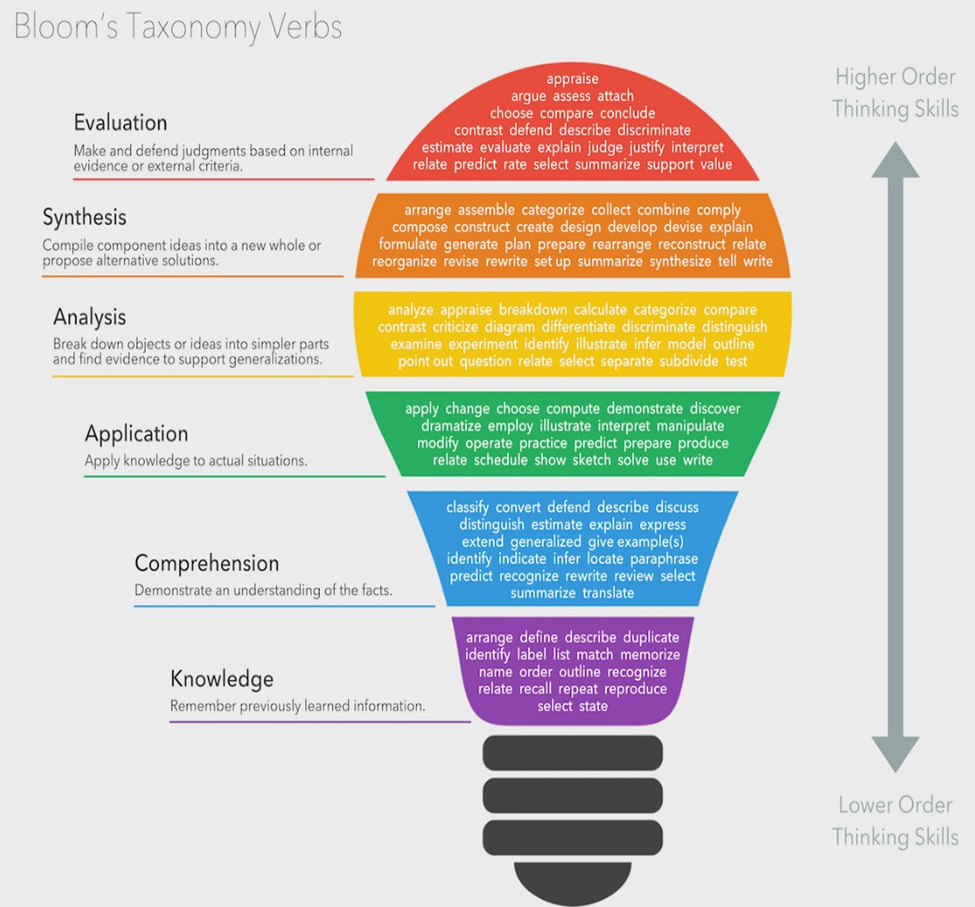
Cognitive objectives relate to knowledge acquired by learners, to the content taught. They focus on developing students’ intellectual abilities, such as thinking, reasoning, and problem-solving skills. Bloom’s taxonomy classifies learning objectives into levels of complexity and thinking skills. The taxonomy helps teachers design lessons that move learners from basic knowledge to higher-order thinking such as analysis, evaluation, and creation. This taxonomy supports effective lesson planning, assessment, and the development of critical thinking in learners. Bloom taxonomy of cognitive objectives has six levels: Knowledge, Comprehension, Application, Analysis, Synthesis, and Evaluation. The figure below shows all thinking levels of the old Bloom taxonomy and their meaning.
Revised Bloom taxonomy
In 2001, this taxonomy was revised by his former student Anderson. Levels were renamed and reordered using verbs as Remember, Understand, Apply, Analyze, Evaluate, and Create.
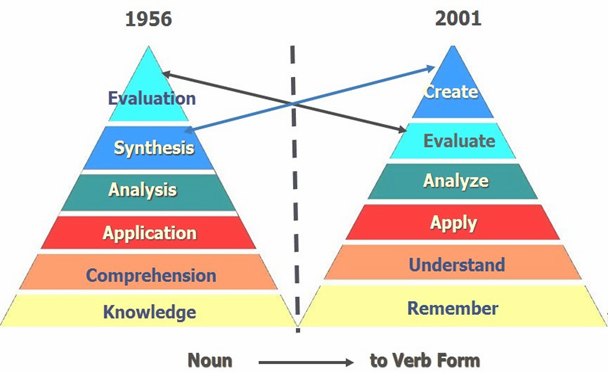
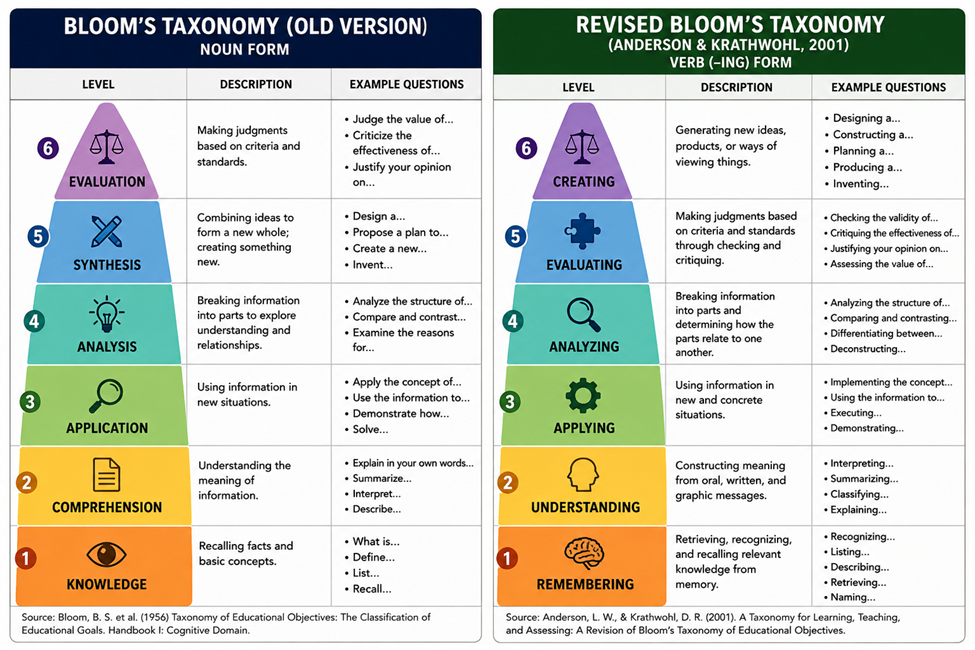
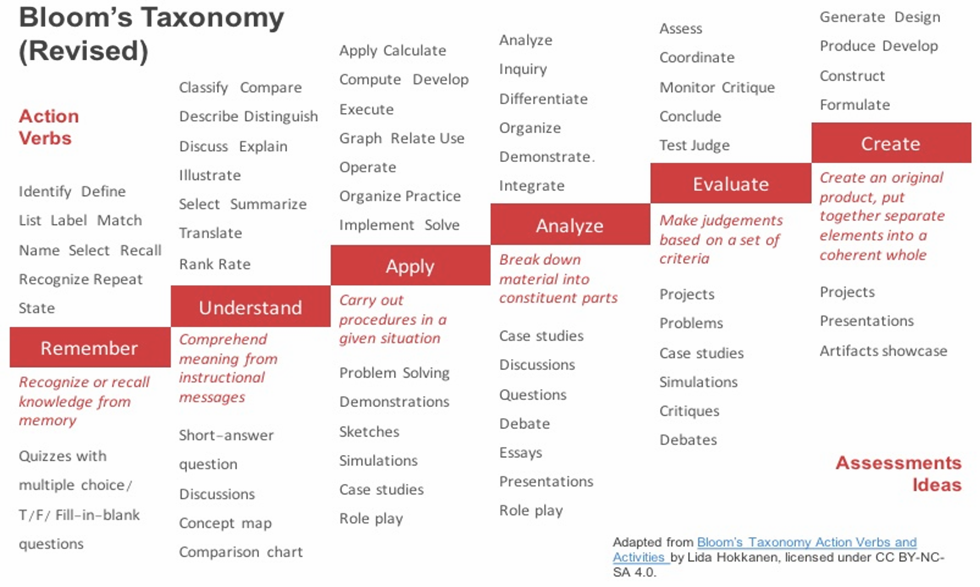
Remembering, understanding and applying are considered as the Lower -Order Cognitive levels of Thinking while Analyzing, Evaluating and Creating are known as the Higher-Order Cognitive levels of Thinking.
Note:
Teachers should use the revised Bloom’s taxonomy which has been found to satisfy the 21st century teaching and learning.