
Dear student,
Kindly engage with the learning materials of unit 5 and do all related activities.
2. Taxonomies and Domains of Educational Objectives
2.4. Krathwohl’s Taxonomy of Affective Objectives
Activity:
1. Think of one song you listened to this week. Just bring it to your mind.
2. Why did you play that song? Mood, lyrics, beat?
3. Would you put this song on the playlist you share with your close friends? Why or why not?
Which level of Krathwohl’s taxonomy does the answer to each question represent?
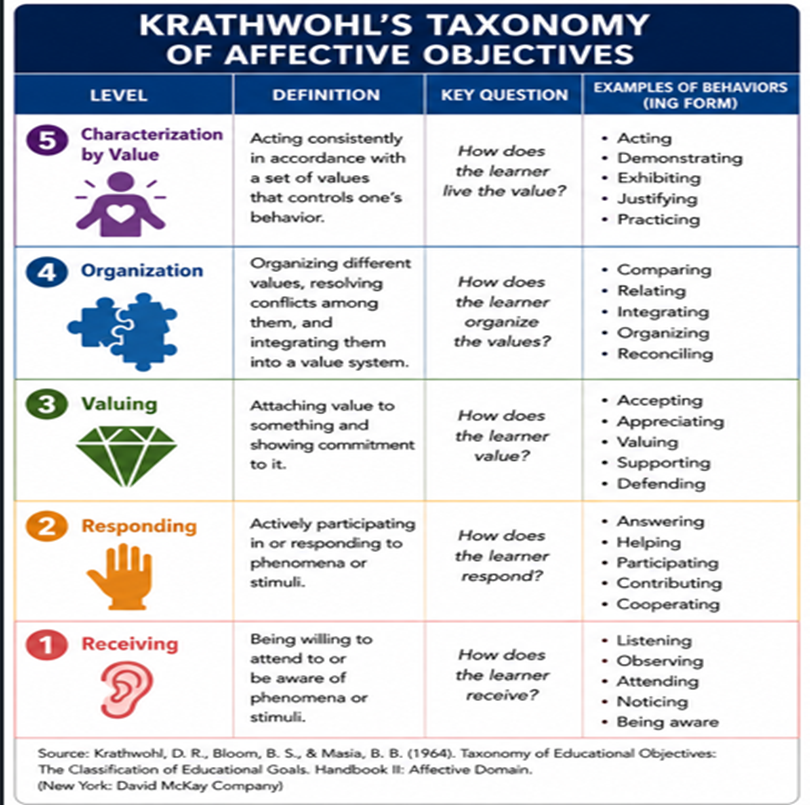
The taxonomy, developed by David Krathwohl in 1964, focuses on the emotional domain of learning and emphasizes the development of attitudes, values, and feelings. The taxonomy describes how learners engage with emotional responses to stimuli, such as how they feel about a subject, their willingness to engage in specific behaviors, or the value they place on ideas and concepts. It guides teachers in fostering not just intellectual but also emotional development in students. Krathwohl’s taxonomy of affective domain has five levels listed from the simplest behavior to the most complex: Receiving, Responding, Valuing, Organizing, and Characterizing.
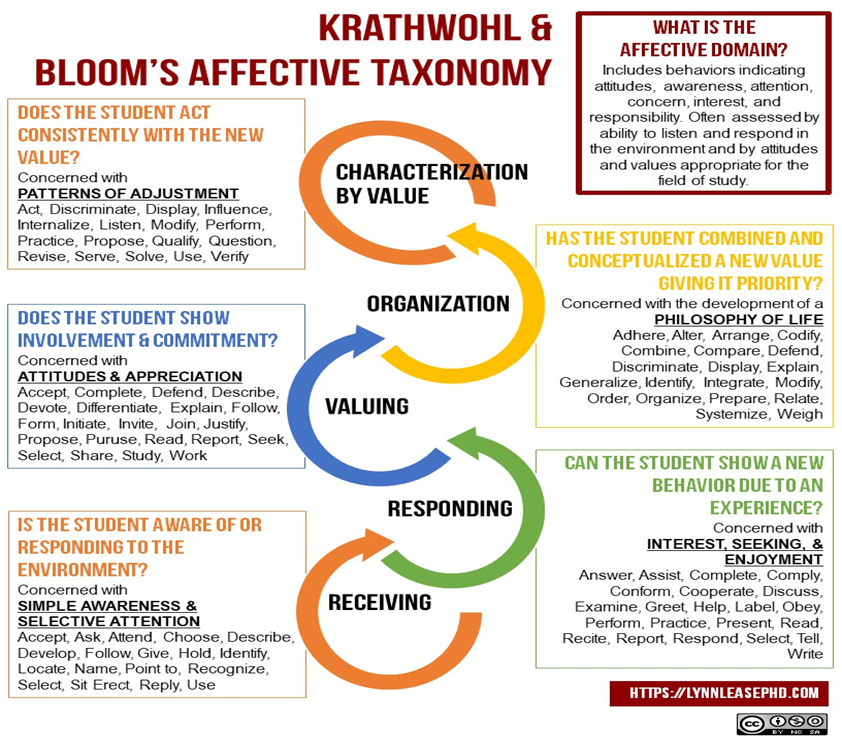
a. Receiving (Level of awareness): The lowest level; the student passively pays attention. Without this level, no learning can occur. Learners are simply aware of or willing to receive information. The learner is sensitised about the existence of certain phenomena and stimuli. He/she is incited to receive them and pay attention to them. It involves the passive process of attending to something and being open to it. Key action verbs: listen, pay attention, notice, observe, be aware. Examples: Listen attentively to a class discussion on environmental issues, observe the ethical behavior demonstrated by a role model, get knowledge of the existence of the school regulation, learners listen to the music on radio, etc.
b. Responding (Level of participation): The student actively participates in the learning process. Not only does the student attend to a stimulus, but he/she also reacts in some way. This could involve following instructions, providing feedback, or engaging in a specific activity. Examples: students will give a clap after a speech; they accept that the school regulation be respected or will participate in the drama festival. Participate in a group discussion about the importance of teamwork. Complete a survey to express opinions on school policies. Key action verbs: respond, participate, discuss, answer, contribute, react.
c. Valuing (Level of value development): The student attaches a value or importance to specific object, ideas, behaviours, concepts, phenomenon, or piece of information. The student associates a value or some values with the knowledge they acquired. The behaviour is motivated, not by the desire to please or to obey, but through the individual engagement to the fundamental value determining the behaviour. Examples: respect the school regulation on all occasions, sponsor one student to go for a cultural show at Serena Hotel, demonstrate a commitment to protecting the environment by recycling, respect for the opinions of others in class discussions, etc. Key action verbs: value, appreciate, prefer, demonstrate commitment to believe in, etc.
d. Organizing (level of value system): This involves commitment to a set of values. The student can put together different values, information, and ideas and accommodate them within their own schema. The student is comparing, relating, and elaborating on what has been learned. Students organize values into a coherent value system, integrating different values into a broader structure. This stage often involves prioritizing and reconciling conflicts between values. Example: Students will organize themselves in study groups of four people; Organize a community service project based on personal values of social responsibility. Key action verbs: organize, integrate, compare, prioritize, formulate.
e. Characterizing (level of internalizing values): It is the highest level; learners internalize values so that they consistently act in accordance with them. These values become part of the learner’s character, influencing behavior and decision-making across various situations. A student has value system to the extent that represents a philosophy of life. For example, the students will be always bound by the school rules and regulations, actively demonstrate leadership and integrity in all aspects of personal and professional life, consistently act in a manner that reflects respect for others and personal ethical standards. Key action verbs: act, demonstrate, influence, embody, internalize.
Affective objectives occur at all levels of the teaching/learning process, but they are often neglected because they belong to the domain of attitudes. It is difficult to assess these objectives, to find verbs of action.