
Dear student,
Kindly engage with the learning materials of unit 5 and do all related activities.
2. Taxonomies and Domains of Educational Objectives
2.5. Dave’s Taxonomy of Psychomotor Objectives
Activity: Suppose the topic of the lesson is: “Drawing a Chair.” Perform the following actions:
1. Watch the teacher draw a simple chair on the board. Did you pay attention to the shapes and lines?
2. Try to draw the chair by copying what you saw the teacher do.
3. Draw the chair independently without looking at the board.
4. Refine your drawing to improve proportions, angles, and neatness.
5. Add extra elements to your drawing, such as a desk, floor lines, or
shading.
6. Draw the chair accurately and consistently without any guidance or reference.
After responding:
Which of these steps were easiest for you? Which step challenged you the most? How did your drawing improve as you practiced at each level?
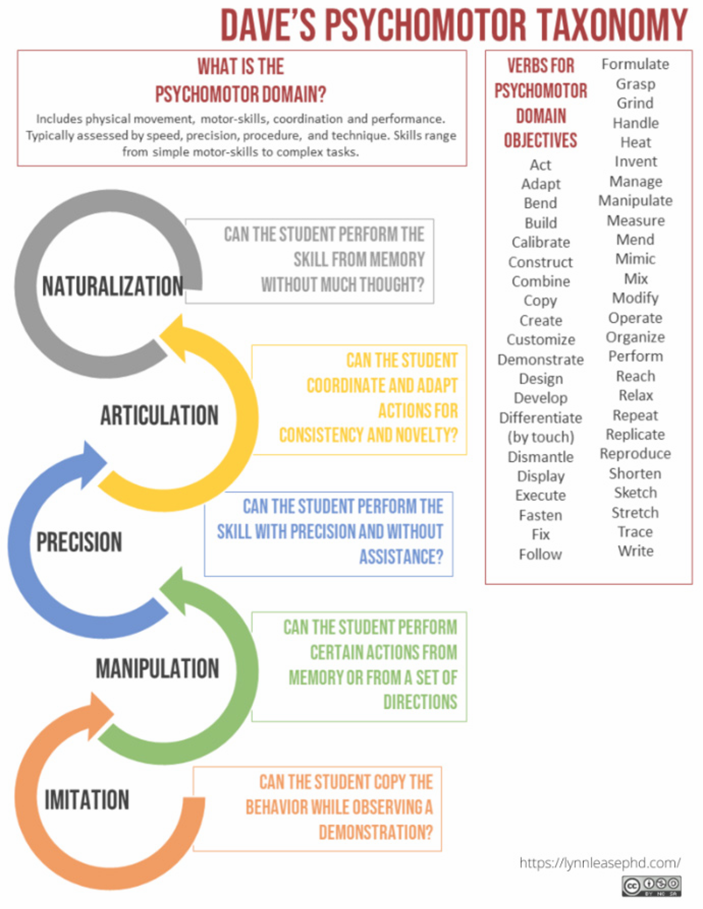
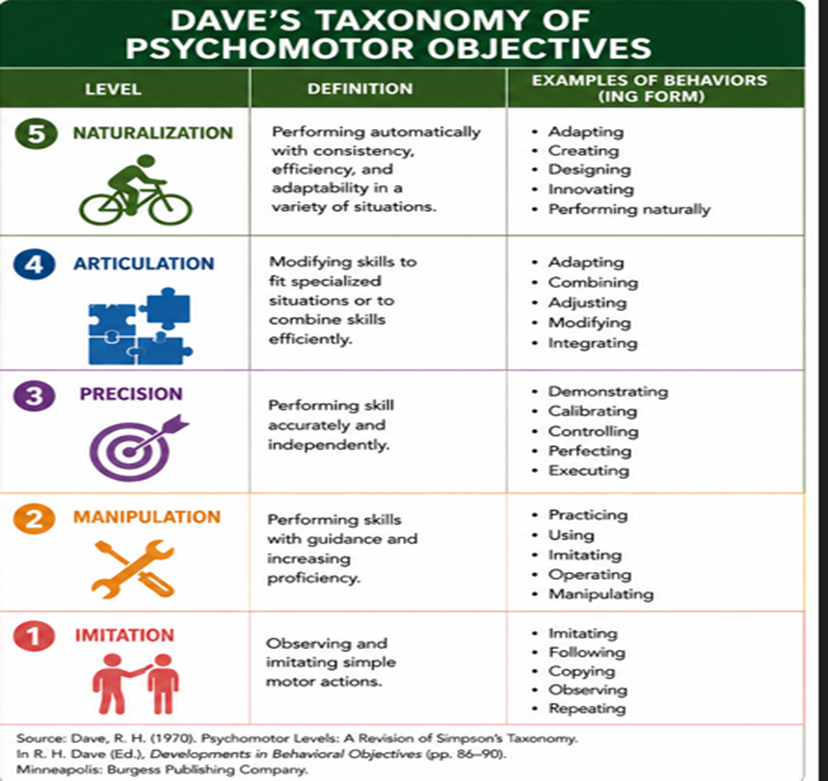
There is no taxonomy that is accepted universally for this domain. A very popular model for the psychomotor domain was established by R.H. Dave. The psychomotor domain encompasses the skills requiring the use and coordination of skeletal muscles, like physical activities of performing, manipulating, and constructing. Psychomotor skills are typically more observable, easier to describe, and measure in terms of evaluation. In general, these objectives are developed in Physical Education as well as other technical and vocational training courses. This taxonomy helps educators design and assess activities that involve physical movement, coordination, and manual skills, focusing on how learners develop proficiency in performing tasks that require fine and gross motor skills. Dave’s taxonomy has five levels: Imitation, Execution, Precision, Coordination and Naturalization.
a. Imitation:
The learner is able to observe and replicate a motor skill, following the teacher’s demonstration. This level involves copying actions, and the skill is typically performed with some guidance. Performance may be of low quality. The learner repeats an observed action, but the neuromuscular coordination is still poor. For example, copying a work of art: the child takes a paper, rudely imitates a friend’s drawing. Key action verbs: imitate, follow, copy, repeat, duplicate.
b. Execution or manipulation:
Learners are able to perform the skill or task on their own, though still relying on basic procedures or instructions. The skill is performed with a greater degree of independence than in the imitation stage, but there is still some reliance on guidance. The learner becomes capable of imitating the teacher’s example. He/she starts differentiating movements and choosing the adequate behaviour. He/she reaches a certain level of ability in handling certain objects. Example: creating work on one’s own, after taking lessons or reading about it. Key action verbs: manipulate, handle, practice, use, perform.
c. Precision:
The learner performs the skill with increased accuracy, coordination, and control. At this level, the task is completed with greater refinement and attention to detail, often without the need for explicit guidance. The learner replicates the model with accuracy and precision. He/she reproduces the required model perfectly. He/she manages to replicate this action in the absence of the model. He/she directs the action and can modify its speed of execution about the situation. Key action verbs: perform, refine, enhance, adjust.
d. Coordination or articulation:
The learner coordinates and combines multiple skills to perform a complex sequence of actions smoothly and efficiently. At this stage, learners can adapt and adjust their movements based on the situation, integrating various motor actions into a cohesive whole. Coordinating a series of actions, achieving harmony and internal consistency. The learner harmonises his/ her action while at the same time being capable to adjust the speed, the duration, and the other factors, so that actions articulate well. Example: Producing a video that involves music, drama, color, sound, etc. The learner associates several words and knows how to write a text within a minimum time. Key action verbs: combine, integrate, coordinate, blend, synchronize.
e. Naturalization:
The learner performs the task with such a high level of proficiency that it becomes almost automatic or second nature. This level represents mastery of the skill, where the learner can perform the task smoothly and efficiently without thinking about the individual steps. Having high level performance become natural, without needing to think much about it. Things become automatic. Key action verbs: perform naturally, master, execute automatically, innovate, adapt. Examples: Michael Jordan playing basketball, Nancy Lopez hitting a golf ball, driving a car skilfully in varying traffic conditions, without needing to consciously focus on basic driving tasks or performing a complicated surgical procedure smoothly and efficiently, with minimal effort or conscious thought.
Note: When determining the objectives that learners should achieve at the end of their learning, the teacher must refer to the above domains of learning because, obviously, he/she must evaluate his/her educational action.
Activity on taxonomy of educational objectives:
1. Using Bloom’s revised taxonomy, design an instructional objective for a lesson of your subject that targets the “Analyze” level.
2. Give one classroom activity that can help students assess “Valuing” level in Krathwohl’s affective domain.
3. Describe how you would assess a learner’s skill at the “Precision” level in Dave’s psychomotor taxonomy during a practical art lesson.
4. For a subject of your domain, choose a topic and create one objective for each of the three domains (cognitive, affective, psychomotor) showing how they could be integrated in a single lesson.
5. Imagine you are teaching learners how to operate a microscope. Identify the psychomotor level they would be at if they can perform the task automatically without conscious thought and explain your choice.