
Dear student,
Kindly engage with the learning materials of unit 5 and do all related activities.
3. Formulating instructional objectives
3.2. How to formulate instructional objectives?
Objectives are statements of change for students. They should specify the kind of behaviour and the content or area in which the behaviour is to operate. Instructional objectives are formulated or defined using verbs of action and specifying the content of the action which must be precise and limited. A well-written or formulated instructional objective should be SMART: Specific, Measurable, Achievable, Relevant, and Time-bound. It must also have ABCD components (Audience: Who is learning? Behaviour: What will they learn? Condition: Under what conditions? and the degree of performance: How well must they perform?)
A. SMART instructional objective
i. Specific: Objectives should clearly describe the attitudes, skills and knowledge or learning outcomes that the learner is expected to demonstrate after a given learning session.
ii. Measurable: The outcomes should be observable and assessable through appropriate tools or activities. The achievement of the objective can be measured by an assessment strategy such as observation, test items or problem-solving exercises.
iii. Achievable: The objective should be realistic, attainable, doable considering the available time, support, resources, and learner characteristics.
iv. Relevant: It should align with broader course goals and curriculum standards. It should be meaningful and worth pursuing, significance, appropriate for the learner’s current stage of development or subject objectives, aligns with real-world needs, the learner’s interests, and the overall educational or developmental context.
v. Time-bound: objectives are set for a particular lesson or learning session, making them time-specific. The learning objective should have a time limit, a specific timeframe or deadline for achieving a goal or completing a task. It means that the objective has a clear start and end time, which helps create a sense of urgency and focus. This is usually done by using the phrase “by the end of this lesson” or by the end of the week, by the end of the unit, within two months, during the semester, by the end of the semester, etc.
B. ABCD components of instructional objectives
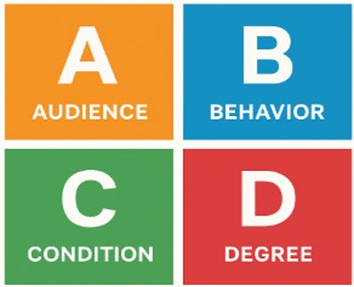
i. Audience (A): Instructional objectives should always specify the audience they are intended to serve. This refers to who the learning objective is aimed at - the group of learners or students. Usually, the audiences are participants in the learning session.
ii. Behavior (B): observable actions that are supposed to be accomplished by the end of the lesson. This component specifies what the learner is expected to do, to perform after the learning experience. A clear instructional objective should have an action verb that demonstrates the skills, knowledge and attitudes to be acquired. Examples of action verbs: explain, identify, analyze, list, draw, write, demonstrate, calculate, describe, etc. It is important to avoid general verbs such as ‘know’ and ‘understand’ as they may not be measurable.
iii. Condition (C): Instructional objectives should identify under which conditions a given task will be performed by the learner. The conditions may include time, tools, place, resources, environment and circumstances. Example: Using or without a calculator, without or referring to the notes, in a classroom setting, after reading the article, referring to a chart, or a map; while being monitored, on boat, in class, etc.
iv. Degree of performance (D): It specifies how well the learner should perform the behavior/task. Example: With accuracy or accurately, without error, correctly, with confidence, etc. The teacher may want to answer: How many? How fast? How well? It is, therefore, important for a teacher to give the specifics of how a learner will be able to perform a given task in terms of quality, quantity and/or time measurements.
C. Example of a SMART instructional objective with ABCD components:
By the end of the lesson, every senior four student will be able to accurately create a simple personal monthly budget using a budget template and classroom examples.
a. How is it SMART?
Specific: It focuses on creating a monthly personal budget.
Measurable: success is measurable through the accuracy and completeness of the student’s budget or the created personal and monthly budget.
Achievable: creating a simple budget is realistic task within a 40-minute lesson (by the end of the lesson) and appropriate for senior four learners using provided templates and examples.
Relevant: Budgeting is a practical life skill, aligns with financial literacy and
relevant to Economics curriculum.
Time-bound: The objective is set to be achieved, or the task is to be completed within one lesson (by the end of the lesson).
b. What are its ABCD components?
A (Audience): Every senior four student- the learners are targeted by the objective.
B (Behavior): create a simple monthly personal budget- an observable and measurable action.
C (Condition): using a budget template and classroom examples- the resources/context given.
D (Degree): Accuracy- indicates the quality expected by the end of the lesson
|
Activity: Choose a topic from the subject you will teach. Then, formulate a good instructional objective that is SMART and includes all the ABCD components.
|