
Dear student,
Kindly engage with the learning materials of unit 5 and do all related activities.
4. Planning key pedagogical documents
4.2. Planning the scheme of work
|
Activity: 1. What is a scheme of work? 2. What are the key elements of a scheme of work? 3. What is the importance of a scheme of work? |
A. 1 Meaning of the scheme of work
A scheme of work is a detailed plan that outlines how the content of a subject syllabus will be delivered by the teacher over a specific period of time, such as a term, semester, or school year. It breaks down the subject matter into manageable units or topics, specifying objectives, content, teaching methods, resources, assessment strategies, and the time allocation for each topic. The scheme of work is prepared by individual teachers or schools; a scheme of work is a long-term planning document that organizes the syllabus content into teachable units over a specific period (term or year).
A.2 Template of a scheme of work
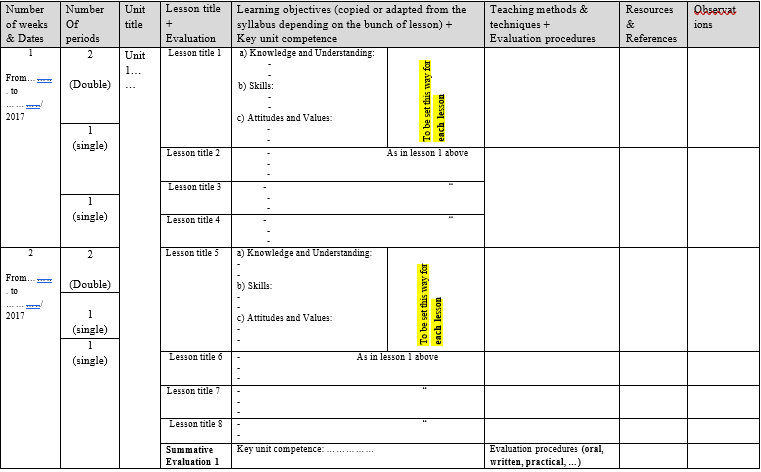
The template has been provided in the new Rwanda curriculum framework to facilitate teachers to prepare their lessons in the same ways as much as schools should be conditioned that any change does not deviate or alienate the principles underlying the implementation of the competence – based curriculum.
REB template of the scheme of work (REB, 2020)
Format of the CBC Scheme of work
Academic year: ……….. Term: ………… School: ……………………… Subject: ………….. Class + Combination: ………… Number of period per week: ……… Teacher’s name: ……………….
A.3 Common interruptions to consider in preparing the scheme of work
The scheme of work is elaborated based on the school calendar. The number of effective teaching periods varies according to both predictable and unpredictable interruptions. Effective teaching time must therefore be estimated before topics are selected. The most common interruptions that are likely to disrupt a scheme of work include: Public holidays, examinations (should be schemed for) if they are internal, revisions (should be schemed for), open days, sports days, planned school breaks e.g. mid-term break, etc.
A.4 Resources in the scheme of work
Teaching resources are all the materials, tools, and aids that a teacher uses to facilitate learning, support instruction, and enhance student understanding. These resources can be physical or digital, human or material, and are selected based on the subject content, learning objectives, student needs, and available time. Types of teaching resources include:
- Human resources: teachers, guest speakers, peers, or community members who contribute knowledge or experiences. Example: A police officer invited to speak about road safety.
- Textual resources: Textbooks, workbooks, teacher guides, reference books, storybooks, and academic journals. Example: A history textbook used to teach about independence movements.
- Visual resources: Charts, maps, posters, flashcards, photographs, drawings, and diagrams. Example: A map used in a geography lesson to teach about continents.
- Audio-visual resources: Videos, films, slide presentations, animations, and recorded lectures. Example: A documentary on climate change shown in science class.
- Digital and ICT resources: Computers, tablets, educational apps, online platforms, projectors, smartboards, and internet-based content. Example: Using Kahoot! or Quizizz for interactive assessment.
- Realia (Real objects): Physical items from the real world brought into the classroom to enhance understanding. Example: Fruits used in a nutrition lesson.
- Manipulatives: Objects students can handle to explore concepts, especially in mathematics or science. Example: Geometric shapes for teaching volume and area.
- Print and writing materials: Exercise books, handouts, worksheets, newspapers, and magazines. Example: A worksheet for practicing grammar.
- Demonstration materials: Lab equipment, models, or experiments used to demonstrate scientific or technical concepts. Example: A model of the human heart in a biology lesson.
Note: The teacher should not indicate a teaching aid which will not be available in class.
A.5 References in the scheme of work
References are the sources of information or ideas that are used in the preparation of the lesson. These may include books, journal articles, websites, reports, interviews, or other documents that were consulted or cited to support facts, theories, arguments, or explanations. It is necessary for the teacher to provide full and complete reference: indicate authors, year of publication, title of the book or article, publisher and relevant pages. Better to use APA referencing style 7th edition used by UR. Examples:
Bayingana, J., Birekeraho, S. J., Wairu, P., & Gitonga, T. (2016). Economics For Rwandan Schools. Senior Four. Student’s Book. Ronghorn.
Rwanda Basic Education Board (REB). (2021). Geography and Environment. Senior 3. Student’s Book. REB.
A.6 Observation column in the scheme of work
The observation column should be filled in immediately when the lesson is over during the week or at the end of the week. The teacher is supposed to indicate whether what was planned for the period has been covered, whether there was over planning or failure of lesson and reasons for either case, etc. Remarks such as excellent, done, ok, well done, satisfactory, taught, etc. might not be very useful to the teacher. Such remarks as “the lesson was not very well done because of inadequate teaching aids”, or “students were able to apply concept learnt in solving problems as evident from supervised practice”, etc. are appropriate. After the remarks, it is necessary to write the date when the lesson was taught.
|
Activity: Consider one of the subjects you plan to teach in secondary schools and prepare a scheme of work for term 3, school year 2025-2026. |